


Wet Waste Compressor is an environmentally friendly equipment specifically designed for handling organic waste with high moisture content, prone to decay, and having a loose volume, such as kitchen waste, fruit and vegetable waste, and dining table leftovers. Its core function is to achieve volume reduction, dehydration, and solid-liquid separation through physical compression, thereby creating conditions for subsequent transportation and treatment.
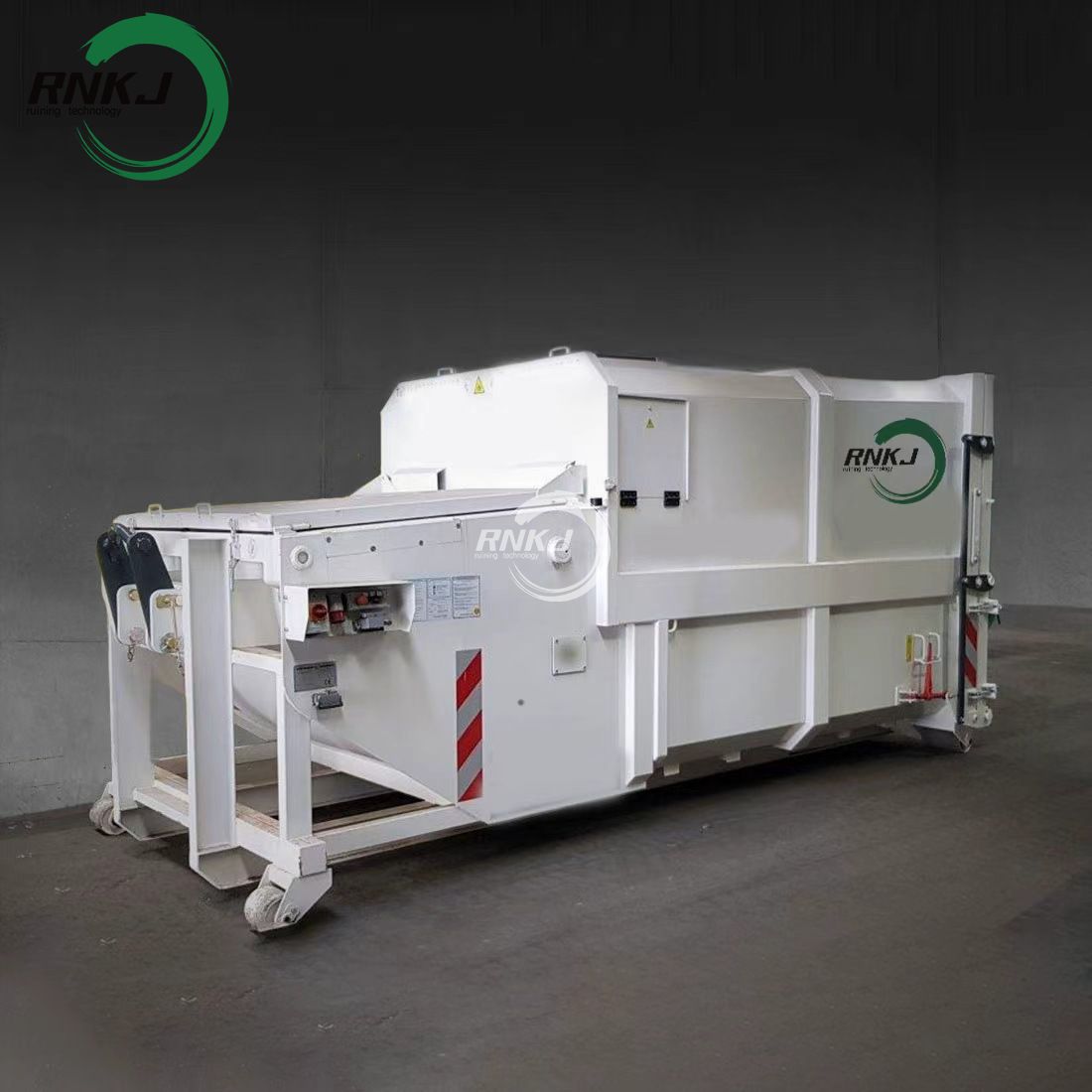
Wet waste is characterized by high moisture content and high degradability. For this reason, our Wet Waste Compressor is purpose-built and optimized based on standard compactors, with four core enhancements:
All components in direct contact with waste are coated with wear-resistant materials, effectively resisting acid-alkali corrosion and abrasion from waste.
Selected models are equipped with screw press or filter screen structures to separate leachate during compaction, reducing secondary pollution during waste transportation and subsequent treatment.
Feed inlets and compaction chambers are fitted with sealing rubber strips and negative pressure odor extraction systems, effectively containing odor dispersion.
Pressure and humidity sensors automatically adjust compaction force to avoid inefficient compaction caused by excessive moisture.
 Product Advantage
 Efficient reduction, enhancing storage and transportation efficiency
Wet waste, with its high moisture content and loose texture, often has a large volume. The Wet Waste Compressor can compress the volume of wet waste to 1/3 - 1/5 of its original size through high-pressure hydraulic squeezing. This significantly reduces the storage space occupation of waste and also lowers the frequency of transportation, directly cutting down transportation costs.
Solid-liquid separation reduces the difficulty of subsequent treatment.
Most wet waste compactors are equipped with a dedicated leachate collection system. During the compaction process, a large amount of water contained in the wet waste can be separated. These leachates will be collected centrally and undergo specialized treatment. This not only avoids the problem of sewage leakage during the waste transportation process but also reduces the energy consumption and secondary pollution risks in subsequent incineration and composting treatment stages.
Sealed design to prevent odor and pathogen spread
Due to the characteristics of wet garbage, which is prone to decay, emit odors and breed bacteria, wet garbage compaction machines generally adopt a fully sealed structure, combined with an odor-removing spray system or negative pressure odor removal device. This can effectively prevent odor diffusion, reduce the breeding of mosquitoes and flies, and ensure the hygiene and safety of the surrounding environment. It is particularly suitable for use in densely populated areas such as residential areas and commercial districts.
Intelligent control, adaptable to various working scenarios
Most of the current wet waste compaction machines are equipped with intelligent control systems. They can not only automatically complete the processes of loading, compaction, and discharging, but also automatically adjust the compaction pressure and time according to the type and moisture content of wet waste, meeting the processing needs of different types of wet waste such as catering waste and kitchen waste. Some devices also support remote monitoring and fault warning, reducing the cost of manual maintenance.
Modular design, flexible installation and operation
Many wet waste compaction machines adopt modular structural design. The components can be easily disassembled and assembled. Not only can the equipment layout be flexibly adjusted according to the size of the site, but also damaged parts can be quickly replaced when a fault occurs, shortening the downtime for maintenance. Moreover, the modular design also makes the later upgrading and renovation of the equipment much simpler.
Working PrincipleFor wet waste with a moisture content of 60% to 90%, mechanical pressure is used to squeeze out the air and water from the waste, significantly reducing its loose volume and achieving solid-liquid separation at the same time.
Feed stage: Wet waste is fed into the compression chamber through the hopper. Some models integrate a crushing function to first break down large pieces of material.
Compression stage: The main compression mechanism applies high pressure, forcing the moisture in the waste to pass through the filter screen or gaps and be discharged.
Dewatering stage: The extracted filtrate is collected through the water collection tank and drainage outlet for subsequent treatment.
Discharge stage: The compressed and formed waste blocks are ejected, facilitating sealed transportation or further processing.
Technical Parameters
Performance Parameters | |
Compression | Horizontal |
Waste bin volume (m³) | 6m³, 9m³,12m³ ,15m³ ,18m³,Custom sizes |
Hook centre height (mm) | 1570 |
Density of compressed rubbish block(kg/m³) | 750kg/m³ |
Compression cycle time (s) | 45s |
Max. lifting force of tipping bucket | 1t,1.5t,2t,2.5t,2.5t |
Tipping bucket volume (m³) | 1.5m³,2.5m³,3.2m³,4.1m³,4.1m³ |
Rated power of motor(kW) | 5KW,5.5KW,7.5KW |
Machine weight (kg) | 4800kg,5500kg,6080kg,6580kg, |
Power supply | Local working voltage |
Operation mode | Automatic + manual |
Size | 6m³: 4180 * 2440 * 2600 (mm); Tipping bucket falling height 2410mm. 9m³: 5080 * 2440 * 2600 (mm); Tipping bucket falling height 2410mm. 12m³ :4180 * 5280 * 2600 (mm); Tipping bucket falling height 2410mm. |

Core Structure CompositionFeed system: hopper, feed door, preventing garbage splashing and odor diffusion.
Compression mechanism: hydraulic system or screw system, providing core pressure.
Dewatering system: filter screen, collecting tank, drainage outlet, achieving solid-liquid separation and collecting leachate.
Sealing system: cylindrical tailgate, continuously adjustable sealing gap, preventing leakage and unpleasant odor from spilling out.
Control system: PLC control, touch screen operation, enabling automatic or manual switching, fault alarm and other functions.
Power system: motor or internal combustion engine, providing power for compression and transportation.

Application ScenariosUrban sanitation: Garbage transfer stations, community garbage collection points, addressing the issues of large volume of wet garbage and high transportation costs
Commercial catering: Large shopping malls, hotels, and unit canteens, handling kitchen waste to reduce the frequency of collection
Food processing: Marketplaces, fresh food supermarkets, food factories, handling vegetable waste, fruit peels, and fruit cores, etc.
Medical environmental protection: Hospital canteens, biological laboratories, handling organic waste to prevent secondary pollution
We have the design that will help you meet your challenges for waste compaction.
We are a professional manufacturer of sanitation machinery, providing customers with ex-factory prices and on-demand customization services. You can contact us via WhatsApp or email.


