


Spiral Garbage Compaction Station is an environmentally friendly equipment that integrates garbage reduction, dehydration and transportation through the principle of spiral propulsion. By generating axial thrust with the rotating spiral blades, the loose garbage is compressed into a high-density form, while separating the water and air within the garbage, significantly reducing the volume and weight of the garbage, making it easier for subsequent transportation and processing.


 Advantages of a Spiral Garbage Compaction Station
Structural and Maintenance Advantages
The core components are merely the spiral blades and the drive motor. The structure is simple and there are few failure points.
Daily maintenance only requires regular checks on blade wear and the condition of the motor. The maintenance cost is over 40% lower than that of hydraulic equipment.
There are no complex hydraulic pipelines and sealing systems, avoiding common faults such as hydraulic oil leakage and pipeline blockage.
Operational performance advantages
The spiral compression method distributes force evenly, effectively handling kitchen waste and wet garbage with moisture content ranging from 30% to 60%. It does not suffer from the common "slippage" problem seen in hydraulic equipment.
Continuous feeding and continuous compression operations can be achieved. The daily processing capacity of a single unit can reach 15-30 tons, with stable operation efficiency.
The compression force gradually increases as the spiral advances, ensuring uniform density of the garbage blocks and preventing them from loosening during transportation.
Scene Adaptation Advantage
The equipment is small in size, with the smallest model occupying an area of only 2-3 square meters, making it suitable for scenarios with limited space such as community garbage rooms and small transfer stations.
It has a strong tolerance for garbage forms, and can directly handle various forms of garbage including bulk, bagged, and bucketed without pre-treatment.
The operating noise is only 60-70 decibels, which is lower than the 80-90 decibels of hydraulic equipment, making it suitable for operation around residential areas.
Core Component Of Spiral Garbage Compaction StationSpiral blades: Usually made of manganese steel or wear-resistant alloy steel, they are divided into equidistant blades and variable-distance blades. The variable-distance blades can gradually increase the squeezing force during the propulsion process.
Spiral shaft: The core component that bears the spiral blades, it needs to have high strength and anti-twisting properties. It is mostly made of solid alloy steel through forging.
Extrusion chamber: Cooperates with the spiral blades to form an extrusion space. The inner wall is usually lined with wear-resistant linings to extend the equipment's service life.
Feed hopper: With a large diameter design, it is convenient for different forms of garbage to enter. Some models are equipped with a feeding device to prevent the feed inlet from getting clogged.
Extraction port: Equipped with adjustable extrusion forming templates of different sizes. By adjusting the hole diameter of the template, the size and density of the garbage blocks can be controlled.
Guide plate: Installed inside the chamber, it guides the garbage to move towards the extrusion area, avoiding garbage accumulation in the chamber.
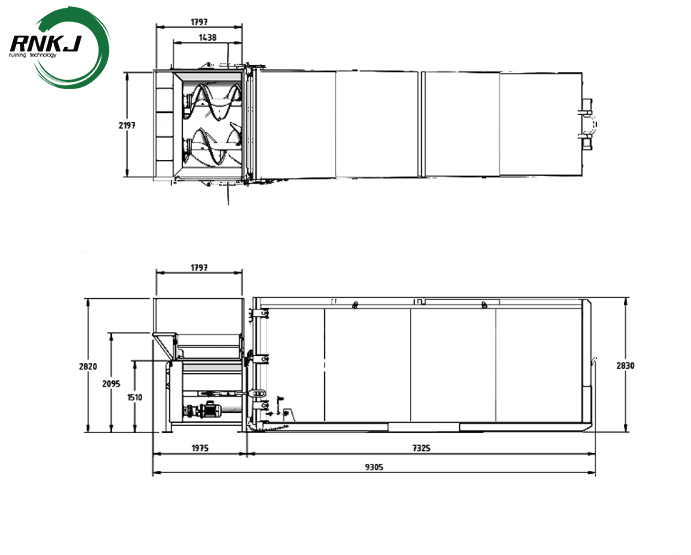
Product Parameters
Performance Parameters | |
Compression | Horizontal |
Waste bin volume (m³) | 6m³, 9m³,12m³ ,15m³ ,18m³,Custom sizes |
Hook centre height (mm) | 1570 |
Density of compressed rubbish block(kg/m³) | 750kg/m³ |
Compression cycle time (s) | 45s |
Max. lifting force of tipping bucket | 1t,1.5t,2t,2.5t,2.5t |
Tipping bucket volume (m³) | 1.5m³,2.5m³,3.2m³,4.1m³,4.1m³ |
Rated power of motor(kW) | 5KW,5.5KW, 7.5KW |
Machine weight (kg) | 4800kg,5500kg,6080kg,6580kg, |
Power supply | Local working voltage |
Operation mode | Automatic + manual |
Size | 6m³: 4180 * 2440 * 2600 (mm); Tipping bucket falling height 2410mm. 9m³: 5080 * 2440 * 2600 (mm); Tipping bucket falling height 2410mm. 12m³ :4180 * 5280 * 2600 (mm); Tipping bucket falling height 2410mm. |
Working Principle
The working process of the Spiral Garbage Compaction Station is based on progressive compression technology and consists of three main stages:
The feeding stage: Garbage is fed into the equipment through a hopper, and the spiral blades rotate to convey the material forward.
The compression and dehydration stage: The spiral design gradually reduces the compression space, generating a continuously increasing compressive force, forcing the moisture in the garbage to be discharged through filters or gaps.
The shaping and discharge stage: The compacted garbage forms a dense cylindrical or block shape and is discharged from the outlet, with a volume reduction of 40% to 70% and a moisture content reduction of 30% to 50%.
Application Scope
Small waste generation points such as residential communities, office buildings, shopping malls, and hotels:
The equipment is compact in size and does not require a dedicated machine room. It can be directly placed in the garbage room or outdoor open space. The processing process has no strong noise or odor, and will not disturb the surrounding residents or office environment. It can directly compress daily generated household waste and food waste, reducing the frequency of garbage collection by 30% to 50%.
Large canteens, dining areas, and pre-treatment centers for food waste:
The spiral compression method can efficiently handle food waste with a moisture content of 30% to 60%. It can not only reduce the volume of the waste but also initially separate some of the food waste leachate; it can directly connect to subsequent oil-water separation equipment or anaerobic fermentation systems, forming a complete processing chain.
Manufacturing factories, logistics warehouses, and express delivery sorting centers:
Can efficiently handle loose materials such as industrial scraps, packaging waste, and express delivery boxes; The equipment has a simple and durable structure, capable of meeting the high-load operation requirements of industrial sites; The compressed garbage blocks are easy to store and transport, which can reduce the cost of industrial solid waste treatment.
Small and medium-sized waste transfer stations with a daily processing capacity of 15-50 tons, and rural waste collection points:
They can operate continuously, with stable processing efficiency, and can match the cleaning capacity of small transfer vehicles; No complex supporting facilities are required, and the infrastructure investment is more than 60% lower than that of hydraulic transfer stations; The operation process is simple, and only 1-2 staff members are needed to complete the daily operation.

We are an established equipment manufacturer equipped with state-of-the-art production facilities, including CNC laser cutting machines, CNC bending machines and machining centers. These ensure our products’ superior quality and exquisite finish.
We accommodate custom design requirements based on drawings, backed by a robust technical team and skilled welding professionals. We look forward to cooperating with you.


