


| Quantity: | |
|---|---|
Efficient waste transfer requires more than simply collecting and storing garbage. At a busy waste transfer station, the ability to continuously feed, compress, and store municipal solid waste can directly affect transportation frequency, operating costs, available space, and overall site cleanliness. The Custom High Efficiency Spiral Garbage Compactor for Transfer Station shown in the image is designed for this type of application, combining a continuous spiral compaction mechanism with a large-capacity waste container.
The equipment is particularly suitable for transfer stations, municipal waste collection points, commercial waste handling areas, residential waste centers, industrial facilities, and other locations where large quantities of solid waste need to be compacted before transportation.
Unlike a conventional ram-type garbage compactor that relies on repeated forward and backward hydraulic pushing, the Spiral Garbage Compactor uses a rotating spiral mechanism to continuously move and compress waste toward the discharge area. Screw-based compaction systems are commonly designed around continuous conveying and compression, allowing waste to be processed progressively rather than relying entirely on intermittent ram strokes.

 What Is a Spiral Garbage Compactor?
A Spiral Garbage Compactor is a waste compaction machine that uses a rotating spiral screw to convey and compress solid waste. As garbage enters the feeding section, the spiral mechanism continuously moves the material toward the compaction zone. Increasing resistance in the compression section creates pressure on the waste, reducing its occupied volume before it enters the collection container.
The machine shown in the image features a compact green compaction unit connected to a large orange waste container. The upper section is equipped with a vertical feeding structure, while the lower section contains the main mechanical and drive components. A working platform and protective railing are also incorporated into the upper structure, making it easier for operators to access and inspect the feeding and spiral mechanism.
The overall configuration can be customized according to the customer's waste volume, site layout, container dimensions, feeding method, waste characteristics, and transfer requirements.
Main Structure of the Spiral Garbage CompactorThe equipment consists of several functional sections that work together to create a continuous waste collection and compaction process.
The upper feeding section provides an inlet for waste entering the compaction system. Depending on the project, the feeding structure can be adapted to different waste collection methods.
The feeding hopper can be designed according to:
Waste loading method
Garbage bin size
Conveyor discharge height
Transfer station layout
Daily waste volume
Available installation space
A properly designed hopper helps distribute incoming waste evenly and reduces unnecessary accumulation around the feeding opening.
The spiral screw is the core working component of the Spiral Garbage Compactor.
As the screw rotates, waste is pushed forward while simultaneously being subjected to increasing resistance. This creates a continuous conveying and compression process. Screw compactors generally use the spiral element to transport material into a dedicated compaction zone where pressure increases as the available space becomes more restricted.
This operating principle provides several practical advantages:
Continuous waste conveying
Progressive compaction
Stable material movement
Reduced manual handling
Efficient use of container space
Adaptability to different waste streams
For transfer station applications, continuous operation can be particularly useful when garbage arrives throughout the day instead of in a single batch.
The compaction chamber is where the main volume reduction takes place.
When waste enters this section, the spiral mechanism continues pushing the material forward. The resistance generated within the chamber forces the waste particles closer together, producing a denser waste stream.
The exact compaction performance depends on waste composition, moisture content, particle size, feeding rate, spiral design, drive power, and operating conditions. Therefore, the system should be engineered according to the actual waste characteristics rather than relying on a single universal compaction ratio.
The drive system supplies the power required to rotate the spiral mechanism and maintain stable operation.
Depending on the project configuration, the compactor can be engineered with an appropriate motor, gearbox, control system, and protection components. The drive system can be selected according to the expected waste load and required operating cycle.
A properly matched drive system helps maintain stable torque during high-load conditions and supports long-term operation in demanding transfer station environments.
The large orange container shown beside the compactor provides the storage space for compacted waste.
The container can be customized in terms of:
Length
Width
Height
Effective volume
Wall thickness
Reinforcement structure
Discharge configuration
Surface coating
Transportation method
The container size can be matched to the capacity of the transfer station and the customer's preferred waste transportation equipment.
The upper structure visible in the image includes a working platform, ladder, and protective railing.
This configuration provides operators with safer access for:
Routine inspection
Cleaning
Lubrication
Component checking
Hopper inspection
Drive system maintenance
Spiral mechanism inspection
For commercial waste transfer stations, convenient maintenance access can help reduce unnecessary downtime and simplify daily equipment management.
How Does a Spiral Garbage Compactor Work?The working process is relatively straightforward.
Municipal, commercial, residential, or industrial waste is transported to the transfer station and loaded into the feeding section.
The garbage enters the hopper of the Spiral Garbage Compactor. The feeding structure can be designed to connect with different upstream collection or conveying systems.
The rotating spiral screw moves the waste forward continuously.
Unlike an intermittent ram movement, the spiral system combines conveying and compaction in the same process. This continuous screw-based approach is one of the main characteristics of spiral compaction equipment.
As the waste reaches the compaction zone, the available space becomes more restricted and resistance increases. The spiral continues pushing the material forward, causing the waste to become denser.
The compacted waste is discharged into the connected waste container.
The container gradually fills with higher-density material, allowing the available storage volume to be used more effectively.
Once the container reaches its working capacity, it can be removed or transported according to the transfer station's logistics system and replaced or emptied as required.
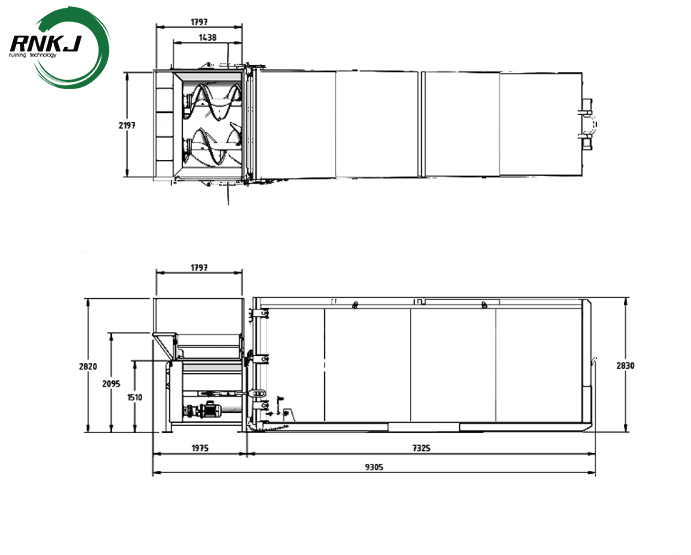
Product ParametersPerformance Parameters | |
Compression | Horizontal |
Waste bin volume (m³) | 6m³, 9m³,12m³ ,15m³ ,18m³,Custom sizes |
Hook centre height (mm) | 1570 |
Density of compressed rubbish block(kg/m³) | 750kg/m³ |
Compression cycle time (s) | 45s |
Max. lifting force of tipping bucket | 1t,1.5t,2t,2.5t,2.5t |
Tipping bucket volume (m³) | 1.5m³,2.5m³,3.2m³,4.1m³,4.1m³ |
Rated power of motor(kW) | 5KW,5.5KW, 7.5KW |
Machine weight (kg) | 4800kg,5500kg,6080kg,6580kg, |
Power supply | Local working voltage |
Operation mode | Automatic + manual |
Size | 6m³: 4180 * 2440 * 2600 (mm); Tipping bucket falling height 2410mm. 9m³: 5080 * 2440 * 2600 (mm); Tipping bucket falling height 2410mm. 12m³ :4180 * 5280 * 2600 (mm); Tipping bucket falling height 2410mm. |
Key Advantages of the Spiral Garbage CompactorOne of the most important advantages of a Spiral Garbage Compactor is its continuous working principle.
The spiral mechanism can simultaneously convey and compact incoming waste, making the equipment suitable for applications with relatively continuous waste generation.
This is particularly useful in:
Municipal transfer stations
Large residential communities
Shopping centers
Industrial parks
Commercial waste collection centers
Public facilities
Waste sorting and transfer facilities
Loose garbage contains a considerable amount of air and empty space. When it is compacted before storage, the same container can accommodate more waste by volume.
This can help improve container utilization and reduce the frequency at which containers need to be transported away from the transfer station.
The actual improvement depends on waste composition and operating conditions, so the system should be sized according to the customer's specific waste stream.
A conventional system may require separate equipment for waste conveying and compaction. A screw-based system can combine these two functions.
The spiral mechanism moves waste toward the discharge end while the compaction section progressively increases pressure on the material.
This integrated approach can simplify the overall waste handling process.
The main compaction unit occupies relatively limited floor space compared with some larger waste processing systems.
This makes it possible to design the equipment around existing transfer station layouts, buildings, loading areas, and transportation routes.
For sites with limited space, the dimensions and hopper arrangement can be customized during the engineering stage.
The word Custom in Custom High Efficiency Spiral Garbage Compactor is important.
Waste transfer stations do not all operate under the same conditions. A small commercial waste station may have completely different requirements from a municipal transfer station.
The equipment can therefore be customized around:
Daily waste throughput
Container volume
Waste type
Moisture level
Feeding height
Available installation space
Electrical requirements
Transportation requirements
Local environmental conditions
Existing waste collection equipment

Waste Types Suitable for a Spiral Garbage CompactorThe equipment can be considered for a broad range of non-hazardous solid waste applications.
Typical materials may include:
Municipal solid waste
Household garbage
Commercial waste
General industrial waste
Packaging waste
Paper waste
Cardboard
Plastic packaging
Light mixed waste
Residential community waste
Market waste
Commercial facility waste
However, waste characteristics should always be evaluated before selecting the final machine configuration.
For example, excessive liquids, oversized objects, long fibrous materials, hazardous waste, sharp metal components, or materials with unusual physical characteristics may require specialized equipment or additional pretreatment.
Screw compactors are also used in other waste-processing applications because the screw can provide conveying and compaction simultaneously, although the exact design varies according to the material being handled.
Spiral Garbage Compactor for Waste Transfer StationsWaste transfer stations are one of the most practical applications for this equipment.
In a typical transfer station, garbage arrives from collection vehicles and needs to be consolidated before long-distance transportation. If loose waste is transferred directly into large containers, a considerable amount of container space can remain unused.
Installing a Spiral Garbage Compactor between the waste feeding point and the storage container creates an additional compaction stage.
The system can help transfer stations:
Increase effective waste storage density
Reduce unnecessary container movements
Improve waste handling efficiency
Reduce manual intervention
Keep waste more contained
Improve site organization
Optimize transportation scheduling
Make better use of limited transfer station space
The final transportation benefit depends on the actual waste density, container volume, transportation distance, local vehicle regulations, and operating schedule.
Spiral Garbage Compactor vs. Traditional Ram CompactorBoth technologies can be used for waste compaction, but their working principles are different.
| Feature | Spiral Garbage Compactor | Traditional Ram Compactor |
|---|---|---|
| Main mechanism | Rotating spiral/screw | Hydraulic ram |
| Waste movement | Continuous | Intermittent |
| Conveying function | Integrated | Usually separate or limited |
| Compaction method | Progressive screw compression | Ram pushing |
| Operation | Continuous-feed oriented | Stroke-cycle oriented |
| Layout | Compact and customizable | Usually larger hydraulic structure |
| Application | Transfer stations, continuous waste streams | Various stationary compaction applications |
| Maintenance focus | Screw, drive, bearings, wear components | Hydraulic cylinder, ram, seals, guides |
| Customization | Hopper, screw, container and layout | Ram size, chamber and container configuration |
The best choice depends on waste composition, daily throughput, available space, required storage capacity, and the customer's overall waste handling process.
Practical Benefits for Waste Management OperationsThe value of a Spiral Garbage Compactor is not limited to the machine itself. It can contribute to the efficiency of the entire waste transfer process.
By increasing the amount of waste that can be stored in a container, the system can potentially reduce unnecessary container exchange or transportation frequency.
A controlled feeding and compaction process helps reduce loose waste accumulation around the loading area.
Mechanical conveying and compaction minimize the need for workers to manually move waste within the processing area.
Compacted waste occupies less volume than loose waste, allowing the available container and transfer station space to be used more effectively.
The compactor can be engineered to integrate with existing transfer station equipment and waste transportation systems.
With an appropriate structural design, wear-resistant components, regular lubrication, and scheduled maintenance, the machine can be used for long-term waste handling operations.
FAQThe rotating spiral moves waste into a restricted compaction zone. Increasing resistance creates pressure on the material, forcing waste particles closer together and increasing bulk density.
Yes. The hopper, screw system, machine dimensions, container size, drive configuration, platform, safety structure, and surface treatment can be customized according to project requirements.
The suitability depends on the specific waste composition and moisture level. For wet or high-moisture waste, the machine should be specially configured according to the material characteristics.
Container dimensions and capacity can be customized according to the customer's daily waste volume, site conditions, transportation equipment, and project requirements.
The screw-based operating principle is particularly suitable for continuous feeding and conveying applications. Actual operating cycles should be determined according to waste volume, equipment configuration, and site requirements.
Maintenance intervals depend on operating hours, waste characteristics, loading conditions, and component specifications. Routine inspection of the spiral, drive system, bearings, fasteners, hopper, electrical components, and safety devices is recommended.
We are an established equipment manufacturer equipped with state-of-the-art production facilities, including CNC laser cutting machines, CNC bending machines and machining centers. These ensure our products’ superior quality and exquisite finish.
We accommodate custom design requirements based on drawings, backed by a robust technical team and skilled welding professionals. We look forward to cooperating with you.


