


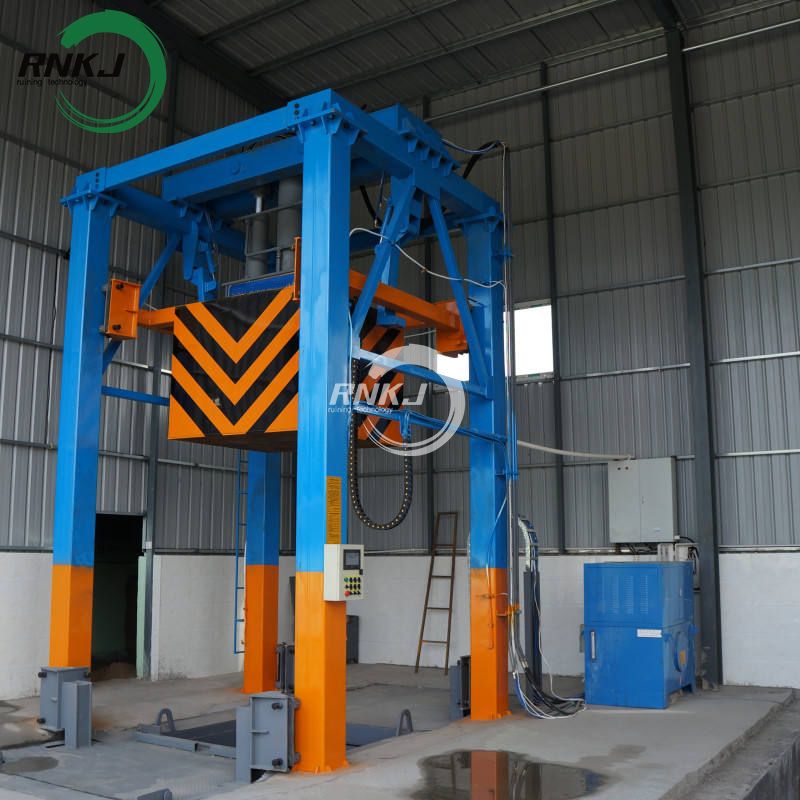
Vertical Trash Compaction Station is a waste treatment equipment that uses hydraulic power in the vertical direction to drive the compression head to forcefully compress and reduce the volume of garbage. It is mainly used for centralized compression and transfer of municipal solid waste, commercial waste, and industrial waste. Its core function is to compress loose garbage to 1/3 to 1/4 of its original volume, forming high-density garbage blocks, which significantly improves the efficiency of garbage transfer and reduces transportation costs.

 Product Advantage
Space and efficiency advantages
Vertical compression fully utilizes gravity, resulting in more uniform and compact compression, with higher compression density.
It has a small footprint, making it suitable for areas with limited space such as city centers.
The one-machine-multiple-box mode significantly improves the transfer efficiency and reduces the frequency of using transportation vehicles.
Environmental protection advantages
Fully enclosed operation, no garbage leakage or sewage overflow, reducing odor emission.
Concentrated collection and treatment of leachate to prevent groundwater pollution.
Compressed garbage blocks are easy to be transported in a sealed manner, reducing the risk of secondary pollution.
Economic value advantages
Reduce transportation costs by over 60%, due to a significant increase in the single transportation volume.
Reduce the land occupation of landfill sites and extend their service life.
The maintenance cost is relatively low, with fewer vulnerable parts and high reliability.
Operational and Safety Advantages
Simple operation, high degree of automation, reducing manual intervention.
Multiple safety protections, including door magnetic interlock, limit protection, and emergency stop function.
Low noise, friendly to the working environment.
Main Components
Compressor Host: Core equipment, including hydraulic system, compression head, load-bearing frame, providing working pressure and compression force.
Garbage Container: Stores compressed garbage blocks, featuring leak-proof design, with capacities ranging from 6 to 20 m³, capable of being separated from the host for easier transportation.
Loading Device: Garbage input port, can be designed with customized feed ports, suitable for different site layouts.
Hydraulic System: Provides power, including cylinders, pumps, tanks, and control valve groups, enabling the lifting and pushing actions of the compression head.
Electrical Control System: Operation and safety protection, including PLC control, emergency stop buttons, limit switches, and full-box indicator lights.
Leachate Treatment System: Collects the wastewater squeezed out during the compression process, transporting it through bottom pipes to the sewage treatment facility to prevent secondary pollution.
Odor Removal and Disinfection System: Spraying device, reducing odor dispersion, killing harmful microorganisms, and improving the working environment.
Technical Parameters
Compression Type | Vertical compression |
Bin Capacity(m³) | 6m³-20m³ (Professional customization) |
Height of Hook (mm) | Customize height |
Density of Garbage Compactor(kg/m³) | 750kg/m³ |
Cycle Time of Compression(s) | 45s |
Operating Mode | Automatic; manual |
Color | Customizable colors |
Material | Corrosion-resistant manganese steel |
Power | Hydraulic/Chain (Customize) |
Lifting Mode | Hydraulic four-post lifting |
Core Working PrincipleGarbage Disposal: Through manual operation, automatic flipping of trash bins, or garbage truck unloading, the garbage is thrown from the top into the vertical compression chamber.
Pre-compression: When the garbage accumulates to a certain height, the hydraulic press head starts to perform initial compression from top to bottom, reducing the volume of the garbage initially.
Continuous Compression: Continuous feeding and compression, the press head repeatedly applies downward pressure until the garbage is compressed to the preset density or volume within the chamber.
Garbage Transportation: After compression is completed, the outflow system discharges the high-density garbage blocks, directly loading them into the sealed garbage transfer vehicle, and transporting them to the landfill.
Equipment Reset: The press head rises, the compression chamber is cleaned, and is ready to receive the next round of feeding and compression process.

Product Style
|
|
Applicable ScenariosUrban residential areas: Small garbage transfer stations within or around residential communities, meeting the compression and transfer needs of daily household waste.
Commercial centers: Areas such as shopping malls, office buildings, and hotels, handling catering waste and office waste to prevent garbage accumulation.
Public places: Areas with high foot traffic such as parks, stations, and airports, improving garbage disposal efficiency and reducing collection frequency.
Industrial parks: Handling light industrial production waste, such as packaging waste and leftover materials, to reduce transportation costs.
Township areas: Small in size, suitable for setting up on the main street of the township to solve the problem of centralized garbage disposal.
Maintenance PointsHydraulic system: Regularly check the oil level and cleanliness of the hydraulic oil, replace the hydraulic oil as required, clean the hydraulic filter element, and ensure that there is no leakage in the hydraulic pipeline.
Sealing components: Check the sealing rubber strips of the compression hopper door and the press head. Replace them in time if they are worn or aged to prevent leakage of sewage and odors.
Loading and discharging mechanism: Regularly lubricate the bucket flipping mechanism and the guide rails and hinges of the discharging door to avoid jamming. Check whether the limit switches and sensors are sensitive.
Cleaning work: After each compression, promptly clean the residual garbage and filtrate liquid in the compression hopper to prevent corrosion of the hopper body.
Electrical system: Keep the control panel dry and clean, check if the connection terminals are loose to avoid short-circuit faults.
Choice Criterion
Classified by processing scale:
Small: Daily processing capacity < 50 tons, suitable for small venues such as communities, schools, and hospitals
Medium: Daily processing capacity 50 - 200 tons, suitable for town and street-level transfer stations
Large: Daily processing capacity 200 - 1000 tons, suitable for large-scale transfer centers at the city level
Choose the vertical type: focuses more on high compression ratio, excellent sealing and environmental protection, land conservation, and community integration.
Choose the horizontal type: focuses more on large-scale continuous processing capacity and transportation flexibility, often used in large regional transfer centers.
We are a professional manufacturer of sanitation machinery, providing customers with ex-factory prices and on-demand customization services. You can contact us via WhatsApp or email.


