


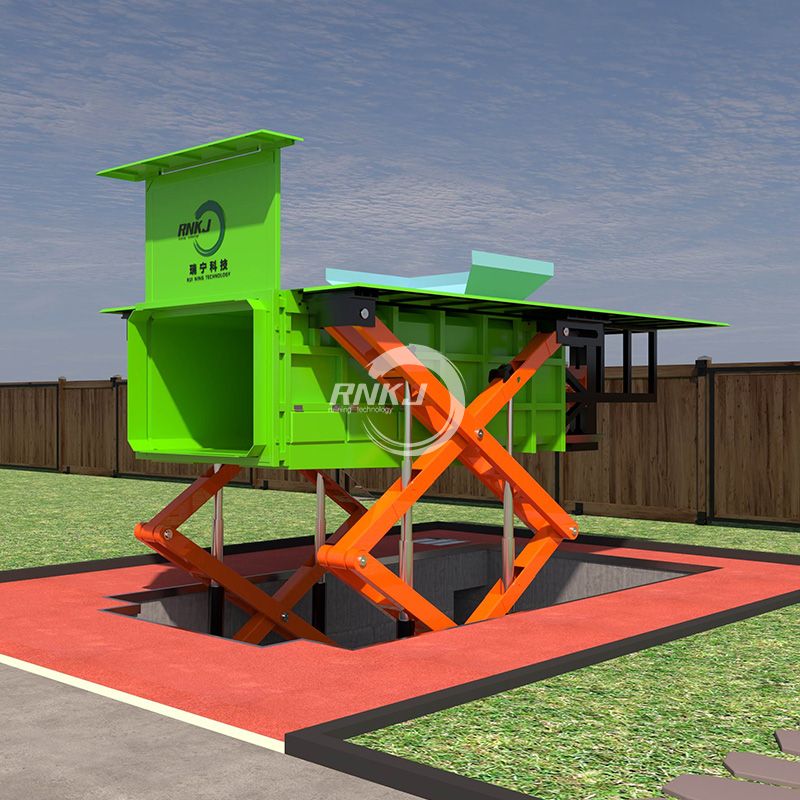
Underground Horizontal Garbage Compaction Station is a modern sanitation equipment that integrates garbage sealed storage, powerful compression, and efficient transportation. The main body of the equipment is buried in the underground space, with only the loading port and control room remaining on the ground. This design solves problems such as large area of traditional garbage stations, odor diffusion, and visual pollution. It is particularly suitable for urban core areas with limited land, densely populated communities, commercial complexes, scenic spots, and other scenarios with high environmental requirements. By transferring the garbage processing process underground, it achieves three breakthroughs: no garbage exposure on the ground, no secondary pollution during operation, and high-efficiency transportation. It is the preferred solution for garbage disposal in the global urbanization process.

 Core technical advantages
Space conservation and environmental friendliness
Underground installation design: The main equipment is deeply buried underground, while only a material feeding port and a small control room need to be reserved on the ground, saving 80% of the ground space and being suitable for various narrow plots.
Fully sealed structure: The compression box body adopts a first-level waterproof standard, and the material feeding port is equipped with an automatic sealing door. During the operation process, there is no odor leakage, no dust diffusion, and no leakage of filtrate, solving environmental pollution.
Noise reduction and energy saving: High-efficiency motors are used, reducing energy consumption by 30% compared to traditional equipment, and supporting variable frequency speed regulation to adapt to different garbage loads.
High-efficiency compression and transportation capabilities
Powerful compression system: Rated compression force 45-63T, compression ratio up to 1:3 to 1:4. High garbage density, significantly reducing transfer frequency.
Automated operation: Supports dual-mode control via remote control or operation console. The entire process of garbage dumping - compression - loading only requires 2-3 cycles, and the single batch operation time is ≤ 15 minutes.
Seamless connection for transfer: The lifting device can lift the compressed box to the ground level and precisely connect with the standard garbage transfer vehicle. There is no scattering or residue during the garbage block pushing process.
Technical Parameters
Compression Type | Horizontal compression |
Bin Capacity(m³) | 6m³-20m³ (Professional customization) |
Height of Hook (mm) | Customize height |
Density of Garbage Compactor(kg/m³) | 750kg/m³ |
Cycle Time of Compression(s) | 45s |
Operating Mode | Automatic; manual |
Color | Customizable colors |
Material | Corrosion-resistant manganese steel |
Power | Hydraulic/Chain (Customize) |
Lifting Mode | Ground gallows, side gallows, four pillars |
Core Structure CompositionUnderground compression main module
Compression chamber: Made of high-strength manganese steel welded together, it has anti-wear and anti-corrosion properties, can withstand 120-180 tons of compression force, and can compress loose garbage to 1/3-1/4 of its original volume, significantly increasing the storage density of garbage.
Pushing device: Equipped with a hydraulic system, the push head adopts a wear-resistant buffer design, enabling uniform and precise garbage compression actions, avoiding garbage splashing and equipment damage.
Sealing door body: Equipped with double sealing rubber strips and an air pressure balance device. During compression operations, it can completely block the leakage of odors and sewage, and a negative pressure odor removal system is set up inside the underground chamber to purify the air.
Ground feeding auxiliary module
Intelligent feeding port: Equipped with an induction-type opening and closing door, it supports three modes of manual feeding, bucket feeder feeding, and small garbage truck unloading. The feeding port is equipped with an infrared monitoring device. When someone or an object approaches, the door automatically stops moving to ensure operational safety.
Dumping area: Can hold 1-2 cubic meters of loose garbage. When the garbage in the dumping area reaches the preset capacity, the automatic compression host will start to push the garbage to the underground compression chamber to achieve unmanned continuous operation.
Control cabinet: Adopted with waterproof and dustproof design, equipped with a display screen, which can display real-time data such as compression times, garbage storage volume, and equipment operation status, and also has a fault warning function.
Integrated transportation connection module
Underground lifting platform: It adopts a scissor-type hydraulic lifting structure, which can smoothly lift the compressed garbage container to the ground and precisely connect with the rear-mounted garbage transfer vehicle. The lifting process has low noise and avoids disturbing the surrounding environment.
Container locking device: Equipped with an automatic positioning lock, the lifting platform can achieve seamless fixation between the lifting platform, the garbage container, and the transfer vehicle, preventing the container from shifting or the garbage from falling during the transfer process.
Sewage collection system: An inclined drainage channel and a sealed sewage tank are set in the underground chamber. The leachate generated during the compression process is collected centrally through the drainage channel to avoid polluting the soil and groundwater.
Working Process Phase 1: Temporary Storage of Garbage for Disposal
Initiate the feeding mode: Staff operate the control panel to select the feeding mode. The intelligent feeding control panel will automatically open the door.
Garbage enters the storage area: Loose garbage falls into the ground hopper storage area through the feeding port. The weight sensor in the hopper continuously monitors the garbage volume.
Storage area full trigger: When the garbage in the storage area reaches the preset capacity, the system automatically closes the feeding port door and initiates the compression and transfer process.
Phase 2: Underground Compression Processing
Pushing the garbage into the chamber: The spiral pushing device in the above-ground storage area transports the loose garbage at a constant speed into the underground compression chamber.
Hydraulic compression operation: The hydraulic system drives the pushing head to move forward, compressing the garbage for the first time. After the compression is completed, the pushing head automatically resets.
Multiple cycles of compression: The system repeats the "push garbage - compress - reset" action until the garbage in the underground compression chamber reaches the preset density.
Odor and wastewater treatment: The odor generated during the compression process is purified in real time by the negative pressure deodorization system, while the leachate flows into the underground sealed sewage tank through the diversion channel.
Phase 3: Full Box Warning and Transfer
Capacity Monitoring Warning: The liquid level sensor and pressure sensor in the underground compression chamber continuously monitor the amount of garbage stored. When it reaches 90% of the total capacity, the system triggers a full box warning, and a prompt is sent to the operation cabinet.
Lift Platform Activation: After confirmation by the staff, the underground scissor-type lift platform is activated. The fully loaded compression box is smoothly lifted to the ground. During the lifting process, the box position is automatically locked.
Transfer Vehicle Docking for Discharge: The lift platform precisely aligns with the rear-mounted garbage transfer vehicle. The rear door of the compression box automatically opens, and the push head pushes the compressed garbage as a whole into the transfer vehicle's compartment.
Cavity Reset Preparation: After the discharge is completed, the lift platform returns the empty box to the underground compression chamber, preparing for the next round of operation.

Product Style
|
|
 Applicable Scene
Urban commercial area: Surrounding areas of pedestrian streets, shopping centers, and office buildings, which not only meet the high garbage disposal requirements but also do not affect the beauty of the commercial environment.
High-end residential community: Improving the living quality of the community, avoiding the garbage station becoming the focus of complaints from the residents.
Tourist attractions: Protecting the natural landscape of the scenic area, reducing the interference of the garbage disposal process on the tourists' experience.
Municipal public areas: Urban squares, stations, parks and other densely populated areas, enhancing the environmental hygiene image of the city.
Customized ServiceCapacity customization: The volume of the underground compression chamber can be adjusted according to customer requirements. There are three basic models available: 10 cubic meters, 15 cubic meters, and 20 cubic meters. Customized solutions for larger capacities are also supported.
Function customization: Optional features such as garbage classification feeding ports, low-temperature sterilization systems, and automatic garbage weight measurement can be selected to meet the waste treatment policies and requirements of different regions.
Appearance customization: The color and shape of the above-ground feeding port and operation cabinet can be customized according to the architectural style of the surrounding area, achieving a perfect integration with the environment.
After-sales guarantee: A 12-month whole machine warranty is provided, along with lifetime technical support.
We are a professional manufacturer of sanitation machinery, providing customers with ex-factory prices and on-demand customization services. You can contact us via WhatsApp or email.


