




| Quantity: | |
|---|---|
 Product Overview
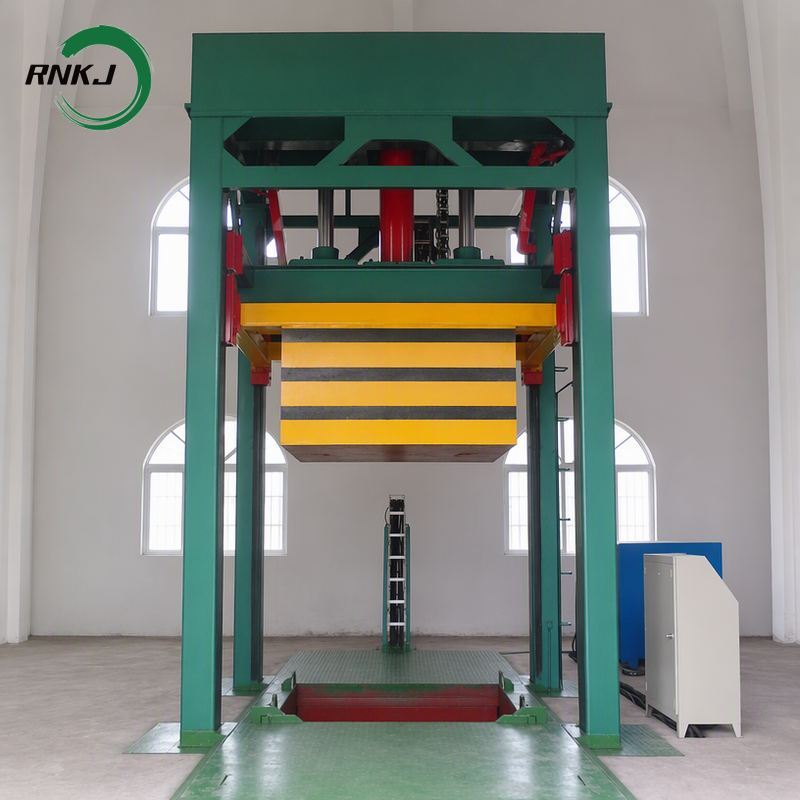
The Heavy-Duty Industrial Hydraulic Vertical Garbage Compactor Station for Municipal Projects is designed to handle the growing waste collection and storage demands of municipal sanitation systems, residential communities, commercial areas, and public facilities. It combines a robust steel structure with a powerful hydraulic compression mechanism to reduce the volume of collected municipal solid waste before transportation.
Unlike conventional open waste containers that simply provide temporary storage, this vertical garbage compactor uses downward hydraulic pressure to compress waste inside a dedicated compression chamber. The vertical compression arrangement makes it possible to utilize the equipment's working height while maintaining a relatively compact installation footprint.
The equipment is engineered for projects that require centralized waste collection, controlled waste storage, and organized transportation. Its compression chamber, hydraulic power unit, feeding arrangement, and waste discharge configuration can be designed according to the actual operating environment.
For municipal sanitation contractors and waste management operators, this industrial vertical garbage compactor station provides a practical solution for handling mixed municipal waste, packaging materials, household refuse, and other suitable solid waste streams.
Heavy-Duty Structural DesignThe overall machine structure is developed to withstand repeated compression cycles and the mechanical loads generated during continuous waste handling operations.
The main frame is manufactured from heavy-duty structural steel, providing support for the compression chamber, hydraulic cylinder assembly, and associated mechanical components.
Key structural features include:
Reinforced Steel Frame: A heavy-duty frame supports the main compression components and maintains structural stability during operation.
Enclosed Compression Chamber: The enclosed chamber helps keep waste within the designated compression area and reduces unnecessary exposure during processing.
Wear-Resistant Contact Surfaces: Selected internal surfaces can be reinforced according to the waste characteristics and expected operating conditions.
Hydraulic Compression Assembly: The hydraulic cylinder drives the compression plate vertically to apply pressure to the waste.
Customizable Equipment Layout: The machine dimensions, chamber configuration, feeding arrangement, and discharge structure can be adjusted to suit different project requirements.
The structural design can be evaluated according to the waste composition, daily processing volume, installation conditions, and expected operating frequency.
Vertical Hydraulic Compression SystemThe hydraulic compression mechanism is the central working component of the vertical garbage compactor station.
During operation, collected waste enters the compression chamber through the designated feeding opening. Once the loading process is completed, the hydraulic system activates the compression cylinder, driving the compression plate downward.
As the plate moves vertically, the loose waste is subjected to controlled pressure and gradually becomes more compact. This process reduces the occupied volume of the waste and allows more material to be stored within the available collection space.
The hydraulic system can be configured according to the required compression force, chamber dimensions, and waste characteristics.
Its main components include:
Hydraulic power unit
Hydraulic oil pump
Main hydraulic cylinder
Compression plate
Hydraulic control valves
Oil pipelines and connecting components
Electrical control cabinet
The hydraulic parameters can be customized based on the actual project requirements. Cylinder specifications, working pressure, motor power, and control configurations should be determined through equipment engineering rather than applying the same settings to every waste stream.
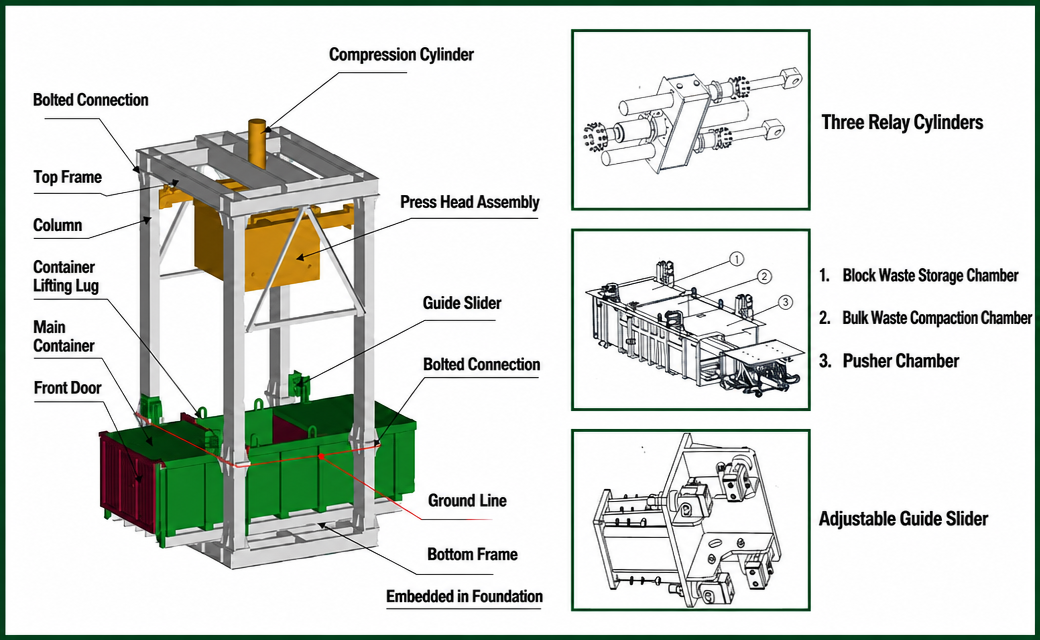
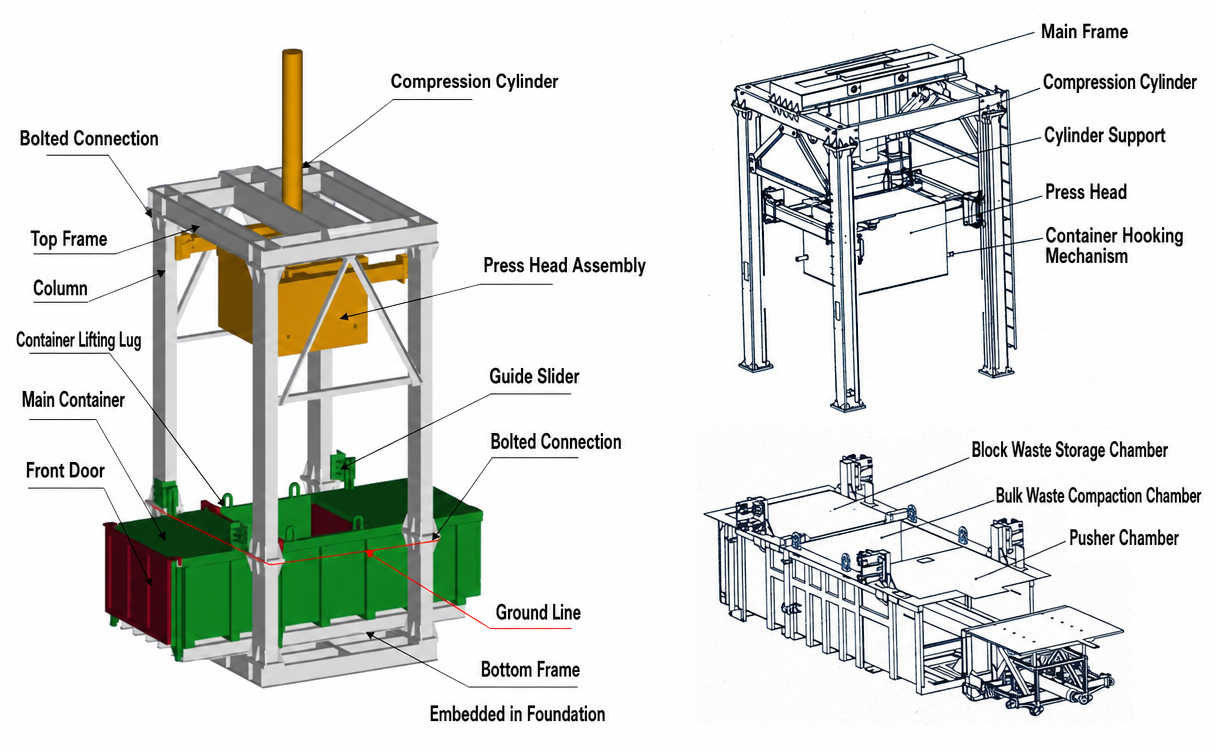
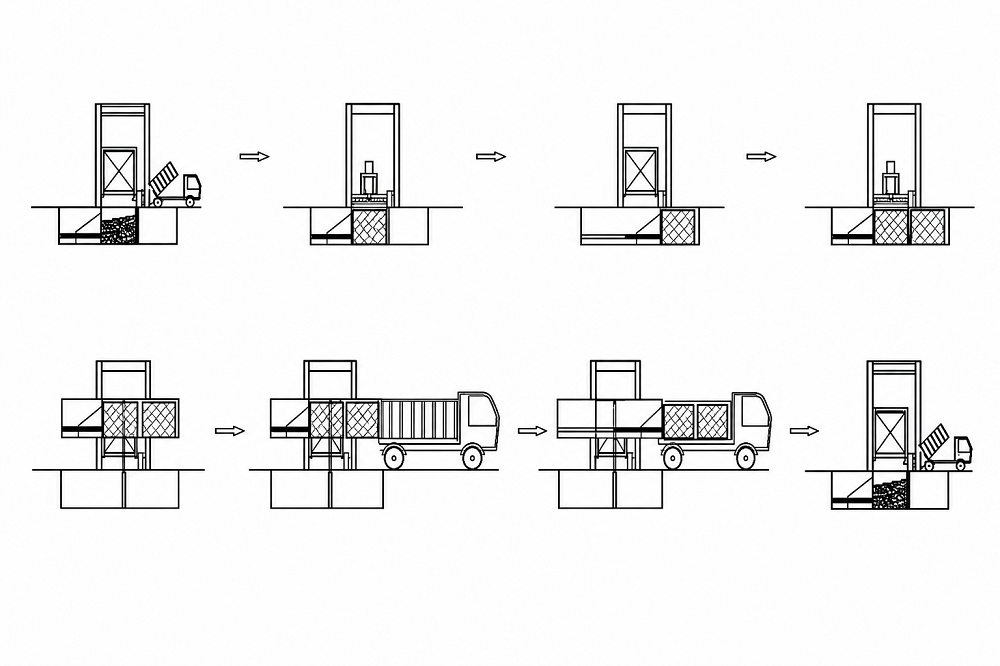
Waste Feeding and Compression OperationThe vertical garbage compaction process is organized around waste loading, hydraulic compression, temporary storage, and final discharge.
Municipal solid waste is collected and delivered to the equipment through the designated feeding opening. The feeding arrangement can be designed according to the collection method and site layout.
Waste enters the compression chamber and accumulates within the available space. The chamber dimensions and loading configuration are determined according to the expected waste volume.
The hydraulic cylinder drives the compression plate downward, applying pressure to the waste. The compression process can be repeated according to the chamber filling level and operating requirements.
After compression, the compacted material remains within the designated storage or discharge area, depending on the equipment configuration.
When the equipment reaches its designated storage capacity, the compressed waste can be discharged using the configured unloading mechanism and transferred to a waste transportation vehicle or downstream treatment facility.
This working arrangement helps organize waste collection at centralized municipal locations and reduces the frequency of transporting loose waste, depending on the actual waste density and operating conditions.
Customizable Capacity and Equipment ConfigurationMunicipal waste projects differ in daily waste generation, available installation space, collection frequency, and transportation arrangements. Therefore, the vertical garbage compactor station can be engineered with different specifications rather than relying on a single standard configuration.
Customization item | Available design considerations |
|---|---|
Equipment capacity | Designed according to daily waste volume and collection frequency |
Compression force | Selected according to waste composition and required compaction |
Compression chamber | Customized dimensions and structural specifications |
Hydraulic system | Cylinder, pump, motor, and working pressure configuration |
Feeding system | Feeding opening and loading arrangement |
Discharge system | Customized unloading structure |
Control system | Manual, semi-automatic, or automatic control options |
Equipment material | Carbon steel with project-specific structural reinforcement |
For projects with different processing requirements, the equipment can be designed around the available site dimensions and the expected waste handling process.
Applications in Municipal Waste ManagementThe Heavy-Duty Industrial Hydraulic Vertical Garbage Compactor Station is suitable for centralized waste collection locations where loose waste needs to be compressed before transportation.
Typical application scenarios include:
Municipal Sanitation Facilities
Used at municipal waste collection points to process household refuse collected from surrounding streets, neighborhoods, and public areas.
Residential Communities
Suitable for centralized waste collection facilities in residential developments where daily household waste needs to be collected and stored in a more organized manner.
Commercial Complexes
Shopping centers, supermarkets, office buildings, and other commercial facilities can use vertical waste compaction equipment to handle packaging materials, general refuse, and other suitable solid waste.
Industrial Parks and Factories
Suitable for processing certain types of industrial solid waste, including packaging waste, cardboard, and other compressible materials, subject to material compatibility.
Public Institutions
Can be incorporated into waste management facilities at schools, hospitals, transportation facilities, and other public service locations.
Product Style
|
|
Why Choose a Heavy-Duty Vertical Garbage Compactor Station?Selecting a suitable vertical garbage compactor involves more than comparing machine dimensions or hydraulic power. The overall equipment configuration should match the site's waste collection and transportation requirements.
The main advantages of this equipment include:
Vertical Compression Arrangement: Uses downward hydraulic force to compact waste within a dedicated chamber.
Heavy-Duty Construction: Reinforced structural components are designed for repeated compression operations.
Centralized Waste Processing: Combines waste loading and compression within one designated station.
Flexible Project Configuration: Capacity, chamber dimensions, hydraulic components, and feeding arrangements can be customized.
Reduced Loose Waste Volume: Compressed waste occupies less space than the same material in an uncompacted condition.
Adaptable Installation: Equipment dimensions and layout can be assessed according to available site space.
Project-Oriented Engineering: Different configurations can be developed for municipal, commercial, and industrial waste management applications.
Technical ParametersThe following table provides a reference framework. Final specifications should be confirmed according to the selected model and project requirements.
Parameter | Configuration |
|---|---|
Product Name | Vertical Garbage Compactor Station |
Equipment Type | Hydraulic Vertical Compression |
Application | Municipal Solid Waste Management |
Capacity | Customizable |
Compression Method | Vertical Hydraulic Compression |
Main Structure | Heavy-Duty Steel Frame |
Compression Chamber | Enclosed Steel Chamber |
Hydraulic System | Industrial Hydraulic Power Unit |
Feeding Method | Customized Feeding Opening |
Control Mode | Manual / Semi-Automatic / Automatic |
Installation | Ground-Mounted / Customized Layout |
Customization | Available |
Customized Vertical Garbage Compactor Solutions for Municipal ProjectsEvery municipal waste management project has its own operational requirements. A vertical garbage compactor station designed for a residential community may have different chamber dimensions, feeding arrangements, and compression configurations from equipment used in a large municipal sanitation facility.
As a professional waste compaction equipment manufacturer, we provide customized vertical garbage compactor solutions based on project-specific requirements.
Before manufacturing, we can evaluate:
Daily municipal waste generation.
Types and characteristics of waste materials.
Required equipment capacity and compression force.
Available installation area and equipment height.
Waste loading and unloading methods.
Electrical and hydraulic system requirements.
Transportation and downstream waste treatment arrangements.
Our engineering team can configure a suitable hydraulic vertical garbage compactor station based on your project drawings, technical specifications, and site conditions.


