






| Quantity: | |
|---|---|
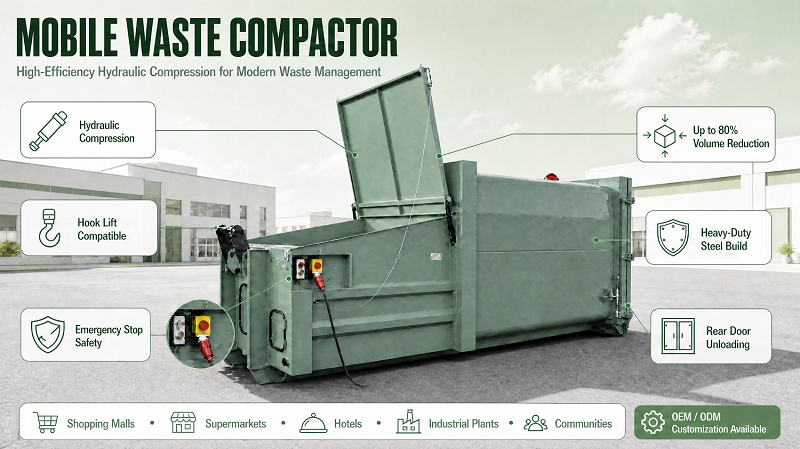
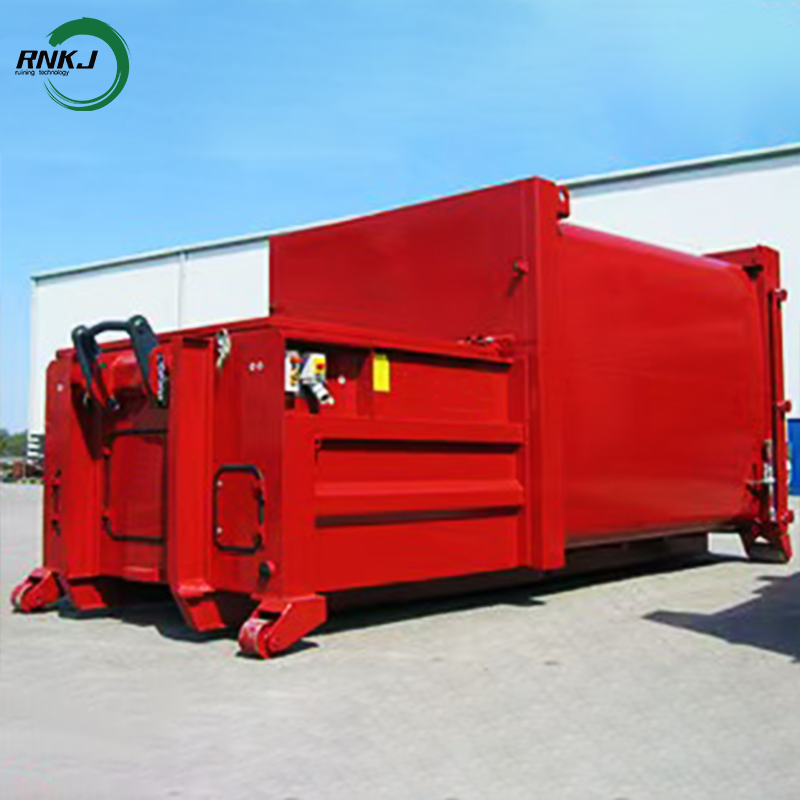
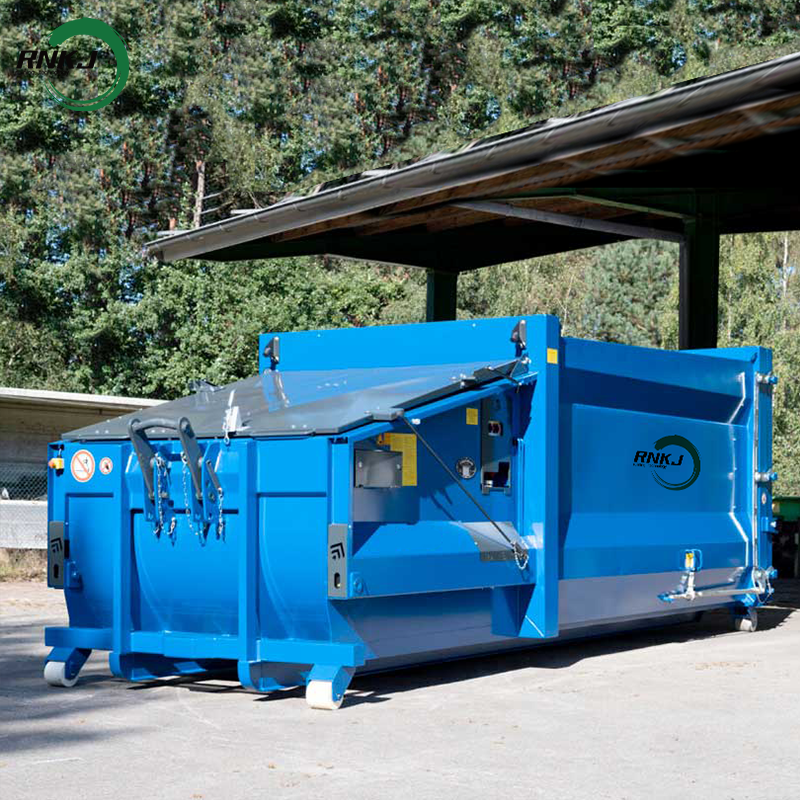
The Customized Capacity High Compression Ratio Heavy Duty Mobile Waste Compactor is a robust and flexible waste compaction solution designed for municipal sanitation, commercial waste collection, industrial facilities, construction sites, transfer stations, residential communities, and other high-volume waste management applications.
As a Mobile Waste Compactor, the equipment combines waste collection, high-density compression, temporary storage, and transportation into one integrated unit. The entire compactor can be loaded, lifted, transported, and unloaded by a hook lift truck, eliminating the need for a dedicated fixed transportation body. This configuration provides waste operators with greater flexibility when serving multiple collection points.
The equipment can be customized according to the required container capacity, waste characteristics, loading method, transportation vehicle, installation space, and operating conditions. Similar mobile compactor systems commonly use hook-lift transport because the compactor can be exchanged or relocated efficiently between different sites.
Designed for demanding working environments, this Heavy Duty Mobile Waste Compactor uses a reinforced steel structure and hydraulic compression system to withstand frequent loading and compaction cycles. High compression performance reduces loose waste volume before transportation, allowing more waste to be handled in each transport cycle and helping improve overall waste transfer efficiency.
 Customized Mobile Waste Compactor for Different Applications
Waste generation varies significantly between residential areas, commercial buildings, factories, logistics centers, construction projects, and municipal collection stations. For this reason, a one-size-fits-all compactor is not always the most efficient solution.
This Customized Capacity Mobile Waste Compactor can be configured according to the customer's project requirements.
Possible customization options include:
Compactor capacity
Overall dimensions
Hook center height
Hopper size
Loading height
Waste feeding method
Compression force
Compression cycle
Hydraulic system configuration
Motor and power supply
Electrical control system
Automatic or manual operation
Sealing structure
Rear discharge door
Drainage system
Odor-control system
Bin lifting system
Safety protection system
Surface treatment and paint
Local transportation requirements
Depending on the project, mobile compactor capacities can be designed in different sizes. Existing mobile compactor products in the market commonly cover medium- to large-volume applications, while customized manufacturers can adapt dimensions and body configuration to suit individual fleet requirements.
This makes the equipment suitable for projects where standard waste compactors cannot fully match the available site space, waste volume, or hook-lift truck configuration.
High Compression Ratio for Efficient Waste HandlingOne of the most important advantages of this Mobile Waste Compactor is its high compression capability.
Loose municipal and commercial waste normally contains a significant amount of air and empty space. If it is transported without compression, the container can become full before its actual weight capacity is reached. A hydraulic compaction system compresses the waste inside the container, significantly increasing the amount of waste that can be stored and transported in each load.
Depending on the waste composition and operating conditions, mobile compactor systems can achieve substantial volume reduction. Some commercial systems specify compression ratios around 3:1, while the actual result depends heavily on waste type, moisture content, particle size, feeding conditions, and machine configuration.
The high compression ratio provides several practical benefits:
More waste stored in the same container volume
Fewer transportation trips
Better utilization of hook lift trucks
Reduced fuel consumption
Lower transportation labor requirements
Improved transfer station efficiency
Reduced waste storage footprint
Longer intervals between waste collection
Better utilization of available container capacity
For waste management contractors handling large quantities of mixed municipal or commercial waste, these advantages can translate into significant improvements in daily transportation efficiency.
Heavy-Duty Construction for Continuous OperationThe Heavy Duty Mobile Waste Compactor is designed for demanding waste handling environments where equipment may operate for long periods and experience frequent compression cycles.
The main body can be manufactured from high-strength steel and reinforced structural components. High-wear areas can be strengthened according to the waste stream and expected operating frequency.
The heavy-duty structure is particularly useful for applications involving:
Municipal solid waste
Commercial waste
Industrial waste
Mixed household waste
Packaging waste
General solid waste
Semi-wet waste
High-volume commercial waste
Construction-related general waste
The internal compression chamber is designed to withstand repeated pressure from the hydraulic ram. Reinforced doors, structural beams, hinges, locking components, and wear-resistant areas can further improve durability.
For projects with particularly abrasive waste, the material and wear protection can also be customized to extend service life.
Hook Lift Truck Transportation SystemA major feature of this product is its compatibility with a hook lift truck.
Instead of requiring the compactor to remain permanently installed at one location, the complete Mobile Waste Compactor can be picked up and transported by the hook lift system.
The basic operating process is:
Waste Loading → Hydraulic Compaction → Temporary Storage → Full Load Detection → Hook Lift Pickup → Transportation → Waste Disposal → Return/Replacement
When the compactor is full, the hook lift truck engages the lifting hook and loads the complete unit onto the truck. The truck then transports the compacted waste to the designated disposal, recycling, treatment, or transfer facility.
Hook-lift systems are widely used for transporting portable compactors and containers because their hydraulic lifting mechanism allows different units to be exchanged using the same truck.
This creates a flexible one-truck-multiple-compactor operating model. Instead of assigning one truck permanently to one compactor, a single hook lift truck can potentially serve several compactor locations according to the collection schedule.
Why Use a Hook Lift Truck with a Mobile Waste Compactor?Traditional fixed waste compactors usually require a permanent installation area and separate waste transportation arrangements. By comparison, a hook-lift-compatible Mobile Waste Compactor integrates the compaction and storage container into a transportable unit.
The compactor can be moved between different locations according to seasonal or operational requirements.
It can be used at:
Residential communities
Shopping centers
Industrial parks
Factories
Warehouses
Logistics centers
Construction sites
Municipal sanitation facilities
Transfer stations
Temporary project sites
Large event venues
Because the unit is mobile, projects can reduce their dependence on permanent civil construction. This can be especially useful for temporary facilities, expansion projects, and locations where permanent waste stations are difficult to construct.
Once the waste has been compressed, the hook lift truck transports a higher-density load instead of loose waste. This helps reduce unnecessary collection trips and improve vehicle utilization.
If waste generation changes between different areas, the compactor can be relocated without rebuilding the entire waste collection system.
Waste management contractors can operate multiple compactors with a smaller number of hook lift trucks, depending on collection schedules and local operating conditions.
Sealed Waste Storage and Environmental ProtectionWaste management is not only about compression capacity. Leakage, odor, litter, and secondary pollution are also important considerations.
The Mobile Waste Compactor can use a sealed body and rear door structure to help contain waste during storage and transportation. Liquid-proof construction and drainage options can be configured for waste streams with higher moisture content.
A properly sealed compactor can help reduce:
Waste leakage
Leachate spillage
Odor dispersion
Wind-blown litter
Contact between waste and the surrounding environment
Cleaning requirements around the collection area
For wet or semi-wet waste applications, additional drainage and sealing configurations can be considered during customization.
Hydraulic Compression SystemThe hydraulic system is the core power source of the Mobile Waste Compactor.
During operation, hydraulic cylinders drive the compression mechanism to push waste into the storage chamber. The hydraulic system can be configured according to the required compression force, cycle time, waste type, and operating frequency.
The main hydraulic components may include:
Hydraulic power unit
Hydraulic pump
Hydraulic cylinders
Hydraulic valves
Hydraulic oil tank
Hydraulic pipelines
Pressure protection components
Control valves
Hydraulic connectors
The hydraulic system provides strong and stable compression force while allowing the compression cycle to be controlled through the electrical system.
For high-frequency applications, hydraulic components can be selected according to the expected duty cycle and local service conditions.
Intelligent Electrical Control System
The Mobile Waste Compactor can be equipped with an electrical control system for convenient and reliable operation.
Depending on the customer's requirements, the control system can support:
Automatic operation
Manual operation
Emergency stop
Compression cycle control
Hydraulic pressure monitoring
Motor protection
Full-load warning
Safety interlocks
Fault indication
Sensor monitoring
Optional remote monitoring
An automatic control mode can simplify daily operation by allowing the machine to perform predefined compression cycles after waste is loaded.
For larger waste management projects, fill-level sensors, load monitoring, or other intelligent functions can be integrated to improve operational visibility. Safety guidance for hook-lift mobile refuse compactors also emphasizes avoiding overfilling and overloading, with load cells or fill sensors being potential measures for controlling these risks.
High-Density Waste Transportation
The purpose of a high-compression mobile compactor is not simply to make the waste container look fuller. The real objective is to increase the amount of waste that can be transported during each collection cycle.
Without compaction:
Loose Waste → Large Volume → Container Fills Quickly → More Trips → Higher Transport Cost
With high-density compaction:
Loose Waste → Hydraulic Compression → Reduced Volume → Higher Loading Density → Fewer Trips → Better Transport Efficiency
This operating model makes the equipment particularly attractive for areas where transportation distances are long or waste collection frequency is high.
Key Advantages of the Heavy Duty Mobile Waste CompactorThe storage volume and body dimensions can be customized according to waste generation and hook lift truck requirements.
Strong hydraulic compression reduces loose waste volume and increases effective loading density.
The complete compactor is designed for lifting and transportation by a hook lift truck.
The unit can be moved between different collection locations without rebuilding a fixed waste station.
Reinforced materials and components are suitable for frequent waste handling and compression cycles.
The enclosed structure helps reduce leakage, odors, and secondary pollution during storage and transportation.
Higher waste density can reduce the number of collection trips required for the same amount of waste.
Multiple mobile compactors can potentially be operated with hook lift truck fleets, improving vehicle utilization.
Capacity, dimensions, loading system, electrical configuration, hydraulic system, and other components can be customized for specific projects.
Mobile Waste Compactor vs. Traditional Waste Container| Feature | Mobile Waste Compactor | Traditional Waste Container |
|---|---|---|
| Waste compression | High-density hydraulic compression | No active compression |
| Waste volume | Significantly reduced after compaction | Remains largely unchanged |
| Transportation | Hook lift truck | Suitable container truck depending on type |
| Loading efficiency | High | Standard |
| Transportation frequency | Potentially reduced | Usually higher |
| Space utilization | High | Lower |
| Sealed storage | Available | Depends on container design |
| Customization | High | Generally limited |
| Suitable for high-volume waste | Excellent | Moderate |
| Flexible relocation | Excellent | Good |
The key difference is that a Mobile Waste Compactor actively processes waste before transportation. This makes it more suitable for projects where waste volume, transportation frequency, and available space are important operational considerations.
Recommended Project ConfigurationFor customers selecting a customized Mobile Waste Compactor, several factors should be evaluated before finalizing the equipment design.
Identify whether the equipment will handle dry waste, mixed municipal waste, commercial waste, semi-wet waste, or other materials.
Estimate the average and peak daily waste volume to determine the appropriate compactor capacity.
The desired compression ratio and output density should be considered together with the characteristics of the waste.
The hook center height, lifting capacity, container dimensions, and truck chassis should be confirmed before manufacturing.
Determine whether waste will be manually loaded, transferred from wheeled bins, fed through a hopper, or delivered through another system.
Available length, width, height, loading clearance, and truck maneuvering space should all be considered.
Projects with continuous or high-frequency operation may require upgraded hydraulic, structural, and wear-resistant components.
For projects looking to reduce waste volume, improve transportation efficiency, optimize hook lift truck utilization, reduce collection frequency, and create a more flexible waste management system, a customized Mobile Waste Compactor can provide a practical and scalable solution.
We are a professional manufacturer of sanitation machinery, providing customers with ex-factory prices and on-demand customization services.
If you would like to obtain more customized specifications or purchase this garbage compaction station at factory price, please contact us via website message or WhatsApp(+86-18853809997).


