




| Quantity: | |
|---|---|
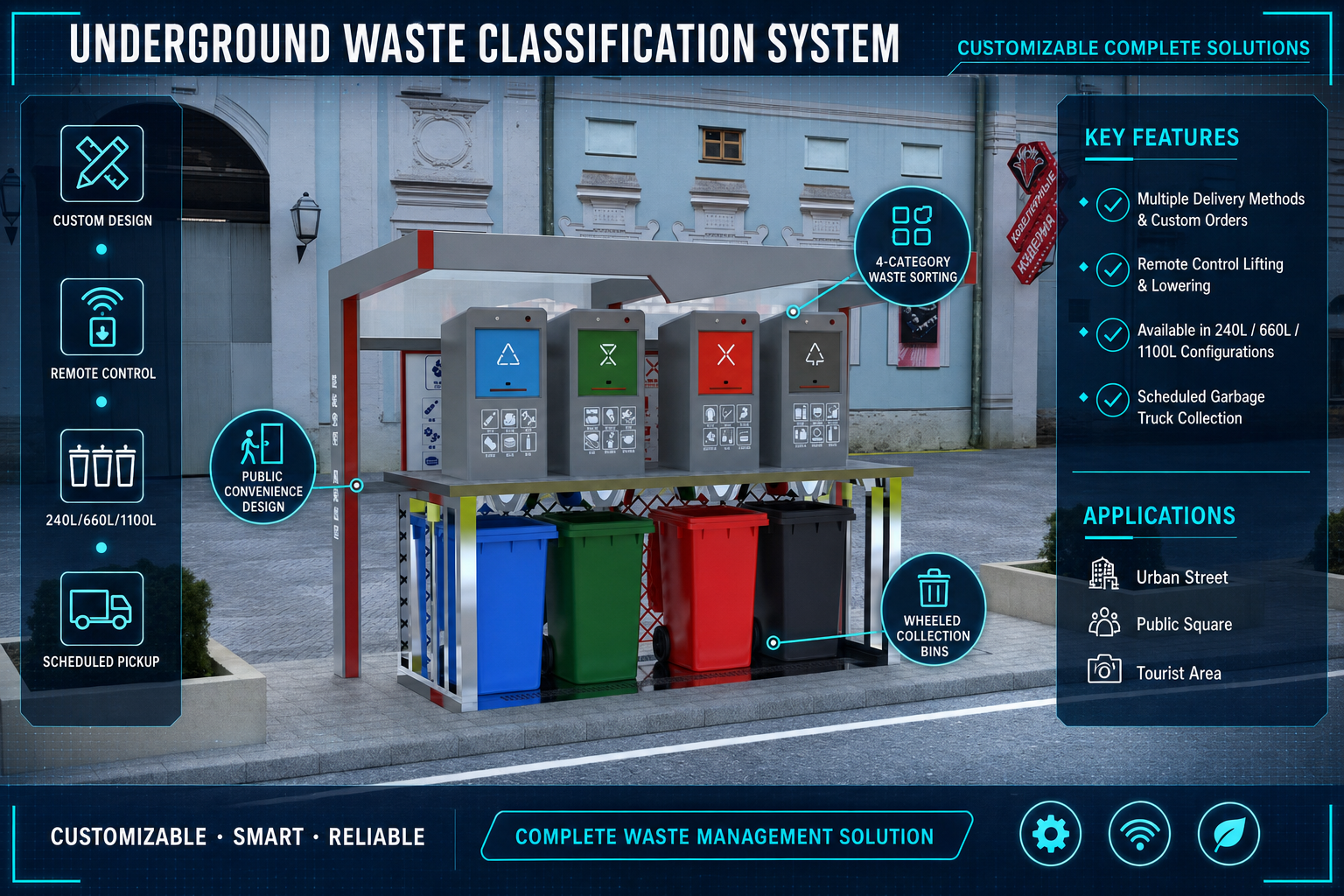
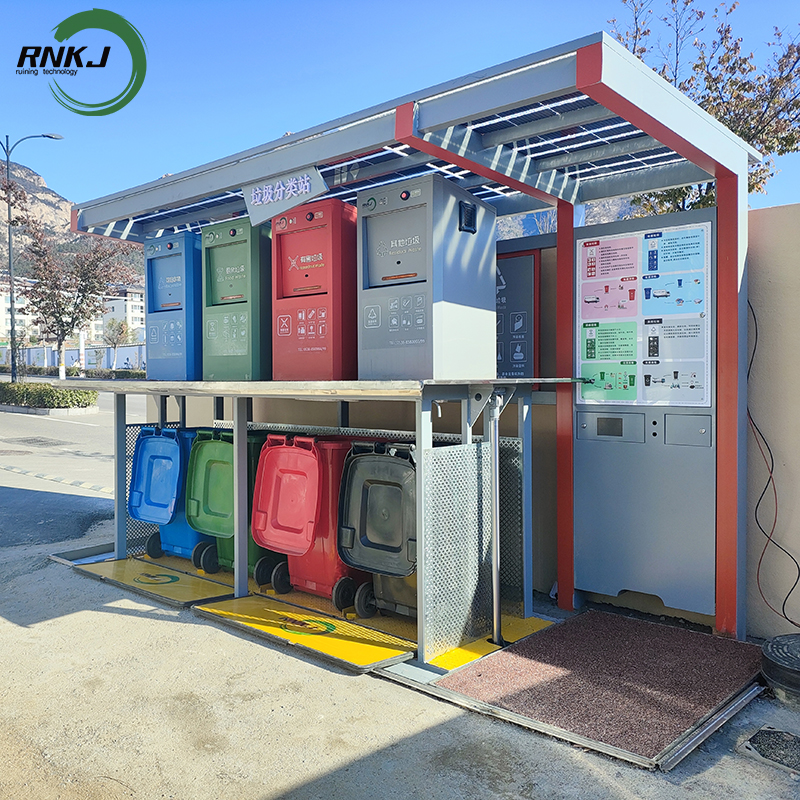
The Underground Waste Classification System is an intelligent and space-saving waste collection solution designed for residential communities, apartment complexes, housing estates, parks, public areas, and other locations where clean and organized waste management is required. By placing classified waste bins underground while keeping the waste disposal and sorting interface above ground, the system makes better use of limited urban space and creates a cleaner appearance for residential environments.
The system supports 240L, 660L, and 1100L waste bins, allowing different configurations according to the waste generation volume, available installation space, and local waste classification requirements. With multiple waste disposal openings, hydraulic lifting equipment, optional remote-controlled operation, and an enclosed underground structure, this Underground Waste Classification System combines waste separation, temporary storage, environmental protection, and convenient collection into one integrated solution.
Unlike conventional above-ground waste bins that occupy considerable public space and can become visually unattractive when overloaded, an underground waste classification system stores the main waste containers below ground. Only the waste classification kiosk and disposal openings remain visible at ground level, helping maintain a cleaner and more attractive residential landscape.
 What Is an Underground Waste Classification System?
An Underground Waste Classification System is a waste collection and storage installation that places multiple classified garbage bins below ground and provides corresponding disposal openings above ground.
Residents can identify the appropriate waste category through clear signs, colors, icons, or labels and dispose of their waste through the corresponding inlet. The waste falls directly into the designated 240L, 660L, or 1100L waste bin installed underground.
When the underground bins need to be emptied, the lifting system raises the bins from the underground pit to the ground level. Waste collection personnel can then remove the full bins and replace or return them according to the configured collection method.
The basic operating process is:
Waste Classification---Separate Disposal---Underground Storage---Hydraulic Lifting---Waste Collection--- Scheduled Transportation
This design reduces the amount of waste equipment visible on the ground while maintaining convenient access for residents and waste collection workers.
Designed for Residential Waste ClassificationResidential areas generate different types of household waste every day. If all waste is placed into conventional mixed garbage containers, recyclable materials and other recoverable resources can easily become contaminated.
The Underground Waste Classification System for Residential Areas provides separate disposal points for different waste categories. Depending on the requirements of the project, the system can be configured for categories such as:
Recyclable waste
General household waste
Food or organic waste
Other waste
Paper and cardboard
Plastic packaging
Metal
Glass
The actual classification configuration can be customized according to local regulations and the waste management requirements of the project.
This source-separation approach makes it easier for residents to participate in waste sorting while helping property managers and waste collection companies organize collection more efficiently.
Customizable Waste Bin Configurations: 240L, 660L, and 1100L OptionsOne of the key advantages of this Underground Waste Classification System is its flexible customization for different standard waste bin sizes.
The system can be customized to match 240L, 660L, or 1100L waste bins, depending on project requirements, site conditions, and expected waste generation.
The 240L configuration is suitable for locations with relatively low waste generation or where smaller individual collection units are preferred.
It can be used in:
Small residential communities
Villas and low-density housing areas
Parks
Small public facilities
Community service areas
The 660L configuration provides a larger storage capacity while maintaining relatively compact dimensions. It is suitable for residential communities, apartment complexes, commercial-residential developments, and public areas with medium waste generation.
The system can be customized to accommodate several 660L bins for different waste categories, allowing multiple waste streams to be collected within one centralized underground installation.
The 1100L waste bin configuration is suitable for high-density residential areas and locations with relatively large daily waste volumes.
Using larger bins reduces the frequency of manual handling and allows more waste to be stored underground before scheduled collection.
The number and capacity of bins can be customized according to the expected waste output and collection frequency of the project.
Space-Saving Underground DesignTraditional waste collection points can require a large amount of visible ground space. Multiple large garbage bins may also affect the appearance of residential landscapes.
The Underground Waste Classification System solves this problem by moving the primary storage area below ground.
Only the waste disposal kiosk remains visible above the surface, while the main waste bins are positioned inside the underground pit.
This design provides several benefits:
Better utilization of limited land
Reduced visible waste storage equipment
Cleaner residential surroundings
Improved pedestrian space
Better integration with landscape design
More organized waste disposal points
Reduced visual impact of large waste bins
For residential developments where landscaping and architectural appearance are important, underground waste collection can be integrated into the overall community design.
Enclosed and Odor-Controlled StructureThe underground section is designed as an enclosed waste storage area. Compared with exposed garbage bins, the enclosed configuration can help reduce the direct exposure of waste to the surrounding environment.
The system can incorporate sealing, drainage, anti-seepage, and odor-control measures according to project requirements.
These features are particularly useful for residential communities where waste collection points are located close to homes, pedestrian paths, gardens, and public facilities.
The enclosed structure helps create a cleaner waste collection environment and can reduce problems associated with:
Waste odors
Waste leakage
Rainwater entering containers
Scattered garbage
Direct exposure of waste
Pest attraction
Visual pollution
For projects with strict environmental requirements, additional deodorization and ventilation solutions can also be considered during system design.
Smart and User-Friendly Waste DisposalA successful residential waste classification system should not only provide sufficient capacity but also make waste sorting simple for residents.
The above-ground kiosk can be equipped with:
Clearly marked waste categories
Color-coded disposal openings
Classification symbols
Multilingual signs
Recycling icons
Public information panels
Advertising or community information areas
The visual design helps residents quickly identify the correct disposal point.
The system can therefore become more than a simple waste storage installation. It can serve as a centralized residential waste sorting station that encourages better waste separation habits.
Product StructureA typical Underground Waste Classification System consists of several major components.
The kiosk provides the visible interface for residents. It can include multiple disposal openings corresponding to different waste categories.
The external structure can be customized in terms of color, signage, dimensions, materials, and appearance to match the surrounding architectural and landscape environment.
Each waste category has a corresponding disposal opening.
The openings can be equipped with manual, foot-operated, or other opening mechanisms according to the selected configuration.
Clear classification labels help residents place waste into the correct container.
The underground section contains the classified waste bins.
Depending on the project, the system can be configured for 240L, 660L, or 1100L garbage bins.
Different bin capacities can also be arranged for different waste streams when required.
The hydraulic lifting system raises the underground bins to ground level for collection and maintenance.
The lifting mechanism is designed to provide controlled movement and simplify the handling of full waste containers.
The underground pit provides the installation space for the waste containers and lifting equipment.
The pit can be designed with appropriate waterproofing, drainage, anti-seepage, and structural protection measures according to site conditions.
The control system manages the lifting and lowering operations.
Depending on the project, it can support manual controls, remote controls, sensors, or other intelligent functions.
For projects requiring independent or supplementary outdoor power, a solar power system can be integrated into the installation.
Underground Waste Classification System vs. Traditional Waste BinsTraditional above-ground waste bins are simple and inexpensive, but they require visible ground-level storage space.
An underground system provides a more integrated approach by combining waste classification, underground storage, lifting, and collection.
| Feature | Underground Waste Classification System | Traditional Waste Bins |
|---|---|---|
| Main storage position | Underground | Above ground |
| Waste classification | Multiple classified openings | Depends on bin arrangement |
| Space utilization | High | Lower |
| Visual impact | Low | Higher |
| Hydraulic lifting | Available | Usually unavailable |
| Bin capacity | 240L / 660L / 1100L | Varies |
| Landscape integration | Excellent | Limited |
| Odor-control potential | Higher with enclosed design | Depends on bin type |
| Smart control | Optional | Usually limited |
| Suitable for modern communities | Yes | Basic applications |
Why Choose Our Underground Waste Classification System?Choosing an underground waste collection system is not only about hiding garbage bins below the ground. A complete solution should consider waste classification, user convenience, collection efficiency, site conditions, safety, maintenance, and future expansion.
Our Underground Waste Classification System can be customized around the actual requirements of each project.
Key advantages include:
Professional underground waste collection design
Support for 240L, 660L, and 1100L bins
Multiple waste classification configurations
Hydraulic lifting operation
Optional remote control
Optional solar power supply
Enclosed underground storage
Space-saving installation
Customizable kiosk design
Suitable for residential and public applications
Integrated waste collection solution
Custom engineering available
Product ParametersModel number | ZFDM-2404 | ZFDM-2406 | ZFDM-6604 |
Size of Kiosk (mm) | 4200*1600*2630 | 5580*1600*2630 | 6400*2300*3000 |
Size of Pit (mm) | 4130*1280*2280 | 5510*1280*2280 | 6220*1920*2680 |
Number of Feeding Ports | 4 | 6 | 4 |
Capacity (L) | 960L (4 barrels) | 1440L (6 barrels) | 2640L (660L per barrel) |
Weight (KG) | 2980 | 3450 | 4950 |
Lift Height (mm) | 1320 | 1320 | 1700 |
Motor Power(kw) | 1.5 | 1.5 | 2.2 |
Voltage | 220V 50HZ / Customized | 220V 50HZ / Customized | 220V 50HZ / Customized |
Opening Mode | sensor | sensor | sensor |
Sewage Pump Power(kw) | 1.1 | 1.1 | 1.1 |
Lift Weight(T) | 2.8 | 3.5 | 5.5 |
Customization OptionsEvery residential project has different requirements. Therefore, the Underground Waste Classification System can be customized according to the installation site and waste management plan.
Customization may include:
Number of waste categories
Number of underground bins
240L / 660L / 1100L bin configuration
Kiosk dimensions
Underground pit dimensions
Hydraulic lifting capacity
Control method
Remote control system
Foot-operated disposal openings
Solar power supply
Waste classification signs
Color and exterior design
Odor-control configuration
Drainage and anti-seepage design
Safety protection system
Collection vehicle compatibility
This allows the system to be adapted to both small residential communities and large-scale urban developments.
FAQ
An Underground Waste Classification System is a waste collection solution that stores multiple classified waste bins below ground while providing separate waste disposal openings above ground.
The system can be designed to accommodate 240L, 660L, and 1100L waste bins, depending on the project configuration.
Yes. It is particularly suitable for residential communities, apartment complexes, villas, housing estates, and other areas where space utilization and environmental appearance are important.
Yes. The underground waste bins can be lifted using a hydraulic lifting platform, making collection and maintenance more convenient.
Yes. Remote-controlled lifting and lowering can be incorporated according to the selected configuration.
Yes. A solar power supply can be integrated into the system for suitable outdoor applications.
We are a professional manufacturer of sanitation machinery, providing customers with ex-factory prices and on-demand customization services. You can contact us via WhatsApp or email.


