


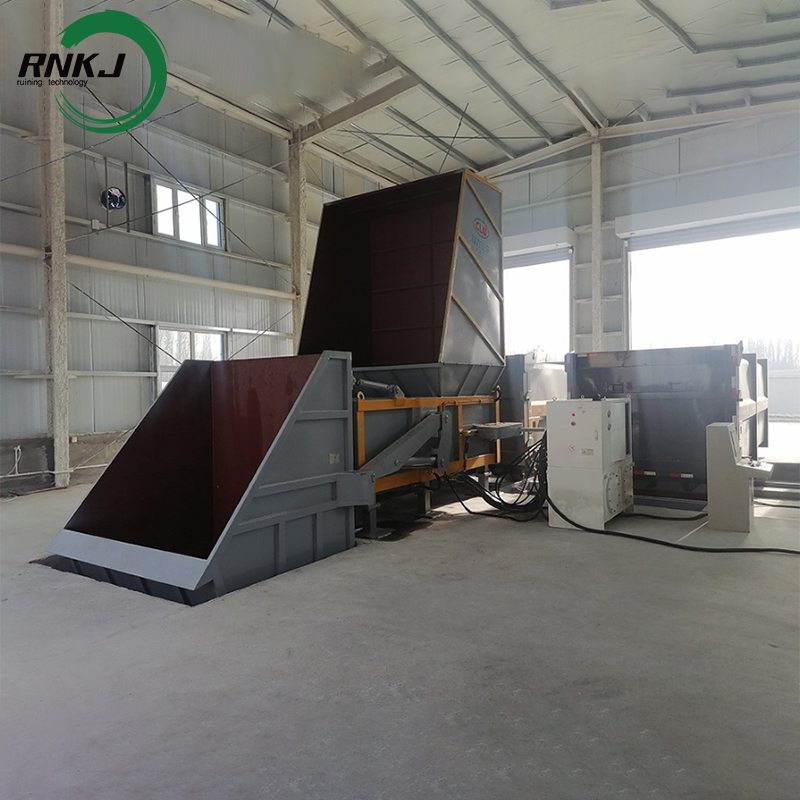


The Separate-Type Garbage Compactor is a stationary hydraulic waste compression system designed for municipal solid waste, commercial waste, industrial waste, residential communities, transfer stations, and other high-volume waste collection applications. Its main structural feature is the separation of the waste compression unit and the waste storage container.
Unlike an integrated garbage compactor, the compression equipment remains installed at the waste collection or transfer station, while the storage container can be separated after it is filled. The full container is then transported to the designated waste treatment facility by a Hook Lift Truck, while an empty container can be connected to the compression unit for continued operation.
This configuration creates a practical workflow of waste loading, hydraulic compression, container storage, container separation, hook-lift transportation, and empty-container replacement. It is particularly suitable for projects where waste generation is continuous and transportation efficiency is an important consideration.

 What Is a Separate-Type Garbage Compactor?
A Separate-Type Garbage Compactor is a hydraulic waste compression system in which the compaction body and waste container are designed as separate units.
The compression unit is installed at a fixed location and performs the main waste compaction operation. Waste is loaded through the feeding hopper and compressed horizontally by a hydraulic pushing mechanism. The compressed waste is then pushed into the connected storage container.
When the container reaches the required filling level, it can be disconnected from the compression unit. The full container is picked up and transported by a compatible Hook Lift Truck. An empty container can then be positioned and connected to the compression unit.
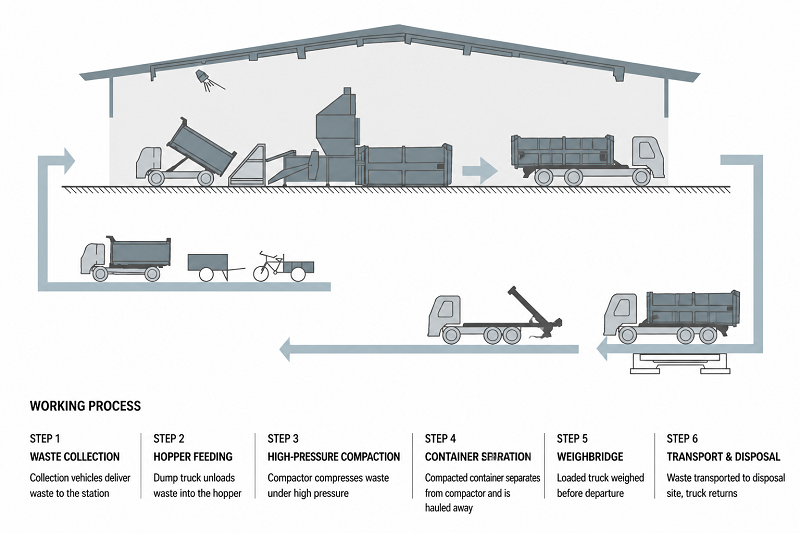
The basic operating sequence is:
Waste Loading → Hydraulic Compression → Container Filling → Container Separation → Hook Lift Transportation → Empty Container Replacement
This operating principle allows the compression equipment to remain at the station instead of being transported together with every load.
Product Type

Separate Compression Unit and Container DesignThe most important characteristic of this garbage compactor is its split configuration.
The system consists of two primary functional sections:
Stationary compression unit
Detachable waste container
The compression unit contains the hydraulic power system, compression chamber, pushing mechanism, feeding hopper, control system, and related components. It remains at the installation site during normal operation.
The container serves as the storage and transportation unit for compacted waste. Once full, it is separated from the compactor and transported away.
This design makes the container an independent transport unit while the compression equipment continues to serve the collection station.
For projects requiring continuous waste transfer, multiple containers can be configured around one compression unit. For example, one container can remain connected to the compactor while another is being transported or emptied.

Hydraulic Waste Compression SystemThe hydraulic compression mechanism is the core working system of the equipment.
After waste enters the feeding hopper, the hydraulic cylinder drives the compression head forward. The waste is pushed through the compression chamber and compressed into the connected container.
The hydraulic system can provide strong and controlled pushing force for repeated compression cycles. Depending on the waste characteristics and project requirements, the compression system can be configured with suitable hydraulic components, control parameters, compression chamber dimensions, and operating cycles.
The compression process reduces the volume of loose waste and allows the available container space to be used more effectively.
The system can be designed for different types of solid waste, including suitable municipal household waste, commercial waste, packaging waste, cardboard, paper, and other general solid waste streams, subject to the final project requirements.
How Does the Separate-Type Garbage Compactor Work?Collected waste is delivered to the station by sanitation vehicles, collection carts, bins, or other suitable equipment.
The waste is discharged into the feeding hopper of the compression unit.
The feeding arrangement can be customized according to the collection method and site conditions.
Once the waste enters the compression chamber, the hydraulic pushing mechanism starts the compression cycle.
The compression head moves forward and pushes the waste toward the connected storage container.
Repeated compression cycles gradually fill the container with compacted waste.
The compacted waste enters the detachable container and remains inside until the container reaches its required filling level.
The container can be designed with a suitable structure and sealing arrangement according to the waste type and transportation requirements.
A properly configured container helps reduce unnecessary exposure of waste during temporary storage and transportation.
When the container is full, the compression operation is stopped and the connection between the compression unit and container is released.
The full container is then separated from the stationary compactor.
This is the key difference between a separate-type system and an integrated compactor.
The complete compression machine does not need to leave the station.
The full container is transferred using a Hook Lift Truck.
The truck engages with the container's lifting structure, loads the container, and transports it to the designated landfill, incineration facility, waste treatment center, or other disposal location.
Because the compression unit remains at the station, transportation is focused on the filled container rather than the entire compression system.
After the full container is removed, an empty container can be positioned at the compression unit.
The container is connected and locked into the required operating position.
The station can then resume normal waste compression.
For high-volume projects, multiple containers can be prepared in advance to support a continuous container rotation process.
Main ComponentsThe hydraulic compression unit provides the main force required to compact waste.
It normally includes:
Hydraulic cylinders
Hydraulic pump
Hydraulic oil tank
Hydraulic valves
Compression head
Compression chamber
Hydraulic pipelines
Control components
The hydraulic system can be configured according to the required compression performance and operating frequency.
The feeding hopper is the waste receiving area of the compactor.
Its dimensions and configuration can be adjusted according to the customer's collection vehicles, loading method, available installation space, and daily waste volume.
Different feeding arrangements can be considered for municipal sanitation stations, commercial facilities, industrial sites, and transfer stations.
The container is designed to receive and temporarily store the compacted waste.
Its capacity, dimensions, steel plate specifications, structural reinforcement, door configuration, sealing structure, and hook-lift interface can be customized according to project requirements.
The container is separated from the compression unit when full and transported independently.
The electrical control system manages the operating sequence of the compression equipment.
Depending on the project configuration, the system can incorporate automatic compression cycles, hydraulic control, safety interlocks, operating controls, and other functions.
The control configuration can be adjusted according to the required degree of automation.
A reliable connection between the compression unit and container is essential for normal operation.
The docking and locking structure helps maintain the correct position of the container during compression and allows the container to be released when transportation is required.
Key Features of Separate-Type Garbage CompactorThe compression equipment and storage container are independent components.
The compactor remains at the station while the filled container is transported away.
The filled container can be transferred using a compatible Hook Lift Truck.
This provides a practical solution for projects that already use hook-lift transportation equipment.
One compression unit can be configured to work with multiple containers.
While one full container is being transported or emptied, another empty container can be prepared for operation.
The main compression system does not need to travel with every waste load.
This allows the compression unit to remain installed at the transfer station and focus on continuous waste processing.
The equipment can be customized according to:
Waste type
Daily waste generation
Required container capacity
Feeding method
Available installation space
Hook lift truck specifications
Electrical requirements
Hydraulic system requirements
Container dimensions
Local transportation standards
The separate configuration is particularly useful where waste is generated continuously and containers need to be exchanged regularly.
It can be applied to municipal waste transfer stations, residential communities, commercial districts, industrial parks, factories, shopping centers, public facilities, and other high-volume waste collection locations.
ApplicationsThe Separate-Type Garbage Compactor can be used in a wide range of waste management projects.
The system can receive household waste collected from different areas, compress it, and transfer the compacted waste into detachable containers for transportation to downstream treatment facilities.
For large residential communities with concentrated waste generation, the compactor can provide a centralized waste compression point.
Shopping centers, commercial complexes, markets, and business districts can use the system to manage relatively high daily waste volumes.
The equipment can be configured for suitable general industrial solid waste and packaging waste, helping facilities organize waste collection and transportation.
Airports, schools, hospitals, campuses, parks, and other large facilities can also consider separate-type compression systems when waste generation is concentrated.
Customization OptionsEvery waste management project has different operating conditions. The Separate-Type Garbage Compactor can therefore be customized according to the actual project requirements.
Container capacity can be selected according to daily waste generation and transportation frequency.
The container length, width, height, opening dimensions, and overall structure can be customized to match the available site and transportation equipment.
Different steel grades and plate thicknesses can be considered according to the expected loading conditions, waste characteristics, service environment, and durability requirements.
The container can be designed according to the customer's existing Hook Lift Truck specifications, including lifting structure and connection dimensions.
The feeding system can be configured according to whether waste is delivered by garbage trucks, collection carts, bins, or other equipment.
Hydraulic power, motor specifications, control components, electrical voltage, and automation functions can be configured according to project requirements.
Why Choose a Separate-Type Garbage Compactor?The main value of a Separate-Type Garbage Compactor lies in its independent compression and transportation structure.
Instead of moving the entire compaction system every time waste transportation is required, the compression unit stays at the station while the filled container is exchanged and transported separately.
This configuration can provide:
Flexible container management
Independent container transportation
Convenient container replacement
Better compatibility with hook lift logistics
Continuous waste collection with spare containers
Customized equipment configuration
A practical solution for high-volume waste transfer
For projects with regular container exchange requirements, this design provides a flexible alternative to conventional integrated waste compactors.
FAQsA separate-type garbage compactor is a hydraulic waste compression system in which the compression unit and waste storage container are designed as separate components. The compression unit remains at the station while the full container can be separated and transported independently.
Waste is loaded into the feeding hopper and compressed by a hydraulic pushing mechanism. The compacted waste enters the connected container. Once the container is full, it is separated from the compression unit and transported to the designated waste treatment facility.
Yes. The detachable container can be designed with a compatible hook-lift structure so that a Hook Lift Truck can pick up and transport the full container. The exact container structure can be customized according to the customer's truck specifications.
No. One of the main features of the separate-type design is that the compression unit remains installed at the waste collection or transfer station. Only the filled container is separated and transported away.
Yes. Multiple containers can be configured for a single compression unit. When one container is full and being transported or emptied, an empty container can be connected to the compression unit for continued operation.
Yes. The system can be customized according to waste type, daily waste volume, container capacity, container dimensions, hook-lift truck specifications, feeding method, hydraulic system, electrical requirements, and available installation space.
A separate-type garbage compactor has an independent compression unit and detachable waste container. The compression unit stays at the station while the full container is transported separately. An integrated compactor generally combines the compression and storage functions into one complete unit.
The Separate-Type Garbage Compactor is a stationary hydraulic waste compression solution built around a simple but flexible concept: keep the compaction equipment at the station and transport the full waste container separately.
Waste is loaded into the compression unit, compacted hydraulically, and pushed into the detachable container. Once the container is full, it is separated from the compression equipment and transported by a Hook Lift Truck. An empty container can then be installed so that waste collection and compression can continue.
With customizable compression capacity, container dimensions, feeding arrangements, hydraulic systems, and transportation interfaces, the Separate-Type Garbage Compactor can be developed for different municipal, commercial, industrial, and large-scale waste transfer applications.
We are a professional manufacturer of sanitation machinery, providing customers with ex-factory prices and on-demand customization services. You can contact us via WhatsApp or email.


