


| Quantity: | |
|---|---|
The Industrial Hydraulic Sealed Leak Proof Split Type Waste Compactor is a heavy-duty waste compression solution designed for municipal sanitation projects, industrial parks, commercial districts, residential communities, waste transfer stations, and other high-volume waste collection sites. Its key feature is the split-type structure, which separates the stationary hydraulic compression unit from the waste storage container.
Unlike an integrated mobile garbage compactor, the compression equipment remains installed at the transfer station while the filled waste container can be detached independently. Once one container reaches its preset capacity, a hook lift truck removes the full container and transports it to the designated disposal or treatment facility. An empty container is immediately positioned at the compactor, allowing waste collection and compression to continue with minimal interruption. This fixed-compactor and interchangeable-container concept is also used in other split-type waste compression systems.
This design makes the system particularly suitable for projects where continuous waste compaction, sealed transportation, reduced transfer time, and efficient container management are important.
 Industrial Hydraulic Split Type Waste Compactor Overview
The Industrial Hydraulic Split Type Waste Compactor consists primarily of a heavy-duty hydraulic compression mechanism, compression chamber, feeding hopper, control system, sealing structure, container docking mechanism, guide rails, and interchangeable waste containers.
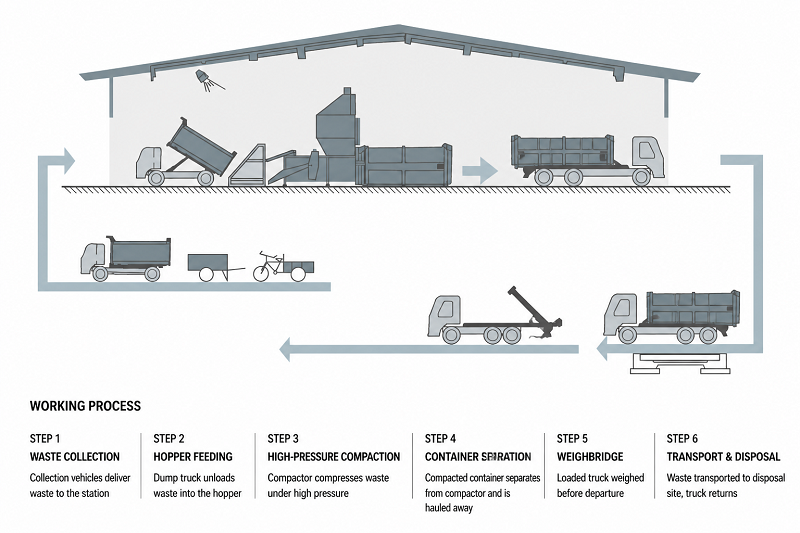
The compression unit is fixed at the waste collection or transfer station. Waste is fed into the hopper and pushed horizontally into the connected container by a powerful hydraulic compression ram. As the waste is compressed, its occupied volume is reduced, allowing significantly more waste to be stored in each container before transportation.
When the container is full, the system can stop the compression cycle, release the container locking mechanism, and separate the filled container from the compactor. The hook lift truck then lifts and transports the loaded container. At the same time, a standby empty container can be installed in its place.
This creates a practical operating sequence:
Waste Loading → Hydraulic Compression → Sealed Storage → Full Container Separation → Hook Lift Transportation → Empty Container Replacement → Continuous Operation
The biggest advantage is that the compression machine does not need to leave the site when the waste container is full.
Product Type

Split-Type Design for Continuous Waste CompactionThe split structure is the core feature of this industrial waste compactor.
In a conventional integrated mobile compactor, the compression system and storage container are normally combined into one complete machine. Once the machine is full, the entire unit may need to be transported for unloading, which can temporarily interrupt waste collection.
The Split Type Waste Compactor uses a different operating model.
The hydraulic compaction system remains at the transfer station, while multiple interchangeable containers are used for waste storage and transportation.
For example:
Container A is connected to the compactor and receiving waste.
When Container A becomes full, it is disconnected from the compression unit.
A hook lift truck picks up Container A.
Container B, which has already been emptied and prepared, is moved into position.
Container B is connected and locked to the compactor.
The compression system resumes operation.
Container A is transported to the disposal, transfer, recycling, or treatment facility.
This parallel operating method allows waste compression and waste transportation to take place independently, helping reduce waiting time and improving equipment utilization.

Sealed and Leak-Proof Waste StorageThe Sealed Leak Proof Waste Compactor is designed to improve cleanliness and environmental control during waste collection, compression, storage, and transportation.
The container can be configured with a sealed structure to help reduce:
Waste leakage
Leachate spillage
Odor escape
Wind-blown waste
Rainwater entering the container
Secondary pollution during transportation
For projects handling wet municipal waste, food-related waste, commercial refuse, or other waste containing moisture, the leak-proof container structure is particularly valuable.
The sealed connection between the compression unit and container can also help create a cleaner working environment around the waste transfer station.
Leak-tight construction is a recognized feature in waste compactor designs intended for wet or high-moisture waste streams.
Heavy-Duty Hydraulic Compression SystemThe Industrial Hydraulic Waste Compactor uses hydraulic power to generate strong and stable compression force.
The hydraulic system drives the compression ram to push waste horizontally into the connected container. Compared with manual or low-power mechanical compression methods, hydraulic compaction provides strong pushing force and is suitable for intensive daily operation.
The hydraulic system can be customized according to:
Required compression force
Container capacity
Waste characteristics
Daily waste volume
Operating frequency
Site conditions
Power supply requirements
The compression cycle can also be configured for automatic or manual operation according to the requirements of the project.
For high-volume waste transfer stations, the hydraulic compression system helps maximize container utilization and reduce the amount of loose waste that needs to be transported.
Hook Lift Container TransportationA major advantage of this Split Type Garbage Compactor is its compatibility with hook lift transportation.
When the container reaches its maximum filling level, it does not need to remain attached to the compactor until the entire waste disposal process is completed.
Instead, the full container is separated from the fixed compression unit and collected by a hook lift truck.
The basic transportation process is:
Waste is continuously loaded and compressed into the container.
When the container reaches the required filling level, the operator or control system stops the compression cycle.
The container is unlocked from the compression unit and moved away from the docking position.
The hook lift truck engages with the container's lifting structure and loads the full container onto the truck.
The loaded container is transported directly to the waste transfer station, landfill, incineration facility, recycling facility, or other designated treatment location.
A prepared empty container is moved into the working position and securely connected to the compactor.
The waste compactor can immediately return to normal operation.
Hook-lift systems are commonly used for transporting portable compactors and containers because the truck can load and demount different container units.
Product ParametersPerformance Parameters | |
Equipment Model | ZYG-15/17/20 |
Compacted Density (t/㎡) | ≥0.75 |
Motor Power (kW) | 11/15/22 |
Hydraulic System Set Pressure (MPa) | 16~20 |
Case Volume (㎡) | 15/17/20 |
Power Supply (V) | 380v, 3-phase, 50HZ |
Continuous Operation with Multiple ContainersOne of the strongest selling points of this Industrial Split Type Waste Compactor is its ability to work with multiple containers.
A single compression unit can be matched with several interchangeable waste containers depending on the project's waste volume and transportation schedule.
For example:
1 Compression Unit + 2 Containers
One container is working while the other is being transported or prepared.
Or:
1 Compression Unit + 3–4 Containers
One container is connected to the compactor, one is being transported, and the remaining containers can be used as standby units.
This configuration creates a flexible waste management system where the compactor remains operational while the full containers are moving through the transportation cycle.
As a result, the system is especially suitable for waste transfer stations with high daily waste volumes and relatively frequent container transportation.
Why Choose a Split Type Waste Compactor?The compression equipment stays at the station. Only the full container is removed.
This means the arrival and departure of a hook lift truck does not require the entire compactor to be taken out of service.
With spare containers available, the full container can be replaced immediately.
This helps maintain uninterrupted waste receiving and compression operations.
Only the loaded container is transported instead of moving the complete compression machine.
This can improve transportation flexibility and allow one hook lift truck to serve multiple containers or waste collection points.
Hydraulic compression reduces the volume occupied by loose waste, allowing more refuse to be stored in the same container volume.
The sealed container helps control waste leakage, odor, and spillage during storage and transportation.
Container capacity, dimensions, structure, hook positions, sealing design, and other specifications can be customized according to project requirements.
The heavy-duty stationary compression unit is designed for frequent waste compaction and can be used in demanding industrial and municipal environments.
Because the main hydraulic compression equipment remains stationary, maintenance personnel can access the hydraulic system, electrical cabinet, cylinders, and compression mechanism without repeatedly moving the complete machine.
Customizable Waste Compactor Station SolutionDifferent waste management projects have different container capacity requirements. Therefore, this Custom Split Type Waste Compactor can be configured with different container sizes according to the customer's waste volume and transportation requirements.
Possible customization options include:
Container volume
Container length and width
Container height
Compression force
Hydraulic power
Motor capacity
Hopper dimensions
Feeding height
Container sealing structure
Hook lift connection dimensions
Guide rail configuration
PLC control system
Automatic operation
Manual emergency operation
Fill-level detection
Safety interlocks
Odor control system
Leachate collection system
Exterior color and customer logo
The final configuration can be designed around the customer's waste type, daily waste generation, container transportation method, site layout, and hook lift truck specifications.
A More Efficient Waste Transfer WorkflowTraditional waste transfer often involves multiple handling stages. Waste may need to be collected, transferred, compacted, loaded again, and transported.
The Industrial Hydraulic Split Type Waste Compactor simplifies this workflow by combining high-density compression with sealed container storage.
The operating concept can be summarized as:
Collect → Compress → Seal → Separate → Hook Lift → Transport → Replace → Restart
The key point is that transportation and compaction do not have to stop each other.
While one full container is traveling to the disposal facility, another empty container can already be connected to the compression machine.
This makes the equipment particularly attractive for busy municipal waste transfer stations, industrial waste collection points, commercial waste hubs, and high-volume sanitation projects.
Why It Is Ideal for Modern Waste Transfer Stations?For a conventional waste compactor, transportation can become a bottleneck when the machine itself must leave the site after reaching full capacity.
The Industrial Hydraulic Sealed Leak Proof Split Type Waste Compactor separates these two processes.
The compression unit stays at the waste transfer station, continuously performing its primary function. The waste container becomes the transport module, allowing a hook lift truck to remove the full container independently.
This approach is especially useful for projects where:
Waste arrives continuously throughout the day
Waste generation is high
Transportation distances are relatively long
Container replacement needs to be fast
A hook lift truck is already available
The customer wants to minimize equipment downtime
Environmental sealing is important
Multiple containers can be deployed at one site
With the right number of spare containers, the system can provide a highly efficient continuous waste compaction and container transportation solution.
We are a professional manufacturer of sanitation machinery, providing customers with ex-factory prices and on-demand customization services. You can contact us via WhatsApp or email.


