


The Hydraulic Hopper Waste Compaction Station is a fixed-type waste transfer and processing equipment that integrates hydraulic power, intelligent control, and environmental protection treatment technologies. Its core function is to compress and reduce the loose waste fed into the hopper through a hydraulic-driven compression mechanism, significantly improving the efficiency of waste transportation, reducing transportation costs, and minimizing the risk of secondary pollution. This equipment is widely used at waste collection points in urban communities, towns, industrial parks, large venues, etc., and is one of the key infrastructures for modern environmental sanitation management.
 Product Core Definition
The Hydraulic Hopper Waste Compaction Station is a mobile installation-type waste treatment equipment. It consists of a hopper feeding system, a hydraulic compression system, a waste storage bin, an electrical control system, and a corresponding environmental protection system. It receives waste from small collection vehicles through the hopper, and then undergoes horizontal or vertical compression by the hydraulically-driven push plate, forming high-density waste blocks which are stored and transported.
Core Structure CompositionHopper Feeding System
Core components: hopper body, lifting mechanism, overflow guard plate
Functional features:Compatible with various collection tools: capable of directly discharging materials into trash cans, three-wheelers, and small motor vehicles
Prevent secondary pollution: a flow guide channel is installed at the bottom of the hopper, and wastewater is directly directed to the sewage system
Safety protection: equipped with safety gratings to prevent personnel or foreign objects from entering the compression area
Hydraulic Compaction System
The hydraulic system is a key component of the equipment, providing the power required for compression:
Core components: hydraulic pump, hydraulic cylinder, hydraulic valve group, accumulator, oil tank, cooling system
Functional features:
Compress:Utilizes multi-stage cylinder relay technology to enhance compression efficiency and uniformity
Overload protection:Automatically stops the system when the pressure exceeds the set value to prevent equipment damage
Sealing design:Uses imported sealing rings to prevent hydraulic oil leakage and increase system lifespan
Compaction & Storage Chamber
Structural Design:
Compression Chamber: The core area for garbage compression, the inner wall is made of wear-resistant steel plates, providing excellent shock resistance and wear resistance.
Storage Chamber: Used for storing the compressed garbage blocks, with a large capacity.
Electrical Control System
Core components: PLC controller, touch screen operation panel, sensors, relays, frequency converter Control mode:
Automatic mode: One-click start, automatically completing the entire process of feeding, compression, pushing blocks, and storage, and performing continuous operations.
Manual mode: Used for equipment debugging, maintenance, and handling special working conditions.
Fault self-diagnosis: Real-time monitoring of system pressure, oil temperature, motor current, etc. When abnormal, it automatically alarms and displays the fault code.
Environmental Protection System
Waste Discharge System: At the bottom of the silo, there is a water collection tank and a discharge port. A self-priming pump is equipped to automatically discharge the leachate generated during the compression process.
Odor Removal and Dust Reduction System: Spray device: Install atomizing nozzles on the top of the hopper and compression silo to spray biological odor-removing agents, achieving a high odor removal rate.
Noise Reduction Design: The hydraulic system uses low-noise pumps and mufflers, resulting in low noise levels.
Safety Protection System
Mechanical protection: A guardrail is installed at the entrance of the hopper, and a safety door is set up in the compression area to prevent personnel from entering accidentally. Emergency device: An emergency stop button is installed on the operation panel and around the equipment. In case of emergency, it can immediately halt all operations.
Product AdvantageThe volume of garbage is reduced, significantly reducing the frequency of garbage transfer and lowering transportation costs.
After compression, the density of the garbage is high, facilitating mechanized loading and unloading and improving transfer efficiency.
The hopper, compression chamber, and storage chamber are all enclosed throughout the process, effectively preventing the spread of garbage odors and the leakage of sewage.
A dedicated sewage system and deodorization device are equipped, meeting environmental protection requirements and improving the quality of the surrounding environment.
It reduces the breeding of mosquitoes and the spread of diseases, enhancing public health safety levels.
Using PLC automatic control, it can be started with one click, reducing manual intervention and lowering labor intensity.
The fault self-diagnosis function enables quick problem location and shortens repair time.
Key components adopt modular design, facilitating replacement and maintenance, and reducing maintenance costs.
Various installation methods and hopper forms are available for selection, suitable for different site conditions.
Equipment parameters can be customized according to the type of garbage and processing volume to meet individual needs.
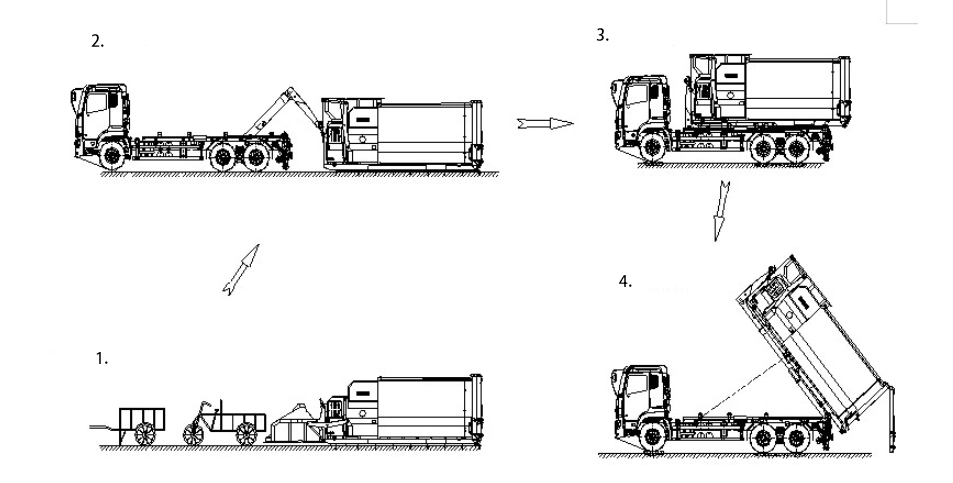
Working PrincipleGarbage collection stage
The small collection vehicle pours loose garbage into the hopper. The overflow guard plate inside the hopper prevents the garbage from spilling out.
When the level sensor detects that the garbage has reached the set height, the compression program is automatically activated.
Compression molding stage
Horizontal type: The hydraulic pump is activated, driving the compression cylinder to push the push plate forward, pushing the garbage in the hopper into the compression chamber and performing horizontal compression.
The filtrate generated during the compression process flows into the sewage system through the drainage channel at the bottom of the container, achieving solid-liquid separation.
Storage stage
After compression is completed, the gate opens and the pusher cylinder pushes the push plate to push the compressed garbage blocks into the storage bin.
The push plate retracts, the gate closes, and the compression bin is ready to receive the next batch of garbage, repeating the compression process.
The storage bin can continuously store multiple garbage blocks until it reaches the set capacity.
Transit stage
When the storage bin is full of garbage, the control system issues a transit prompt and transfers the garbage to the garbage disposal terminal via the boom truck.
Product ParametersPerformance Parameters | |
Compression | Horizontal |
Waste bin volume (m³) | 6m³, 9m³,12m³ ,15m³ ,18m³,Custom sizes |
Hook centre height (mm) | 1570 |
Density of compressed rubbish block(kg/m³) | 750kg/m³ |
Compression cycle time (s) | 45s |
Max. lifting force of tipping bucket | 1t,1.5t,2t,2.5t,2.5t |
Tipping bucket volume (m³) | 1.5m³,2.5m³,3.2m³,4.1m³,4.1m³ |
Rated power of motor(kW) | 5KW, 5.5KW, 7.5KW |
Machine weight (kg) | 4800kg,5500kg, 6080kg,6580kg, |
Power supply | Local working voltage |
Operation mode | automatic + manual |
Size | 6m³: 4180 * 2440 * 2600 (mm); Tipping bucket falling height 2410mm. 9m³: 5080 * 2440 * 2600 (mm); Tipping bucket falling height 2410mm. 12m³ :4180 * 5280 * 2600 (mm); Tipping bucket falling height 2410mm. |
Support Customization
Intelligent SMART technology

Product Selection Reference FactorsWhen choosing a hydraulic hopper-type waste compression station, the following factors should be comprehensively considered:
Waste characteristics: including the type of waste, moisture content, composition, etc., which affect the compression ratio and equipment selection
Processing scale: select the appropriate model based on the daily processing volume
Site conditions: site area, terrain, groundwater level, etc., determine the installation method and equipment size
Transfer frequency: a high transfer frequency can choose a small-capacity storage bin, while a low transfer frequency requires a large-capacity storage bin
Environmental protection requirements: select appropriate odor removal, noise reduction and sewage discharge configurations according to local environmental protection standards
Budget constraints: comprehensively consider the equipment procurement cost, operation cost and maintenance cost
The Hydraulic Hopper Waste Compaction Station, as the core equipment of the modern waste disposal system, achieves waste reduction through efficient hydraulic compression technology. Combined with the fully enclosed design and intelligent control system, it effectively addresses the problems of low efficiency, high pollution and high cost in the traditional waste collection and transportation process.
We are a professional manufacturer of sanitation machinery, providing customers with ex-factory prices and on-demand customization services. You can contact us via WhatsApp or email.


