


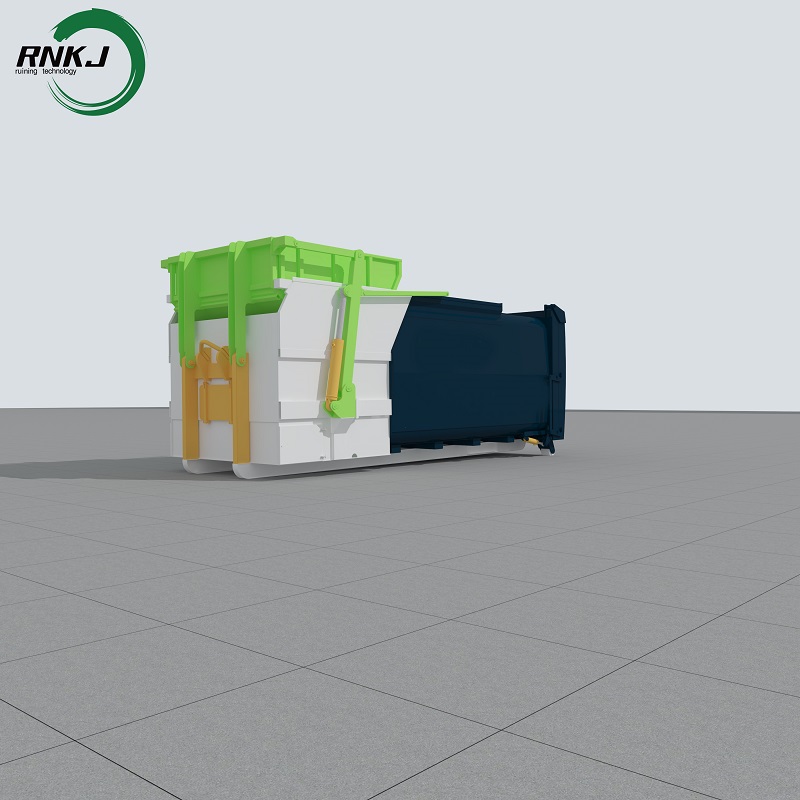

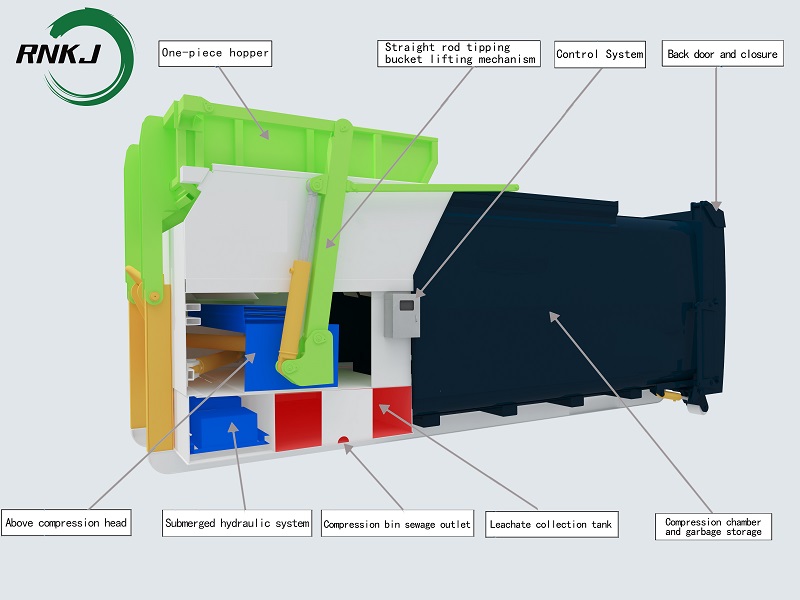


The High Capacity PLC Controlled Hopper Waste Compactor is a heavy-duty waste handling solution designed for commercial facilities, industrial sites, municipal waste transfer points, residential communities, and other locations where large volumes of waste need to be collected and compacted efficiently.
This Hopper Waste Compactor combines a large-capacity feeding hopper, hydraulic compression technology, PLC-based control, and a transportable waste container into one integrated system. Compared with conventional waste containers that simply store loose garbage, the compactor continuously reduces waste volume before transportation, allowing more waste to be handled in each collection cycle.
The equipment shown in the image features a spacious front hopper for convenient waste loading and a compacting unit positioned behind the feeding area. After the container reaches its designed loading level, the entire unit can be lifted and transported using a hook lift truck, making it suitable for flexible waste transfer operations without requiring a fixed waste transfer building.
 What Is a Hopper Waste Compactor?
A Hopper Waste Compactor is a mechanical waste compaction system that receives waste through a large hopper and uses a hydraulic compression mechanism to push and compact the material into a storage container.
Unlike bucket-type compactors designed primarily around garbage-bin lifting, a hopper configuration provides a direct and spacious feeding area. Waste can be loaded by workers, carts, small collection vehicles, or other suitable handling equipment according to the project requirements.
The basic operating concept is simple:
Waste Loading → Hopper Feeding → Hydraulic Compression → Waste Storage → Full-Load Transportation
By compacting waste before transportation, the system helps improve container utilization and reduce the frequency of waste collection trips.
The main advantage of this High Capacity Hopper Waste Compactor is its ability to handle continuous waste input in environments where ordinary garbage bins or open containers may become full quickly.
The large hopper provides a convenient loading area, while the hydraulic compaction mechanism moves waste into the container and compresses it. This allows the available container volume to be used more effectively.
The system can be configured according to the customer's required capacity, waste type, loading method, vehicle dimensions, and site conditions. Different container capacities and hopper dimensions can be considered for municipal, commercial, industrial, and institutional waste management projects.
Typical applications include:
Municipal solid waste collection
Residential community waste transfer
Commercial property waste management
Shopping malls and supermarkets
Industrial parks
Factories and manufacturing facilities
Logistics and distribution centers
Hotels and large commercial complexes
Schools and universities
Hospitals and public institutions
Waste transfer stations
High-volume commercial waste collection points
The PLC control system is an important part of the equipment. PLC-based control allows the operating sequence of the hydraulic compaction system to be managed in a structured and reliable way.
Depending on the configuration, the control system can coordinate functions such as:
Hydraulic compaction cycles
Ram forward and return movement
Automatic operating sequences
Equipment start and stop functions
Safety interlocks
Operating status monitoring
Fault and abnormal-condition indication
Manual and automatic operating modes
The PLC system can also be configured according to the customer's operating requirements. This makes the PLC Controlled Hopper Waste Compactor easier to integrate into different waste collection and transfer processes.
Compared with a purely manual hydraulic operating system, PLC control provides better consistency in repeated compaction cycles and can simplify daily operation for waste management personnel.
Heavy-Duty Hydraulic CompactionHydraulic power provides the main force required for waste compression.
During operation, the hydraulic cylinder drives the compaction mechanism forward, pushing loose waste from the hopper into the storage container. As additional waste enters the system, the compaction cycle can be repeated to progressively utilize the available container space.
The hydraulic system is designed for repeated working cycles and can be selected according to the waste characteristics and required operating frequency.
For projects handling mixed municipal waste, commercial refuse, packaging materials, lightweight industrial waste, and other compressible solid waste, hydraulic compaction can significantly improve the efficiency of the overall collection process.
Large Hopper for Convenient Waste LoadingThe hopper is one of the most distinctive features of this Hopper Waste Compactor.
Its wide and open loading structure provides a practical interface between the waste generation point and the compaction equipment. Instead of manually placing individual bags into a small garbage bin, operators can feed larger quantities of waste into the hopper.
The hopper can be adapted to different loading methods depending on the project. For example, waste may be transferred into the hopper using:
Manual loading
Waste carts
Garbage bins
Small collection vehicles
Material handling equipment
Other compatible loading equipment
The loading height, hopper dimensions, opening size, and feeding configuration can be customized based on the actual site layout.
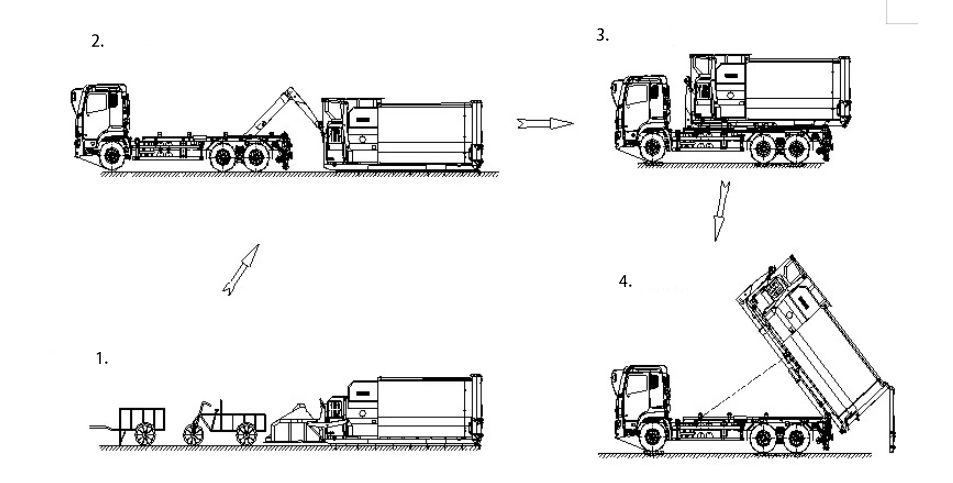
Hook Lift Truck TransportA major feature of this mobile waste compaction solution is the hook lift truck transport system.
Once the storage container reaches the required filling level, the complete compactor unit can be handled by a compatible hook lift truck. The truck lifts the unit from the ground and transports it to the designated waste treatment, transfer, or disposal facility.
This transportation method provides several practical advantages.
The compactor does not need to remain permanently installed at one location. It can be positioned at different waste collection points according to operational requirements.
The hook lift truck handles the lifting and transportation process, reducing the need for manual movement of a heavy waste container.
Because the waste is already compacted before transportation, the transport vehicle can move a greater amount of waste per trip compared with transporting the same material in a loose condition.
The standardized hook lift interface makes the equipment suitable for waste management fleets already using hook lift trucks, subject to matching vehicle and equipment specifications.
How the Hopper Waste Compactor WorksThe working process of the High Capacity Hopper Waste Compactor can be divided into several stages.
Waste is deposited into the large front hopper. The hopper provides sufficient space for continuous loading during normal operation.
The hydraulic compaction mechanism begins its operating cycle and moves the waste from the hopper toward the storage container.
The compaction ram applies hydraulic force to compress the waste. Loose materials are pushed together, reducing the amount of empty space between individual waste items.
After completing the compression stroke, the ram returns to its original position and prepares for the next cycle.
As more waste enters the hopper, the compression process is repeated. This allows the container to be filled more efficiently.
When the container reaches its planned loading capacity, the compaction operation is stopped and the unit is prepared for transportation.
A compatible hook lift truck engages with the compactor container and transports the entire unit to the next destination, such as a transfer station, recycling facility, waste treatment plant, or disposal site.
Key Product FeaturesThe spacious hopper and large storage container are designed for locations generating significant quantities of waste.
The PLC control system provides coordinated operation of the hydraulic compaction cycle and helps simplify equipment management.
Hydraulic compression provides strong and repeatable compaction performance for a wide range of general solid waste materials.
The complete unit is designed for transportation by hook lift truck, providing greater flexibility for waste transfer operations.
The compaction and storage components form an integrated mobile waste handling solution that can be moved when necessary.
The large hopper makes it easier to transfer waste from different collection sources into the compaction system.
Capacity, hopper dimensions, hydraulic specifications, control functions, container configuration, and other technical parameters can be adjusted according to project requirements.
The hydraulic compaction cycle can be repeated as waste is generated, making the system suitable for high-volume waste collection points.
Hopper Waste Compactor vs. Conventional Waste ContainerA conventional waste container mainly provides storage space. Once waste is placed inside, it remains largely uncompacted.
A Hopper Waste Compactor, on the other hand, actively compresses waste during the collection process.
| Feature | Conventional Waste Container | Hopper Waste Compactor |
|---|---|---|
| Waste storage | Yes | Yes |
| Waste compression | No or limited | Hydraulic compression |
| Hopper loading | Usually limited | Large feeding hopper |
| PLC control | No | Available |
| Space utilization | Lower | Higher |
| High-volume waste handling | Limited | Suitable |
| Hook lift transport | Depending on container | Designed for hook lift truck transport |
| Automated compaction | No | Yes |
| Collection efficiency | Standard | Improved |
The right choice depends on waste volume, site conditions, collection frequency, available transportation equipment, and project budget.
Applications in Municipal Waste ManagementMunicipal waste collection is one of the major application areas for a Hopper Waste Compactor.
In residential communities, municipal collection points can generate a large amount of waste every day. A high-capacity compactor can receive waste throughout the collection period, compress it, and store it until transportation is required.
When the unit is full, a hook lift truck can transport it to a municipal transfer station or waste treatment facility.
This creates a practical workflow:
Community Waste Generation → Hopper Loading → Hydraulic Compaction → Temporary Storage → Hook Lift Transportation → Waste Treatment
The system can therefore function as a mobile waste transfer solution without requiring every collection point to have a permanent large-scale transfer facility.
FAQA Hopper Waste Compactor is a hydraulic waste compression machine equipped with a large feeding hopper. Waste is loaded into the hopper and then compressed into a storage container, improving storage and transportation efficiency.
The complete unit is designed to be transported using a compatible hook lift truck. When the container reaches the required loading level, the hook lift truck can lift and transport the compactor to the designated waste treatment or transfer location.
Yes. The system uses PLC-based control to manage the compaction sequence and related operating functions. The control configuration can be customized according to the project requirements.
It is mainly designed for compressible municipal, commercial, household, and general industrial solid waste. Waste containing hazardous, explosive, pressurized, or unsuitable materials should not be loaded unless specifically approved for the application.
Yes. The hopper dimensions, storage capacity, hydraulic system, control configuration, and other components can be customized according to the required waste volume and site conditions.
The High Capacity PLC Controlled Hopper Waste Compactor provides an efficient approach to modern waste collection, compression, storage, and transportation. Its large feeding hopper makes waste loading convenient, while the hydraulic compaction system reduces the volume of compressible waste and improves container utilization.
With PLC-controlled operation and hook lift truck transportation, the system can be integrated into flexible municipal, commercial, and industrial waste management workflows.
For projects requiring a reliable Hopper Waste Compactor, this configuration offers a combination of high-capacity waste handling, automated hydraulic compression, mobile transportation, and customizable engineering. It is particularly suitable for customers seeking to improve waste collection efficiency while reducing unnecessary transportation and manual handling.
We are a professional manufacturer of sanitation machinery, providing customers with ex-factory prices and on-demand customization services. You can contact us via WhatsApp or email.


