



| Quantity: | |
|---|---|
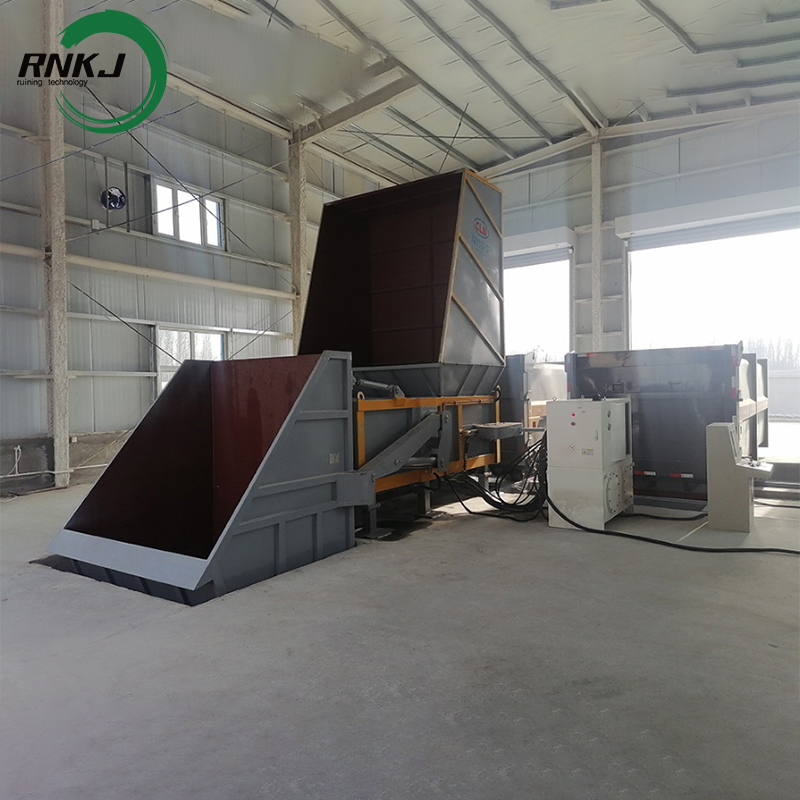
The Heavy Duty Separate-type Waste Compactor Station is a high-capacity waste compression solution designed for municipal sanitation projects, urban waste transfer stations, residential communities, industrial parks, commercial areas, and other locations that generate large volumes of solid waste.
Unlike conventional integrated waste compactors, this system adopts a separate compactor and container design. The waste compression unit remains installed at the transfer station, while the waste container can be detached after filling. Once the waste has been fully compacted and transferred into the container, the container is separated from the compression equipment and directly transported away by a suitable transport truck.
This configuration makes the waste collection, compaction, container exchange, and transportation processes more efficient. Similar stationary compactor systems are commonly designed around a fixed compaction unit and detachable container, allowing the filled container to be removed while the compaction equipment remains in place.
For city sanitation departments and professional waste management contractors, the Separate-type Waste Compactor Station provides a practical way to reduce waste volume, improve transportation efficiency, optimize transfer station space, and support continuous waste collection.
 What Is a Separate-Type Waste Compactor Station?
A Separate-type Waste Compactor Station is a stationary waste compression system consisting primarily of a hydraulic compaction unit, waste feeding hopper, compression mechanism, detachable waste container, hydraulic system, electrical control system, and container positioning or transfer structure.
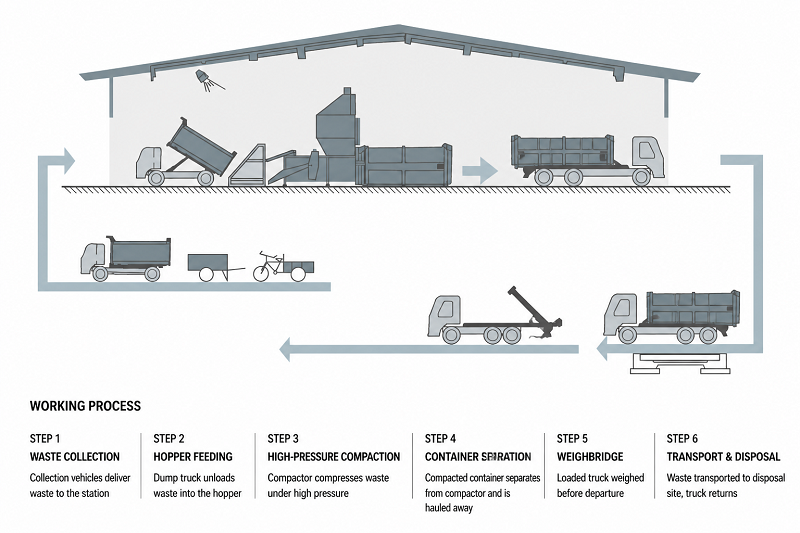
During normal operation, municipal garbage is delivered to the station by collection vehicles, hand carts, electric vehicles, or other waste collection equipment. The waste enters the receiving hopper and is then pushed into the container through a powerful hydraulic compression mechanism.
The compaction process significantly reduces the volume of loose waste before transportation. When the container reaches the required filling level, the connection between the waste compactor and container is released. The filled container is then removed and transported directly to a landfill, incineration plant, recycling facility, or other designated waste treatment center.
The compactor itself remains at the station and can be connected to another empty container for continued operation.
This two-part configuration is also commonly described in the industry as a stationary compactor with detachable container or fixed waste compactor transfer station.
Product Type

Key Features of Separate-Type Waste Compactor StationThe most distinctive feature is the separate configuration.
The compression equipment and waste container work together during the compaction process but can be separated when the container is full.
This design provides greater flexibility than an integrated mobile compactor because the fixed compression equipment does not need to be transported with every load.
After compaction is completed, the filled container can be removed and transported directly by a suitable waste transport truck.
This helps simplify the transfer process and eliminates the need for additional unloading and reloading procedures between the compactor and transportation vehicle.
For city sanitation projects, this can help improve the overall waste transfer workflow.
One of the main reasons to use a Separate-type Waste Compactor Station is to improve transportation efficiency.
Loose waste contains a large amount of empty space. Compression reduces the volume of the waste before it leaves the transfer station.
As a result, a transport container can carry more compacted waste per trip than an equivalent container filled with uncompacted waste.
The EPA's discussion of detachable-container transfer systems also notes that containers can be replaced and transported after being filled, while compaction equipment can be used to increase payload efficiency.
Because waste is compacted before transportation, the amount of waste transported per vehicle trip can increase.
This can potentially reduce:
Number of transportation trips
Fuel consumption
Driver working hours
Vehicle utilization pressure
Road traffic generated by waste collection
Transportation operating costs
Actual savings depend on waste composition, compression ratio, container size, transport distance, vehicle payload limits, and local operating conditions.
A major advantage of the separate-type configuration is that the compression station can remain at the site.
When the full container is removed, an empty container can be connected to the compression unit.
This makes it possible to establish a continuous workflow:
Waste Collection → Waste Feeding → Hydraulic Compression → Container Filling → Container Separation → Truck Transportation → Empty Container Replacement → Continued Compression
With multiple containers available, the station can maintain a relatively continuous waste reception process.
The system uses a hydraulic drive mechanism to provide the force required for waste compression.
The hydraulic system can be configured for heavy-duty municipal sanitation applications and frequent operating cycles.
A hydraulic control system also allows the compression movement to be controlled according to the operating requirements of the station.
The Heavy Duty Separate-type Waste Compactor Station is particularly suitable for locations where waste generation is relatively high.
Typical applications include:
Municipal sanitation projects
Urban waste transfer stations
City garbage collection centers
Residential community waste stations
Large residential developments
Industrial parks
Commercial districts
Shopping centers
Markets
Hospitals
Hotels
Logistics centers
Airports
Railway stations
Public facilities
Large institutions
Stationary compactors with detachable containers are also commonly applied in commercial, industrial, institutional, transportation, and municipal waste management environments.

Main Components of Separate-Type Waste Compactor StationThe compression unit is the core operating component of the station.
It includes the compression chamber, hydraulic cylinders, push head, guide structure, and associated mechanical components.
Its primary function is to compress incoming waste and push it into the detachable container.
The receiving hopper provides the waste loading area.
It can be designed according to the type of waste collection vehicle and feeding method used at the project site.
The hopper can receive waste from small sanitation vehicles, carts, bins, or other collection equipment.
The hydraulic system provides the power required for the compression cycle.
It generally includes hydraulic pumps, hydraulic cylinders, valves, pipelines, hydraulic oil tank, and related components.
The hydraulic system is designed to deliver controlled and reliable compression force for repeated operation.
The container is the storage and transportation component of the system.
After waste is compacted, it is transferred into the container. Once the container reaches its working capacity, it can be disconnected from the compression unit and transported away.
The container capacity, dimensions, lifting structure, rear door, sealing structure, and transportation interface can be customized according to project requirements.
A reliable connection mechanism is important because the container and compression unit must remain securely connected during compression.
The connection structure can also help reduce waste leakage and prevent unwanted movement during operation.
Proper sealing between the compactor and container is an important consideration for municipal waste transfer applications.
The electrical control system manages the operating sequence of the equipment.
Depending on the configuration, the system can include:
Control cabinet
PLC control
Emergency stop system
Hydraulic controls
Safety sensors
Limit switches
Operation buttons
Container positioning detection
The control system can be customized according to the automation requirements of the project.
How Does the Heavy Duty Separate-Type Waste Compactor Station Work?The operating process is designed to simplify municipal waste collection and transportation.
Household garbage, commercial waste, industrial non-hazardous waste, or other municipal solid waste is collected from different areas and transported to the waste compactor station.
Depending on the project, waste can be delivered by:
Small garbage collection trucks
Electric sanitation vehicles
Hand carts
Three-wheel collection vehicles
Municipal waste collection vehicles
Garbage bins with lifting equipment
Manual feeding systems
The receiving hopper provides a centralized point for waste unloading.
After the waste enters the hopper, the hydraulic system activates the compression mechanism.
The waste is pushed toward the container through a controlled compression cycle. The compaction chamber and hydraulic push head are designed to handle repeated heavy-duty operation.
The hydraulic compression mechanism applies strong pushing force to reduce the volume of waste.
Compared with transporting loose garbage directly from a collection point, compacted waste occupies considerably less space. This allows more waste to be loaded into each transport container and can reduce unnecessary transportation trips.
Transfer-station systems using detachable containers are specifically intended to compact municipal solid waste into larger transportable containers before long-distance transportation.
The compacted waste is continuously transferred into the waste container.
The container acts as the final collection and transportation unit for the compressed waste. Its structure can be designed according to the customer's transportation method, container capacity, loading requirements, and local vehicle standards.
When the container is full, the container is separated from the compression unit.
This is one of the most important characteristics of the Separate-type Waste Compactor Station.
Instead of transporting the entire compaction machine, only the filled container needs to be removed from the station.
After separation, the full container is picked up and transported directly by the corresponding transport truck.
Depending on the project configuration, the container can be designed for hook-lift, roll-on/roll-off, or other compatible container transportation systems.
This operating principle is widely used in fixed compactor transfer stations, where only the filled detachable container travels to the disposal facility while the compaction unit remains at the station.
An empty container can then be positioned and connected to the compactor.
The station can continue receiving and compacting waste without waiting for the previously filled container to return.
For high-volume municipal sanitation projects, multiple containers can be prepared so that one container is being transported while another is connected to the compactor.
Product ParametersPerformance Parameters | |
Equipment Model | ZYG-15/17/20 |
Compacted Density (t/㎡) | ≥0.75 |
Motor Power (kW) | 11/15/22 |
Hydraulic System Set Pressure (MPa) | 16~20 |
Case Volume (㎡) | 15/17/20 |
Power Supply (V) | 380v, 3-phase, 50HZ |
Why Choose a Separate-Type Waste Compactor Station?The system combines waste collection, compression, storage, and transportation into a coordinated workflow.
Waste is compressed before transportation, making better use of container capacity.
The filled container can be removed without moving the entire compaction system.
An empty container can then be connected to the fixed compactor.
This provides greater operational flexibility and can reduce downtime.
The transportation truck does not need to carry the stationary compression equipment.
It is primarily responsible for transporting the filled container.
This makes the transportation process more focused on container movement and waste disposal.
For city sanitation departments managing multiple collection areas, the Separate-type Waste Compactor Station can serve as a centralized transfer point between small collection vehicles and long-distance waste transportation.
Small vehicles can make short collection routes, while larger transport vehicles move compacted waste from the station to the final treatment facility.
This separation between collection and long-distance transportation is one of the fundamental concepts behind modern waste transfer stations.
Separate-Type Waste Compactor Station vs. Integrated Waste Compactor| Feature | Separate-Type Waste Compactor Station | Integrated Waste Compactor |
|---|---|---|
| Compactor and container | Separate | Integrated |
| Compactor transportation | Remains at station | May move with container |
| Filled container | Removed separately | Entire unit may be transported |
| Container replacement | Easy to configure | Less flexible |
| Continuous operation | Excellent with multiple containers | Depends on equipment configuration |
| Suitable application | Transfer stations and high-volume projects | Mobile collection and flexible locations |
| Transportation method | Container transported by suitable truck | Complete compactor or mobile unit transported |
| Stationary installation | Yes | Usually mobile or transportable |
The separate configuration is particularly advantageous when the project requires a fixed compaction station and independent container transportation.
Application in City Sanitation ProjectsFor large cities, municipal waste is generated continuously across residential, commercial, industrial, and public areas.
Sending small collection vehicles directly to distant disposal facilities can result in inefficient vehicle utilization.
A Heavy Duty Separate-type Waste Compactor Station can be positioned as an intermediate transfer point.
Small collection vehicles deliver waste to the station. The waste is compressed into large containers. Once the container is full, it is separated from the compactor and transported by a larger suitable truck.
This creates a practical collection–transfer–transport–disposal system.
It is especially useful when the distance between the waste collection area and final treatment facility is relatively long.
Customizable Waste Compactor Station SolutionDifferent city sanitation projects have different requirements.
The Separate-type Waste Compactor Station can be customized according to:
Waste generation volume
Required container capacity
Daily waste throughput
Compression requirements
Available installation area
Collection vehicle type
Transportation truck type
Container lifting method
Electrical power supply
Local environmental requirements
Automatic or semi-automatic operation
Site access conditions
Optional equipment can include container transfer systems, bin lifters, feeding hoppers, safety sensors, automatic controls, drainage systems, and other accessories.
For larger projects, a two-container arrangement can be considered so that one filled container can be transported while another empty container remains available for the compactor. This operating concept is already used in stationary compactor transfer systems to maintain continuous waste reception.
FAQFlexible site selection, easy bin replacement, convenient maintenance, and low requirement for foundation pit construction.
Mainly for domestic solid waste, municipal household garbage; not suitable for hazardous waste, corrosive and high‑moisture industrial waste.
After compression, the whole waste bin can be detached and transported by special garbage truck, no secondary loading needed.
Separate‑type separates compactor and bin for quick bin swap; integrated type is all‑in‑one unit with fixed container, less flexible for multi‑bin operation.
Yes. One hydraulic compaction unit can be paired with multiple detachable containers. While one container is being transported or unloaded, another empty container can be connected immediately, ensuring continuous operation and maximizing equipment utilization.
Check hydraulic system oil leakage, lubricate moving parts, clean sealing surfaces, inspect electrical control components regularly.
The Heavy Duty Separate-type Waste Compactor Station is designed for modern municipal waste transfer and sanitation operations where efficient compression, flexible container handling, and reliable transportation are important.
Its key advantage is the separation of the compression unit and waste container. After the garbage has been compressed and the container is filled, the container can be separated from the compression equipment and directly transported away by a suitable waste transport truck, while the fixed compression unit remains at the station.
With an appropriate empty-container replacement strategy, the station can continue receiving waste while the filled container is being transported to the final treatment facility.
For city sanitation departments, municipal waste management contractors, waste transfer station operators, industrial parks, residential developments, and other high-volume waste generators, this configuration provides a practical way to build a more efficient waste collection and transportation workflow.
If your project requires high-capacity waste compression, detachable container transportation, continuous waste transfer, and customized municipal sanitation equipment, the Separate-type Waste Compactor Station can be configured according to the site's waste volume, vehicle type, container capacity, and transportation requirements.
We are a professional manufacturer of sanitation machinery, providing customers with ex-factory prices and on-demand customization services. You can contact us via WhatsApp or email.


