




| Quantity: | |
|---|---|
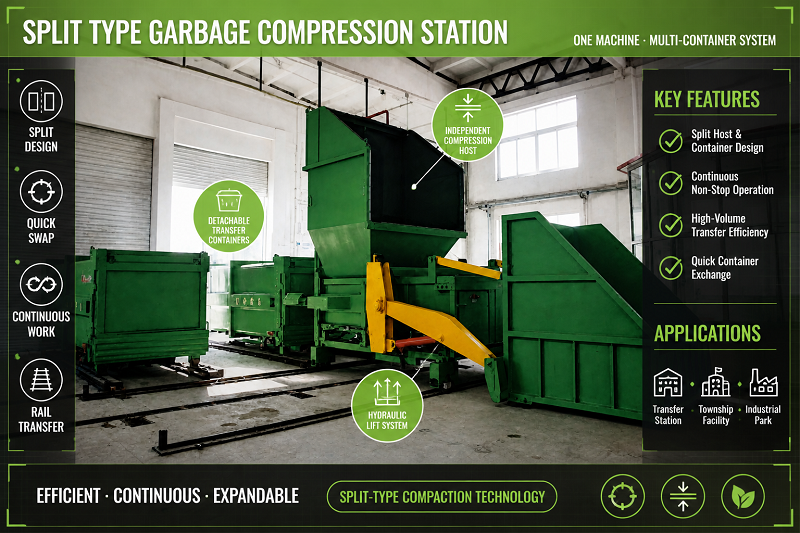
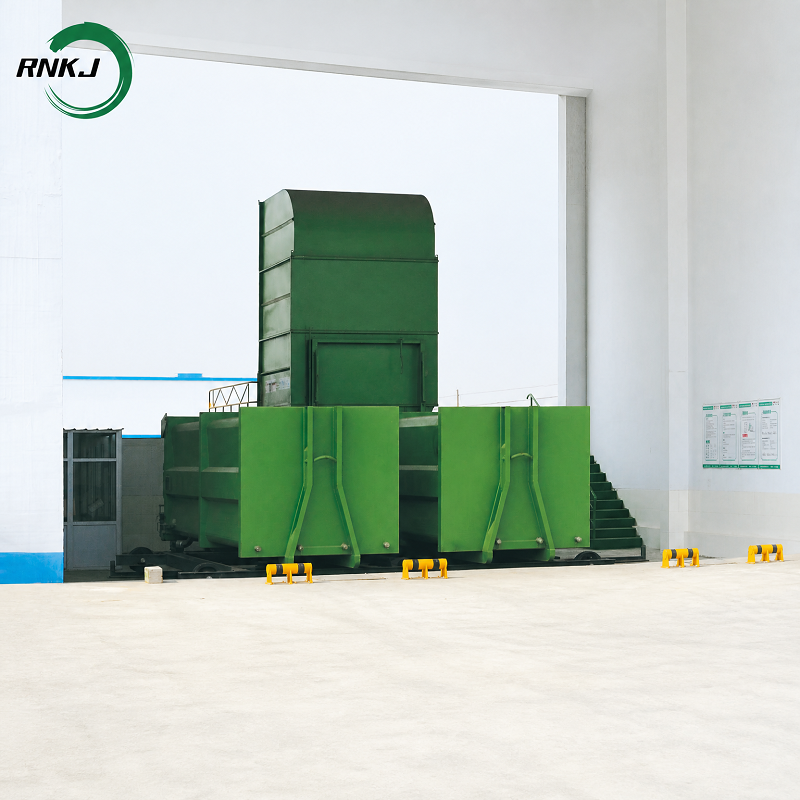
Our 8m³ hydraulic high‑compression mobile split‑type garbage compression station is a professional waste transfer solution engineered for municipal sanitation, town‑level waste transfer stations, large communities, industrial parks and commercial districts. Unlike all‑in‑one mobile compactors where the whole machine must stop for transportation, this split‑layout design keeps the heavy‑duty compression host firmly fixed on‑site. Only the filled 8‑cubic‑meter waste container gets swapped out and hauled away by hook‑lift trucks. This architecture eliminates long‑downtime interruptions and enables non‑stop waste receiving and compaction work shifts.
 Product Type

Core Mechanical StructureThis is the power‑compression heart of the station, bolted onto concrete foundation with rail guiding bases. It never shifts position during container replacement procedures.
Tipping Feeding Hopper & Lifting Arm: The large‑volume tipping skip accepts waste from small collection trucks, hand‑cart and bicycle‑mounted waste trolleys. Hydraulic lifting arms tip loose refuse into the compression chamber, realizing ground‑level feeding without high‑platform modification. Waste dumping happens smoothly with low noise and low spill‑over risk.
High‑force Hydraulic Compression Ram Assembly: Heavy‑duty horizontal push ram driven by industrial hydraulic station delivers strong compression force. It squeezes loose household waste repeatedly, squeezing out air and leachate. Waste bulk volume can be reduced to 1/3‑1/5 of original loose volume, compaction density reaches 0.8‑1.0 t/m³. Thickened wear‑resistant steel plates cover ram surfaces and compression chamber walls to extend service life under heavy‑load continuous operation.
Hydraulic Locking & Docking Mechanism: Precision hydraulic lock latches tightly connect the compactor outlet face with mobile container inlet. It ensures zero gap during compression cycles to prevent waste overflow and sewage leakage. When one container reaches full load, hydraulic latches unlock automatically for container separation. Built‑in guiding rails guarantee accurate repeated docking every time a new empty container slides into position.
PLC Automatic Control Cabinet: Supports full‑auto cycle, semi‑manual and manual operation modes. It integrates full‑load alarm, fault self‑diagnosis, interlock safety protection for all hydraulic actions. Operators monitor status via touch‑screen panel; no complex specialized skills required for daily running. Optional remote monitoring interface is available for site management teams.
Leachate Collecting System: Liquid waste generated during compression gets collected inside container base. Sewage travels together with the container during transportation, no on‑site sewage drainage required for the compression host itself, simplifying station civil‑work construction.
All‑sealed box body construction prevents odor escape and waste spillage in transit. Reinforced frame and hook‑lift lifting points are built to match standard hook‑lift garbage trucks. Once filled, hook‑lift vehicles directly pick up the full container and carry it away. An empty spare container rolls into position and locks to the compactor immediately afterward.
Multiple‑container configuration is flexible: you can match 2‑4 containers for one compression host according to your daily waste volume. One container is under compaction on‑site, others are out for transportation or waiting as standby units.
Step‑by‑Step Working ProcessWaste Feeding: Small waste collection vehicles, waste trolleys back up to the tipping skip. Waste is unloaded into the feeding hopper. Hydraulic lifting arm tilts the skip and dumps refuse into the compression chamber.
Hydraulic Compression Cycle: Horizontal compression ram pushes waste continuously into the docked mobile container. Air and leachate are squeezed out during repeated pressing cycles.
Full‑load Prompt: When the 8m³ container reaches preset filling threshold, the system triggers full‑load alarm signal. Compression movement halts automatically.
Container Separation (Compactor Host Stays Fixed): System closes intermediate gate between compactor and container. Hydraulic locking latches release. The full container slides out along guiding rails.
Full‑box Transportation: Hook‑lift truck arrives, hooks and lifts the loaded container, transports it to waste disposal facilities for dumping.
Swap Empty Container: A spare empty mobile container slides along rails into working position. Hydraulic docking latches lock tightly between fixed compactor and new empty container. The station resumes waste receiving and compression work right away, no waiting for truck return.
This workflow realizes parallel operations: waste compression on‑site and container transportation off‑site run simultaneously, instead of sequential stop‑and‑wait patterns seen on integrated mobile compactors.
Key Advantages of Fixed‑Host & Swappable‑Container DesignMinimize Operational Downtime: The compression unit stays installed permanently. Only containers are swapped. Waste receiving never stops while full bins are hauled away. Compared with one‑piece mobile compactors which halt entirely during transit, overall daily throughput increases significantly.
Lower Total Ownership Cost: Purchase one heavy‑duty compression host, pair it with several lower‑cost mobile containers. You avoid buying multiple expensive full compression machines. Hook‑lift trucks only need to transport empty/full containers instead of heavy whole compactor units, cutting fuel consumption and vehicle wear‑and‑tear.
Excellent Environmental Performance: Fully sealed feeding‑compression‑storage‑transport chain. Waste leachate stays inside containers and gets transported together, no scattered sewage pollution on transfer‑station floors. Optional spray deodorization system can be integrated on request.
Robust Durability: High‑load compression host stays stationary. No frequent moving‑vibration damage to hydraulic pumps, motors and electrical components. Only lightweight containers do moving trips, greatly extending core‑equipment service lifespan.
Flexible Site Adaptation: Suits newly‑built or renovated waste transfer stations. It can be installed in indoor workshops as shown in project drawings. It works for small‑town transfer stations, residential‑cluster waste hubs and industrial‑zone waste processing points. Civil‑work requirement is moderate, only need reinforced concrete foundation and simple ground rails.
Simple Maintenance: Main wearing‑parts concentrate on stationary compression host. Maintenance teams can service the host on‑site without disconnecting or moving heavy compression assemblies. Containers are interchangeable; damaged single container can be repaired or replaced individually without shutting down the whole station.

Typical Application ScenariosMunicipal & township waste transfer stations
Large residential communities, new town districts
Industrial parks, logistics zones, large commercial complexes
Tourist scenic spots, hospital campuses and large‑scale comprehensive waste‑collection hubs
Technical Reference Specs| Item | Parameter |
|---|---|
| Effective Container Volume | 8 m³,Customized |
| Compression Force | Customized heavy hydraulic thrust |
| Container Type | Hook‑lift compatible swappable mobile bin |
| Control Mode | PLC automatic / manual dual‑mode |
| Feeding Method | Hydraulic tipping skip feeding |
| Core Unit Status | Compression host fixed on‑site; containers detachable & swappable |
| Matching Vehicle | Standard hook‑lift garbage truck |
| Compaction Density | 0.8‑1.0 t/m³ ,Customized |
Why Choose an 8m³ Hydraulic High Compression Mobile Split Type Garbage Compression Station?Compared with conventional stationary or integrated waste compactors, this split type solution provides greater operational flexibility.
Operators can prepare multiple detachable containers according to daily waste generation. While one container is being transported for disposal, another empty container is immediately installed, allowing the hydraulic compaction unit to continue working without interruption. This rotating container system is particularly suitable for locations where waste collection cannot be paused during transportation.
The fixed hydraulic unit also reduces maintenance frequency because hydraulic hoses, electrical cables, and control systems remain connected at all times. As a result, the equipment achieves higher reliability and lower long-term operating costs.
Optional ConfigurationsWe support tailored modification for hopper height, rail dimension, hydraulic pressure and auxiliary functions such as deodorizing spraying, leachate treatment unit according to your local site layout, daily waste output and hook‑lift truck models. Our engineering team provides site‑layout drawing guidance, installation guidance and after‑sales support for overseas clients.
To meet different project requirements, the equipment can be customized with various options:
Container capacities from 8m³ to 20m³
PLC automatic control system
Remote control operation
Automatic hopper cover
Leachate collection system
Odor control spraying system
Automatic weighing system
Full container alarm
Stainless steel hopper
Customized operating voltage
Multi-language control interface
Why Choose Our Customized Industrial Hydraulic Split Type Garbage Compactor?Compared with conventional waste collection equipment, a Split Type Garbage Compactor provides:
High waste compression ratio
Continuous operation without downtime
Lower transportation costs
Reduced labor requirements
Better environmental protection
Higher equipment utilization
Longer service life
Lower maintenance costs
Flexible container replacement
Excellent return on investment
It is an ideal solution for modern municipalities, industrial facilities, and commercial waste management projects.
FAQA split type garbage compression station separates the hydraulic compaction unit from the waste container. The compression equipment stays permanently installed, while only the filled container is transported and replaced with an empty one.
The loaded container is removed using a hook lift truck, allowing quick replacement without moving the hydraulic compression unit.
Yes. One hydraulic compression station can operate with multiple interchangeable containers, greatly improving operational efficiency.
The system is suitable for municipal solid waste, commercial waste, packaging waste, household refuse, market waste, and many other types of non-hazardous solid waste.
Yes. The hydraulic system is designed for intensive daily operation and is ideal for high-volume waste transfer applications.
We are a professional manufacturer of sanitation machinery, providing customers with ex-factory prices and on-demand customization services. You can contact us via WhatsApp or email.


