
Views: 0 Author: Site Editor Publish Time: 2026-09-21 Origin: Site


Escalating commercial waste hauling costs constantly drain facility budgets. High-volume operations face severe bottlenecks when waste processing systems fail to keep up. Choosing standard equipment for heavy industrial applications introduces massive operational risks. You risk frequent mechanical failures. You face hazardous liquid leakage. Suboptimal compaction ratios fail to reduce your hauling frequency.
Under-specifying your waste management equipment directly impacts your daily productivity. A rigorous, specification-driven evaluation process is mandatory. You must match hydraulic capabilities to your specific waste profile. Structural integrity must withstand continuous daily abuse. Site constraints must align perfectly with operational realities. Selecting the right heavy duty mobile waste compactor requires analyzing engineering data, not just standard brochures. This guide breaks down the critical technical criteria buyers must evaluate to ensure long-term reliability and maximum hauling efficiency.
Waste Profile Dictates Design: The choice between standard and high-compression models depends entirely on the ratio of wet to dry waste and the material's structural memory.
Site Constraints are Non-Negotiable: Accurate measurement of loading docks, overhead clearance, and hauler access lanes is a prerequisite before reviewing equipment specifications.
Condition and Sourcing Matter: Weighing a new custom build against a used or refurbished unit requires careful analysis of warranties, expected lifespan, and immediate ROI.
Manufacturer Support is Critical: Partnering with a reliable mobile waste compactor manufacturer ensures access to replacement parts, technical support, and compliance with regional safety standards.
You must conduct a comprehensive waste audit before evaluating equipment. Guessing your daily tonnage leads to undersized machines and overflowing docks. Track your daily and weekly volume outputs accurately. Measure peak disposal times to understand throughput requirements. Categorize your waste streams into dry, bulky materials and wet, organic waste.
Follow these steps to execute a baseline waste audit for your facility:
Weigh all outgoing waste containers over a 14-day period to establish an accurate daily average.
Log the exact times of day when waste generation peaks, such as shift changes or post-production cleanups.
Calculate the percentage of wet organic matter versus dry recyclable material in your standard load.
Identify any oversized or highly rigid items that require specialized hopper dimensions to prevent bridging.
Dry materials like cardboard, wooden pallets, and heavy plastics possess high structural memory. They require prolonged hydraulic pressure to remain crushed. Wet waste from food processing, hospitals, or hospitality generates heavy, liquid-dense loads. Your waste profile directly dictates the equipment architecture. Static units bolt permanently to a concrete pad. They detach from the receiver box during hauling. These suit high-volume dry waste perfectly. Mobile units fuse the compactor and receiver into one seamless container. This design is mandatory for wet waste applications. It relies on liquid-tight seals and specialized drainage ports to prevent environmental contamination.
| Feature | Static (Stationary) Compactor | Mobile (Self-Contained) Compactor |
|---|---|---|
| Best Waste Type | Dry waste, cardboard, plastics, pallets | Wet waste, food organics, mixed municipal |
| Liquid Retention | Low (seams between unit and box can leak) | High (100% liquid-tight welded construction) |
| Hauling Process | Only the receiver box is hauled away | The entire unit (compactor + box) is hauled |
| Footprint Requirement | Requires longer permanent installation space | Compact footprint, highly versatile placement |
Installation requires precise site engineering. You need a reinforced concrete pad rated for at least 4,000 PSI to handle heavy industrial loads. The pad must support the combined weight of the compactor, the compacted waste, and the hauling truck. A standard 6-inch depth with a heavy rebar grid is the minimum requirement for industrial applications. Anything less will crack under the repetitive stress of roll-off trucks dropping heavy steel containers.
Overhead clearance is a strict constraint. Roll-off trucks require 20 to 25 feet of vertical clearance to deploy their hoist rails safely. You must also calculate the turning radius for the hauler's fleet to ensure seamless access. Tight alleys or enclosed loading bays often require custom guide rails to force the truck into the correct alignment.
Align the equipment specifications with your local waste hauler. Verify the receiver type required by their trucks. Most fleets use cable hoist systems, but hook-lift setups are increasingly common. Mismatched receiver hardware causes immediate installation failures. High-traffic loading zones require strategic placement. You must plan container swap logistics to minimize operational downtime during peak business hours.
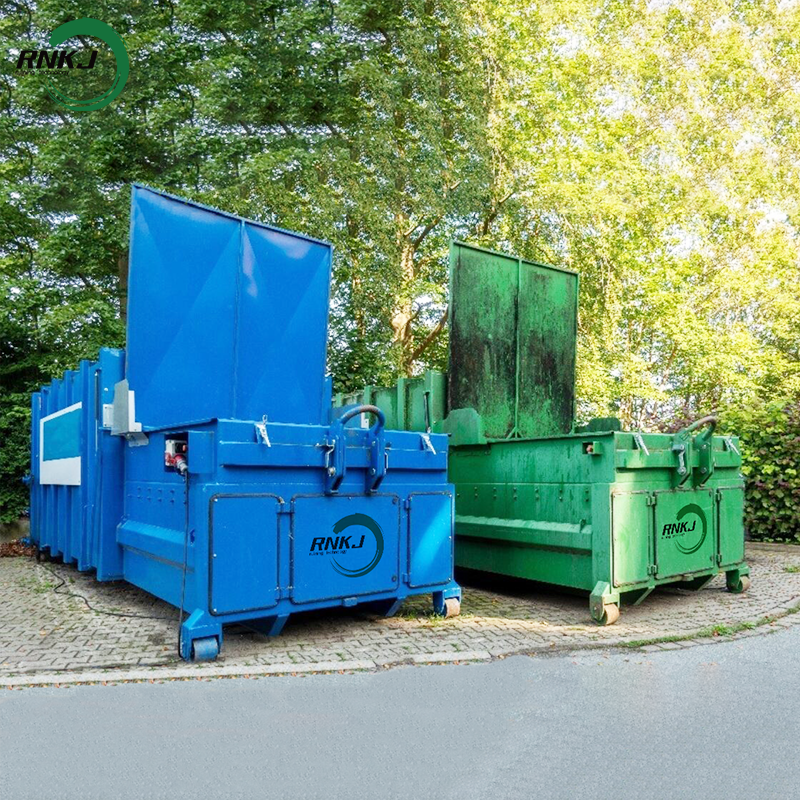
Compaction ratios dictate your hauling frequency. A standard 4:1 ratio means four cubic yards of loose waste compress into one cubic yard. Higher ratios translate directly to fewer hauler pickups and massive operational savings. Evaluating a high compression heavy duty waste compactor requires analyzing the hydraulic cylinder bore size. Larger cylinders generate exponentially more crushing force.
Review the operating pressure specifications closely. Normal operating pressure handles daily loads. Maximum hydraulic force engages when crushing highly resistant materials. Operating constantly at maximum force accelerates motor burnout and degrades hydraulic seals. You want a system that achieves your target compaction ratio while running comfortably at normal pressure. Deep ram penetration into the receiver box is also critical. It prevents compressed materials from springing back into the charge chamber.
| Hydraulic Metric | Standard Duty | Heavy Duty Industrial |
|---|---|---|
| Cylinder Bore Size | 4 to 5 inches | 6 to 8 inches |
| Normal Operating Pressure | 1,500 to 1,800 PSI | 2,000 to 2,500 PSI |
| Maximum Force | 35,000 to 45,000 lbs | 60,000 to 90,000+ lbs |
| Ram Penetration | 6 to 10 inches | 12 to 18 inches |
Equipment sizing must match your waste generation rate. A 12 CBM industrial mobile compactor serves as an excellent baseline for mid-to-high volume commercial applications. It offers a strong balance between footprint size and waste capacity.
Hopper design impacts labor efficiency heavily. Ground-fed hoppers require manual lifting or automated cart tippers. Dock-fed designs allow seamless horizontal loading from warehouse floors. Walk-on or drive-on enclosures suit specialized industrial setups where forklifts dump hoppers directly into the charge box.
The charge box capacity determines how much waste you can load per cycle. Large, bulky waste requires a wider hopper opening to prevent bridging. Bridging occurs when materials jam above the ram, halting operations. Calculate your required throughput in cubic yards per hour. Ensure the machine can process your peak volume without causing loading delays.
Cycle time measures how long the ram takes to complete one full forward and reverse stroke. Standard cycle times range from 30 to 45 seconds. Faster cycles improve labor efficiency. Operators spend less time waiting to load the next batch. Continuous loading capabilities depend heavily on this metric.
Electrical requirements demand strict attention. Heavy-duty applications require 3-phase power. Single-phase motors lack the torque necessary for high-compression tasks. Verify your facility's voltage configurations. Most industrial sites run on 208V, 230V, or 460V systems. Motor horsepower standards vary based on the application. A 10 HP motor suits standard operations. A 15 HP or 20 HP motor is necessary for extreme industrial environments processing rigid materials.
Structural engineering determines equipment longevity. Look for Abrasion Resistant (AR) steel plates in high-wear zones like the floor and ram face. AR400 or AR500 steel withstands the constant scraping of abrasive materials. Standard mild steel warps under continuous heavy loads. Floor thickness should exceed standard commercial grades. Demand continuous welding techniques. Spot welding leaves micro-gaps that eventually fracture under hydraulic stress.
Outdoor installations face brutal environmental degradation. Weather-resistant coatings are non-negotiable. Inspect the primer types used by the manufacturer. Zinc-rich epoxies provide superior rust inhibition. Marine-grade polyurethane finishes protect the steel from UV damage and corrosive waste liquids. Proper weatherproofing prevents premature structural failure.
Handling wet waste requires a 100% liquid-tight mobile trash compactor. Liquid leakage creates slip hazards and attracts severe regulatory fines. The engineering relies heavily on the rear door seal. P-shaped neoprene seals offer excellent compression recovery. They maintain a tight barrier against liquid egress even after years of use.
Evaluate the heavy-duty ratchets and hinges securing the door. Ratchet binders must pull the door evenly against the seal. Uneven pressure creates leak points. Robust hinge pins prevent the door from sagging over time. Maintaining seal integrity prevents environmental contamination, eliminates pest infestations, and controls aggressive odor leakage.
Operator safety supersedes all other design criteria. Mandatory safety features include multiple emergency stop buttons. Place them within immediate reach of the loading zone. Safety interlock switches on hopper doors cut power instantly if opened during a cycle. Key-operated controls prevent unauthorized personnel from activating the machinery.
Control panel design requires careful evaluation. Ensure the enclosure is NEMA-rated for weatherproofing. NEMA 4 or NEMA 4X enclosures protect against heavy rain, direct hose-downs, and corrosion. Place the panel ergonomically. The operator must have clear visibility of the loading chamber while operating the controls. Verify compliance with OSHA, ANSI, or CE standards based on your geographic region.
Integrating telemetry transforms waste management logistics. Smart monitoring systems track hydraulic pressure spikes. These spikes correlate directly to container fullness. The system transmits this data via cellular networks to a centralized dashboard. Facility managers gain real-time visibility into equipment status.
Automated alerts optimize hauler dispatching. The system sends notifications at 75% and 100% capacity. This eliminates hauling half-empty containers. It also prevents equipment overloading, which causes severe mechanical strain. Smart monitoring reduces unnecessary hauling trips and maximizes operational efficiency.
Standard off-the-shelf models fail to meet complex facility requirements. You must specify a custom heavy duty waste compactor for unique architectural constraints. Non-standard loading dock heights require bespoke hopper engineering. Existing building chutes demand custom transition enclosures to prevent waste spillage. Facilities handling highly organic waste often integrate specialized ozone generators for advanced odor control.
Custom engineering involves trade-offs. Lead times increase significantly. Initial capital requirements are higher. However, bespoke solutions eliminate daily operational friction. They integrate seamlessly into your existing workflow. Evaluate whether a standard model requires expensive facility modifications. If so, a custom-engineered unit is the smarter investment.
Purchasing used or refurbished equipment lowers initial capital expenditure. However, you must analyze the hidden risks. Used models often conceal severe hydraulic wear. Hoses suffer from dry rot. Cylinders develop internal scoring that reduces crushing force. Structural fatigue manifests as wavy floor plates or cracked welds.
Outdated safety compliance is a major liability. Older units may lack modern interlocks or NEMA-rated panels. When assessing a refurbished unit, scrutinize the warranty coverage. Demand a detailed inspection report of the hydraulic power unit. Calculate the expected remaining lifespan. A cheaper used unit that requires constant emergency repairs destroys your operational budget rapidly.
Your relationship with the manufacturer dictates long-term success. Evaluate their years in business and engineering track record. A reputable mobile waste compactor manufacturer provides comprehensive warranty structures. Look for separate coverage terms for parts, labor, and structural integrity. Structural warranties should span several years.
Investigate their local service network. You need rapid access to certified technicians and replacement parts. Equipment downtime paralyzes facility operations. Request case studies or references from clients with similar waste profiles. Verify their ability to deliver on technical promises and post-installation support.
Financial justification relies on calculating precise hauling savings. Document your current monthly hauling costs. Project your future costs based on the new compaction ratio. A 4:1 ratio effectively cuts your hauling frequency by up to 75%. Compare these projected savings against the equipment's capital cost. This formulaic approach reveals the true timeline for breaking even.
Avoid the trap of cheap, under-specced equipment. Low-grade models introduce massive hidden costs. Hydraulic fluid leaks require expensive environmental cleanups. Structural warping demands heavy welding repairs. Excessive downtime forces you to order emergency open-top dumpsters at premium rates. Investing in heavy-duty engineering prevents these catastrophic expenses.
Flawless implementation requires rigorous site preparation. Reinforce the concrete pad to the exact depth specified by the engineering drawings. Route electrical conduits safely away from high-traffic zones. Install steel guide islands. These heavy-duty rails ensure the hauler truck aligns the container perfectly during every swap, preventing damage to the compactor.
Implementation failures stem from poor planning. Underestimating power supply requirements delays commissioning. Ignoring overhead clearance prevents the roll-off hoist from operating. Failing to account for hauler truck alignment angles causes daily logistical nightmares. Double-check every dimension with your hauler and manufacturer before pouring concrete.
A heavy-duty waste compactor is a strategic infrastructure investment. It directly impacts your operational efficiency and environmental compliance. It is never a generic commodity purchase. You must match your waste type to the correct compression and seal specifications. You must verify site dimensions and hauler compatibility rigorously. Evaluate structural durability and hydraulic power to ensure long-term reliability. Decide carefully between new, custom, or refurbished sourcing based on your risk tolerance.
Initiate a formal waste audit to document daily volume, peak times, and wet-to-dry material ratios.
Measure your site footprint, overhead clearance, and turning radii, then share these with your waste hauler.
Request detailed technical drawings and hydraulic specifications from shortlisted manufacturers.
Verify the availability of local service technicians and replacement parts for your chosen equipment.
A: A well-maintained heavy duty mobile garbage compactor typically lasts 10 to 15 years. Lifespan depends heavily on the waste type and preventative maintenance. Highly abrasive or corrosive waste accelerates wear. Regular hydraulic fluid changes and structural inspections extend operational life significantly.
A: Used models offer lower upfront costs but carry hidden risks. You must rigorously check hydraulic health, structural fatigue, and safety compliance. If the refurbished unit includes a strong warranty and passes a certified inspection, it can be a viable option.
A: Heavy-duty industrial compactors require 3-phase electrical power. Common configurations are 208V, 230V, or 460V. You must install a dedicated electrical disconnect switch within the line of sight of the machine to comply with safety regulations.
A: You must specify a self-contained mobile compactor. Ensure it features 100% continuous welding. Verify the rear door uses high-grade P-shaped neoprene seals and heavy-duty ratchet binders to maintain a watertight barrier during operation and transport.
A: Roll-off trucks require significant vertical space to deploy their hoist rails when loading or unloading the container. Most trucks need 20 to 25 feet of overhead clearance. Failing to provide this space makes container swaps impossible.
A: A 4:1 ratio means the machine compresses four cubic yards of loose waste into one cubic yard of space. This drastically increases the amount of material a single container holds, directly reducing the number of hauling trips required.


