
English
Views: 0 Author: Site Editor Publish Time: 2026-11-17 Origin: Site


Waste collection requirements are becoming increasingly diverse across industrial facilities, commercial properties, construction sites, municipal projects, and large public areas. Traditional stationary waste compaction equipment is usually installed at a fixed location, which may limit its flexibility when waste needs to be collected from multiple sites or transported over long distances.
A Hook Lift Mobile Waste Compactor provides a more adaptable solution by combining hydraulic waste compression with a hook lift transportation system. Designed to work with a compatible hook lift truck, this type of mobile waste compactor can be loaded, transported, positioned, and unloaded as a complete unit. It allows waste management operators to move compaction equipment between different collection locations according to changing operational requirements.
Unlike ordinary waste containers, a mobile garbage compactor integrates a hydraulic compression system and an enclosed storage container. Waste can be compressed directly inside the unit before transportation, helping reduce its volume and improve collection efficiency.
For industrial, commercial, and large-scale waste collection projects, a fully enclosed hydraulic mobile waste compactor offers flexibility, convenient transportation, and customizable capacity options.
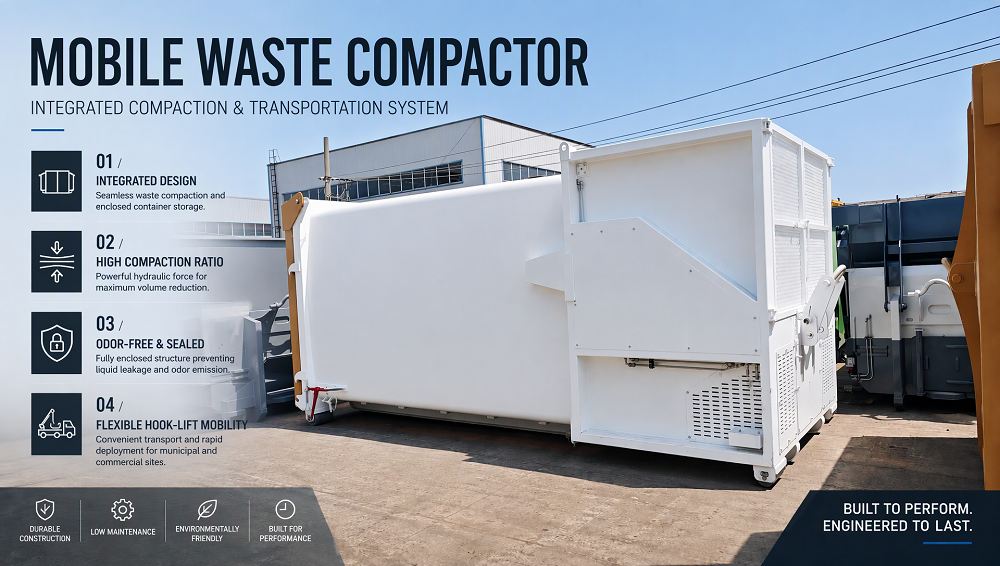
A Hook Lift Mobile Waste Compactor is a mobile hydraulic waste compression machine designed to work with a hook lift truck. It combines a waste compression mechanism, an enclosed container, a hydraulic power system, and a hook lift-compatible frame into one integrated piece of equipment.
The hook lift system allows the entire compactor to be loaded onto or removed from a compatible truck. This makes it possible to transport the equipment between different waste collection sites without permanently installing a compression station at each location.
The main components generally include:
Hydraulic Compression System: Generates compression force to reduce the volume of collected waste.
Enclosed Container: Provides storage space for compressed waste and helps prevent waste from scattering during collection and transportation.
Hook Lift Frame: Designed to match the lifting and loading requirements of a compatible hook lift truck.
Control System: Manages the operation of the hydraulic compression mechanism.
Power Unit: Supplies the hydraulic energy required for waste compaction.
Safety Protection System: Supports safer equipment operation through appropriate protective and control devices.
Depending on project requirements, the mobile waste compactor can be customized in terms of container capacity, structural dimensions, hydraulic configuration, and other operating specifications.
One of the biggest advantages of a hook lift mobile garbage compactor is its ability to move between different collection locations. Instead of building a permanent waste compaction station at every site, operators can use compatible hook lift trucks to transport the equipment wherever it is needed.
The hook lift structure allows the complete mobile compactor to be loaded onto a truck and transported to another designated location.
For example, a waste management company may need to collect waste from several commercial facilities, industrial workshops, or temporary construction sites. A mobile hydraulic waste compactor can be positioned at a location where waste is generated and later transported to another site when operational requirements change.
This transportation method is particularly useful for projects where waste collection points are frequently relocated.
A fixed waste compaction station is generally limited to its installation location. In comparison, a hook lift mobile compactor can be repositioned based on waste generation volume and collection schedules.
It can be used in:
Industrial parks and manufacturing facilities
Commercial buildings and shopping centers
Construction and renovation sites
Municipal waste collection projects
Logistics centers and warehouses
Large public facilities and temporary events
This flexibility helps waste management operators adjust equipment deployment according to actual site conditions.
Not every waste collection project has enough space, infrastructure, or budget for a permanent compaction station.
A mobile waste compactor provides an alternative for projects that require hydraulic compression but do not need permanently installed equipment.
Because the unit can be transported using a compatible hook lift truck, operators can arrange waste collection points without constructing a dedicated stationary compaction facility at every location.
Transportation efficiency is another important reason to choose a hydraulic mobile waste compactor.
Ordinary waste containers mainly provide temporary storage. Once they become full, the waste must be transported without necessarily undergoing mechanical compression.
A mobile waste compactor works differently. Its hydraulic compression mechanism applies pressure to collected waste, reducing its volume and allowing more material to be stored within the available container space.
The hydraulic system drives the compression mechanism to push waste into a more compact condition. This process is suitable for handling different types of municipal, commercial, and industrial solid waste, depending on the equipment configuration.
The compression force, hydraulic cylinder specifications, operating cycle, and feeding structure can be designed according to the characteristics of the waste and the customer's project requirements.
By reducing the volume of waste before transportation, a mobile garbage compactor can make better use of its internal storage capacity.
This is particularly valuable for businesses that generate large amounts of packaging materials, general industrial waste, commercial refuse, and other compressible solid waste.
The actual compaction performance depends on material type, moisture content, feeding conditions, and hydraulic configuration.
When waste is compressed before transportation, the container can generally accommodate more waste than an equivalent uncompressed storage arrangement.
Depending on the waste composition and project conditions, this may help reduce collection frequency and unnecessary transportation trips.
For waste management companies handling multiple collection locations, improving container utilization can contribute to more organized transportation planning.
For industrial and commercial waste management, controlling waste scattering and environmental exposure is an important consideration.
A Fully Enclosed Mobile Waste Compactor features an enclosed container structure that provides a contained space for waste storage and transportation.
Compared with open-top waste containers, the enclosed design offers several practical advantages.
During storage and transportation, loose waste may be affected by wind, vehicle movement, or external environmental conditions.
The enclosed container helps keep waste inside the equipment, reducing the risk of scattered materials around the collection site.
For general municipal and commercial waste, an enclosed structure can help limit direct exposure of stored waste to the surrounding environment.
For projects involving wet or high-moisture waste, additional sealing measures and liquid collection configurations may be considered according to the waste characteristics.
It is important to select the appropriate structural design based on the actual application rather than assuming that every standard mobile compactor has the same liquid-handling capability.
Industrial parks, commercial facilities, and municipal collection areas often operate in outdoor environments.
A fully enclosed hydraulic mobile waste compactor provides a more contained storage solution while supporting convenient transportation between different locations.
A major advantage of a hook lift mobile waste compactor is its adaptability to different waste collection requirements.
Instead of being designed for only one fixed application, the equipment can be configured for different industries and project scales.
Manufacturing facilities, industrial workshops, and production plants may generate substantial quantities of packaging waste, discarded materials, and general industrial refuse.
A heavy-duty mobile waste compactor can be positioned near waste generation areas to collect and compress suitable industrial waste.
Its reinforced structure and hydraulic compression system can be configured according to the expected waste load and operating conditions.
Shopping centers, supermarkets, hotels, and large commercial buildings often generate considerable volumes of packaging materials, cartons, and general commercial waste.
A mobile garbage compactor provides a centralized collection and compression solution.
The equipment can be positioned in a designated waste collection area and transported away when the container reaches its operating capacity.
Municipal waste collection projects may involve multiple collection points, public facilities, community areas, and temporary waste transfer locations.
A hook lift mobile waste compactor offers a flexible equipment deployment option for municipal solid waste management.
Its transportation capability makes it suitable for projects where waste collection locations or service requirements change over time.
Construction and renovation sites may produce large quantities of packaging materials, discarded materials, and other compressible waste.
A mobile waste compactor can be deployed at designated collection areas and relocated as project activities progress.
The equipment configuration should be selected according to the type, density, and dimensions of the waste being handled. Heavy construction debris may require a different collection and handling solution.
Waste generation volumes vary significantly between industrial plants, commercial facilities, and municipal collection projects.
Therefore, selecting the correct container capacity is essential when purchasing a mobile waste compactor.
A professional mobile waste compactor manufacturer can provide different capacity options and customized configurations according to project requirements.
For example, 10 CBM and 12 CBM mobile waste compactors can be considered for projects requiring a balance between storage capacity, transportation arrangements, and equipment dimensions.
For larger waste collection projects, customized capacities can also be evaluated based on the available transportation equipment and site conditions.
Important customization options include:
Container Capacity: Customized capacity according to daily waste generation and collection frequency.
Container Dimensions: Length, width, and height designed to match project requirements and transportation restrictions.
Hydraulic System: Hydraulic power, cylinder specifications, and compression mechanism selected according to waste characteristics.
Steel Structure: Material thickness and structural reinforcement designed for the expected operating load.
Hook Lift Compatibility: Frame dimensions, lifting structure, and connection arrangements matched to the customer's hook lift truck.
Control Configuration: Operating controls and electrical components selected according to application requirements.
Optional Accessories: Additional safety devices, liquid collection arrangements, and other functional configurations where required.
Customized manufacturing helps ensure that the mobile compactor matches both the waste collection process and the available transportation system.
Before purchasing a hook lift mobile waste compactor, buyers should evaluate several technical and operational factors.
Choosing equipment based only on container capacity may lead to compatibility problems or unsuitable performance during actual operation.
This is one of the most important considerations.
The compactor must match the hook lift truck's lifting capacity, hook height, rail arrangement, loading dimensions, and other relevant technical specifications.
Buyers should provide the truck model or detailed hook lift system parameters to the manufacturer before confirming the equipment design.
Estimate the daily waste generation volume, waste density, and expected collection frequency.
A 10 CBM mobile waste compactor may be suitable for certain medium-volume collection applications, while larger projects may require a 12 CBM or customized capacity.
The final selection should also consider the maximum permitted transportation load.
Different waste materials have different compression characteristics.
Cardboard, packaging materials, general commercial refuse, and suitable industrial solid waste may require different compression configurations.
The manufacturer should understand the actual waste composition before recommending the hydraulic system and compression structure.
For industrial applications, the container and supporting frame should be designed to withstand repeated loading, compression, lifting, and transportation operations.
Steel grade, plate thickness, reinforcement layout, and welding quality are important factors to evaluate.
Hydraulic mobile waste compactors contain mechanical, hydraulic, and electrical components that require regular inspection and maintenance.
Buyers should consider the availability of replacement parts, technical support, hydraulic component quality, and maintenance accessibility.
Working with an experienced mobile waste compactor manufacturer can help ensure that equipment specifications match the project's long-term operating requirements.
Although both equipment types can be used for waste collection and transportation, their functions are different.
| Comparison | Hook Lift Mobile Waste Compactor | Traditional Hook Lift Container |
|---|---|---|
| Main Function | Waste collection and hydraulic compression | Waste collection and storage |
| Compression System | Integrated hydraulic compression mechanism | Usually no built-in compression system |
| Waste Volume Reduction | Reduces waste volume through mechanical compaction | No mechanical compaction |
| Transportation | Compatible hook lift truck | Compatible hook lift truck |
| Storage Structure | Enclosed compaction container | Open-top or enclosed container |
| Application | Industrial, commercial, and municipal waste compaction | General waste collection and transportation |
| Equipment Configuration | Hydraulic system, compression mechanism, container, hook lift frame | Container and hook lift structure |
The main difference is the integrated hydraulic compression function.
For projects that generate large quantities of compressible waste and require improved storage utilization, a hook lift mobile waste compactor can provide more functionality than a standard hook lift container.
Selecting a reliable manufacturer is important for ensuring that the equipment matches the customer's waste management requirements.
An experienced Mobile Waste Compactor Manufacturer should be able to provide more than a standard container with a hydraulic compression mechanism.
Professional manufacturing capabilities should include:
Customized equipment design according to project requirements.
Different container capacities and structural dimensions.
Hydraulic compression system configuration.
Hook lift frame design compatible with the customer's truck.
Reinforced steel structures for different operating conditions.
Manufacturing quality inspection and functional testing.
Technical support and after-sales service.
Before requesting a quotation, buyers should prepare basic project information, including waste type, daily waste volume, required container capacity, hook lift truck specifications, and installation or operating conditions.
These details help manufacturers recommend a suitable mobile hydraulic waste compactor and provide a more accurate quotation.
A hook lift mobile waste compactor is used to collect, compress, store, and transport suitable solid waste. It is commonly used in industrial facilities, commercial properties, municipal waste collection projects, and other locations requiring flexible waste management.
The equipment is designed with a hook lift-compatible frame. A compatible hook lift truck can load the complete compactor onto the vehicle, transport it to another location, and unload it at the designated collection or disposal site.
A mobile waste compactor is designed to be transported between different locations using a compatible vehicle. A stationary waste compactor is generally installed at a fixed site and is not intended for routine transportation as a complete unit.
Capacity can be customized according to project requirements. Common project configurations may include 10 CBM and 12 CBM, while other capacities can be discussed according to waste volume, truck specifications, and transportation restrictions.
Yes. A properly configured heavy-duty mobile waste compactor can handle various types of suitable industrial solid waste, including packaging waste and general factory refuse. The compression structure and hydraulic system should be selected according to the material characteristics.
It requires a compatible hook lift truck. The truck's lifting capacity, hook dimensions, loading height, and other technical parameters must match the compactor's frame and transportation design.
Yes. Manufacturers can customize container capacity, overall dimensions, hydraulic configuration, steel structure, hook lift frame, and optional accessories according to the customer's application and transportation requirements.
A Hook Lift Mobile Waste Compactor is an effective option for waste management projects that require flexible equipment deployment, hydraulic compression, and convenient transportation.
By integrating a hydraulic compression system with a hook lift-compatible container structure, it allows waste to be collected and compacted at designated locations before the entire unit is transported to another site.
Its flexible transportation method, enclosed storage structure, customizable capacity, and suitability for different waste collection environments make it a practical solution for industrial, commercial, and municipal waste management.
If you are looking for a customized mobile hydraulic waste compactor, choosing a manufacturer that understands both waste compression technology and hook lift truck compatibility is essential.
Contact us to discuss your project requirements. We can provide customized mobile waste compactor solutions with different capacities, structural configurations, and hydraulic systems to meet your waste collection and transportation needs.


