
English
Views: 0 Author: Site Editor Publish Time: 2026-08-18 Origin: Site


As residential communities become more densely populated, traditional garbage collection methods face increasing challenges related to space utilization, appearance, odor control, waste sorting, and collection efficiency. Large numbers of above-ground garbage bins can occupy valuable public space and may become difficult to manage when waste volumes increase.
An Underground Waste Classification System provides a different approach. Instead of keeping multiple large garbage bins exposed at ground level, the main waste containers are installed below ground, while residents use an above-ground waste classification kiosk to dispose of different types of household waste.
So, what is the difference between an Underground Waste Classification System and traditional garbage bins?
The main difference is that an underground system combines waste classification, underground storage, hydraulic lifting, and organized collection into an integrated waste management solution, while traditional garbage bins generally provide simple above-ground waste storage.
This article compares the two solutions in terms of design, space utilization, waste classification, appearance, odor management, collection, capacity, operation, and application scenarios.
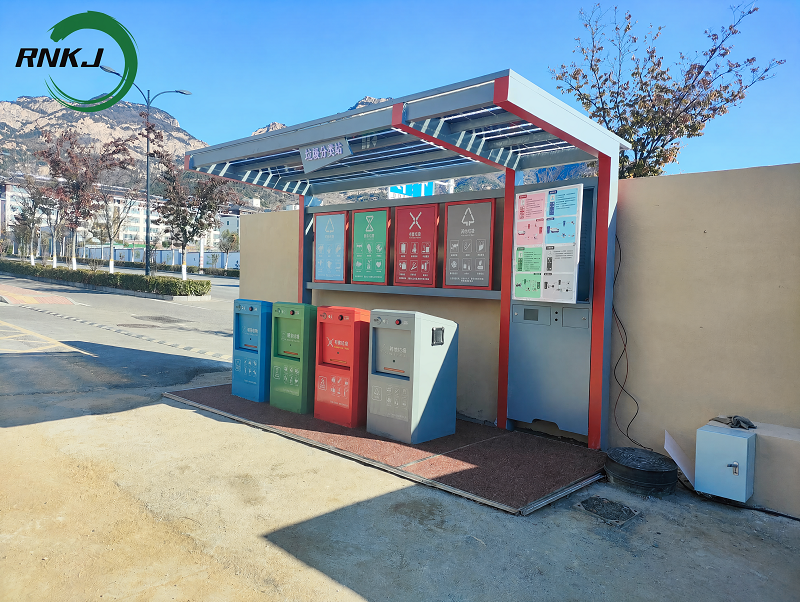
An Underground Waste Classification System is a centralized waste collection solution designed to store classified waste bins below ground.
Residents dispose of waste through designated openings located in an above-ground kiosk. Each opening corresponds to a specific waste category, such as recyclable waste, general waste, organic waste, or other locally defined categories.
The waste is then transferred into the corresponding underground container.
The system can be customized to accommodate 240L, 660L, and 1100L waste bins, depending on the requirements of the residential project.
A typical operating process is:
Waste Classification → Separate Disposal → Underground Storage → Hydraulic Lifting → Waste Collection → Transportation
When the bins need to be emptied, the hydraulic lifting mechanism raises the underground containers to an accessible position. Authorized operators can then handle the containers according to the project's collection method.
This design makes the system particularly suitable for residential communities, apartment complexes, housing estates, parks, and modern urban developments.
Traditional garbage bins are commonly used above-ground waste containers that allow residents or workers to deposit household waste directly into the bin.
They can range from small individual household bins to larger commercial or municipal containers.
Traditional garbage bins are generally simple to install and operate. However, when several waste categories need to be collected separately, multiple containers may be required at the same location.
For example, a residential waste collection point may need separate containers for:
Recyclable waste
General waste
Food waste
Glass
Paper
Plastic
Other waste
As the number of containers increases, the collection point can occupy more ground space and have a greater visual impact on the surrounding environment.
The biggest difference between the two solutions is their overall design philosophy.
Traditional garbage bins focus primarily on above-ground waste storage.
An Underground Waste Classification System combines source waste separation, underground storage, lifting equipment, and centralized collection.
The following factors illustrate the differences more clearly.
Traditional garbage bins are normally positioned above ground.
Residents can directly see the containers, and the bins occupy physical space around roads, sidewalks, buildings, or designated waste collection areas.
When multiple large containers are required, the occupied space can increase significantly.
The main waste containers are installed below ground.
Only the disposal kiosk and related access points remain visible above ground.
This allows the system to maintain the necessary waste storage capacity while reducing the amount of visible waste equipment.
Key difference:
Traditional Garbage Bins = Above-Ground Storage
Underground Waste Classification System = Underground Storage + Above-Ground Disposal Interface
Space is an important consideration for modern residential communities.
Traditional garbage bins require ground-level space for every container. If a project needs four or more waste categories, several containers may have to be positioned together.
An underground system moves the main storage volume below the surface.
This makes it possible to create a centralized waste collection point without placing multiple large garbage containers directly in the pedestrian environment.
The advantage becomes particularly noticeable in:
High-density residential communities
Apartment complexes
Urban neighborhoods
Landscaped residential areas
Mixed-use developments
Public spaces
For projects where land is limited, an Underground Waste Classification System can provide better use of available surface space.
Traditional garbage bins can support waste separation, but the effectiveness depends heavily on how the bins are arranged and labeled.
If several independent bins are placed together, residents need to identify the correct container before disposing of their waste.
An underground waste classification system is designed around the classification concept from the beginning.
The above-ground kiosk can include clearly identified disposal openings for different waste categories.
It can also be customized with:
Waste category names
Color-coded panels
Recycling symbols
Graphic instructions
Multilingual signs
Public information displays
This creates a more organized waste sorting station and can help residents understand where different types of waste should be deposited.
The appearance of a waste collection point can have a significant effect on residential environments.
Traditional garbage bins are visible throughout the day. When bins become full, the appearance of the collection area can deteriorate quickly.
An Underground Waste Classification System hides most of the waste storage equipment below ground.
The visible portion can be designed as an architectural or landscape feature rather than a group of exposed garbage containers.
The kiosk can be customized in terms of:
Color
Shape
Materials
Signage
Dimensions
Waste classification graphics
This makes underground waste collection particularly suitable for modern residential communities where landscaping and visual quality are important.
Traditional garbage bins are exposed to the surrounding environment.
Depending on the type of waste, temperature, weather conditions, and collection frequency, odors may become noticeable around conventional waste collection points.
Open or poorly sealed containers may also expose waste to rain, wind, insects, and other environmental factors.
An underground system provides an enclosed storage environment.
The underground structure can incorporate appropriate:
Sealing
Drainage
Anti-seepage measures
Odor-control solutions
Ventilation solutions
Cleaning arrangements
These features can help create a cleaner waste collection environment.
However, it is important to understand that an underground system does not automatically eliminate odors. Proper waste classification, container sealing, cleaning, ventilation, and collection frequency remain important.
Traditional garbage bins are available in many different sizes.
However, a residential project may need several different container capacities depending on waste generation.
The Underground Waste Classification System described in this solution can be customized for:
240L waste bins
660L waste bins
1100L waste bins
The 240L option is suitable for smaller waste streams, low-density residential areas, villas, or locations where smaller containers are preferred.
The 660L option provides a medium-capacity solution for residential communities and apartment complexes.
The 1100L option is suitable for higher-volume waste streams and high-density residential developments.
The system can also be configured with different bin sizes for different waste categories, depending on the project requirements.
Traditional garbage bins are generally handled using conventional waste collection procedures.
Depending on the container type, workers may manually move the bins or use suitable collection equipment.
An underground system uses a hydraulic lifting mechanism to bring the underground bins to the working position.
This can make container access more convenient for collection personnel.
The operating process may include:
The underground bins receive classified waste.
The collection schedule is determined.
The hydraulic lifting system raises the bins.
Operators access the containers.
The full bins are collected or emptied according to the project arrangement.
The containers are returned underground.
Remote control or other control options can also be incorporated according to the system configuration.
Traditional garbage bins are generally simple products with limited automation.
The Underground Waste Classification System can integrate additional control functions.
Depending on project requirements, options may include:
Hydraulic lifting
Remote control
Sensors
Scheduled operation
Electrical control systems
Solar power supply
Safety protection systems
The image-based system shown for this product also supports remote-controlled lifting and lowering as an available configuration.
This provides greater flexibility for property managers and waste collection operators.
Traditional garbage bins do not normally require an independent power supply.
An underground system with hydraulic lifting and intelligent controls may require electrical power.
For suitable projects, a solar power supply can be integrated into the system.
Solar-powered operation can be considered for outdoor residential communities, parks, green spaces, and other locations where independent or supplementary power is desirable.
The actual solar configuration should be selected according to the lifting mechanism, control system, operating frequency, local climate, and project requirements.
From a resident's perspective, traditional garbage bins are simple: open the lid and throw away the waste.
However, when multiple waste categories are required, the collection point can become confusing if the containers are poorly organized.
An underground waste classification kiosk provides a centralized interface.
Residents can identify the correct waste category and use the corresponding disposal opening.
The system can use large text, icons, colors, and graphics to make waste classification easier.
For residential communities, this can create a more organized and user-friendly waste disposal environment.
Both systems require regular maintenance.
Traditional garbage bins are relatively simple, but they still need:
Cleaning
Disinfection
Inspection
Damage checks
Odor management
Replacement of damaged bins
An underground system includes additional mechanical and structural components.
Maintenance may involve:
Hydraulic system inspection
Electrical control inspection
Lifting mechanism maintenance
Underground pit cleaning
Drainage inspection
Waterproofing inspection
Container cleaning
Safety system inspection
Therefore, an underground waste collection solution requires a more comprehensive maintenance plan.
The advantage is that the system can provide more functions and better integration than a simple standalone garbage bin.
Traditional garbage bins require relatively little installation work.
They can usually be placed directly in an appropriate collection area.
An underground system requires more detailed site planning because the main storage area is installed below ground.
Before installation, the project should consider:
Available installation space
Underground utilities
Soil conditions
Drainage
Groundwater conditions
Waterproofing
Pedestrian access
Waste collection routes
Collection vehicle access
Required waste capacity
Local construction requirements
For new residential developments, it is often easier to integrate the underground waste system into the initial site and landscape planning.
Traditional garbage bins generally have a lower initial investment because they have a simple structure and do not require underground construction or hydraulic lifting equipment.
An Underground Waste Classification System usually requires a higher initial investment because it may include:
Underground civil works
Hydraulic lifting equipment
Electrical controls
Structural components
Drainage systems
Safety systems
Optional solar power
Customized waste classification kiosks
However, purchase price should not be the only factor considered.
For residential projects, the total value of a waste collection system should also be evaluated based on:
Land utilization
Collection efficiency
Maintenance
Community appearance
Waste classification
Long-term operation
Property management requirements
A higher initial investment may be reasonable when the project requires a more integrated and visually optimized waste collection solution.
| Feature | Underground Waste Classification System | Traditional Garbage Bins |
|---|---|---|
| Storage position | Underground | Above ground |
| Waste classification | Integrated classification interface | Depends on bin arrangement |
| Surface space | Lower visual footprint | More visible storage space |
| Hydraulic lifting | Available | Usually unavailable |
| Bin options | 240L / 660L / 1100L | Various |
| Appearance | Highly customizable | Basic |
| Landscape integration | Excellent | Limited |
| Odor-control options | Available | Depends on bin design |
| Remote operation | Optional | Usually unavailable |
| Solar power | Optional | Generally not required |
| Installation | Requires underground planning | Simple placement |
| Initial investment | Generally higher | Generally lower |
| Maintenance | Mechanical + electrical + structural | Mainly cleaning and container maintenance |
| Best suited for | Modern residential communities | Basic waste collection |
There is no single waste collection solution that is suitable for every project.
Traditional garbage bins can be a practical choice when:
The project has sufficient ground space
Waste collection requirements are simple
Initial investment is the primary concern
Waste classification requirements are limited
A basic waste storage solution is sufficient
An Underground Waste Classification System may be more appropriate when:
Surface space is limited
Waste classification is required
Community appearance is important
Multiple waste categories need centralized collection
Underground storage is preferred
Hydraulic lifting is required
Smart operation is desired
The project is a new residential development
Long-term landscape integration is important
The best choice should be based on the actual waste volume, site conditions, collection method, budget, and local waste management regulations.
Modern residential waste management is no longer only about providing a place to throw garbage.
A complete waste collection solution should consider the entire process from waste disposal to storage and final collection.
The Underground Waste Classification System combines several functions into one solution:
Classification + Underground Storage + Hydraulic Lifting + Centralized Collection
It can help residential communities achieve:
More efficient land utilization
Better waste classification
Reduced visual clutter
More organized waste collection
Flexible waste bin capacity
Improved community appearance
Convenient hydraulic lifting
Optional intelligent operation
Customizable system design
The ability to accommodate 240L, 660L, and 1100L waste bins also makes the system adaptable to different residential waste generation levels.
Before purchasing or specifying an Underground Waste Classification System, several factors should be evaluated.
Determine the approximate daily waste volume generated by residents.
This helps determine the required number and capacity of waste bins.
Choose between 240L, 660L, and 1100L configurations according to waste volume and collection frequency.
Decide which waste streams need separate collection.
Check underground utilities, drainage, soil conditions, groundwater, and available space.
The system should be designed around the actual waste collection equipment and operating process.
Depending on the project, manual operation, remote control, sensors, or other intelligent functions can be considered.
Projects can evaluate conventional electrical power or an optional solar power system.
The difference between an Underground Waste Classification System and traditional garbage bins goes far beyond where the garbage containers are located.
Traditional garbage bins provide a simple above-ground waste storage method, while an underground system integrates waste classification, underground storage, hydraulic lifting, and centralized collection into a more comprehensive solution.
For residential communities with limited space, modern landscaping requirements, multiple waste categories, and higher expectations for waste management, an Underground Waste Classification System can provide significant advantages.
With customizable 240L, 660L, and 1100L waste bin configurations, hydraulic lifting, optional remote control, solar power, and a customizable above-ground classification kiosk, the system can be adapted to different residential projects.
Ultimately, the right solution depends on the project's waste generation, available space, collection method, budget, and operational requirements. For modern residential developments seeking a cleaner, more organized, and space-efficient approach to waste collection, an Underground Waste Classification System is a practical option worth considering.


