
Views: 0 Author: Site Editor Publish Time: 2026-09-02 Origin: Site


Facility managers and procurement heads face a persistent challenge when upgrading waste infrastructure. They often default to the largest capacity available. This approach ignores vehicle compatibility, spatial limitations, loading mechanisms, and specific waste stream densities. Choosing the wrong equipment creates hidden operational costs. A unit that is too small triggers excessive hauling fees. A unit that is too large violates footprint constraints or exceeds legal road weights. You must evaluate your site logistics before making a decision. You need to understand transport mechanisms and labor efficiency. A mobile waste compactor integrates the press and the container into one sealed unit. It handles wet, mixed, and general waste effectively. We will break down the technical differences between the 8 CBM and 12 CBM models. This guide provides the data you need to align equipment size with your actual site requirements.
Capacity vs. Footprint: An 8 CBM mobile waste compactor offers spatial agility for urban and retail environments, while a 12 CBM unit drastically reduces hauling frequency for industrial applications.
Transport Compatibility: Sizing must align with existing fleet capabilities, particularly the rated load capacity, axle configuration, and chassis length required for a hook lift mobile waste compactor.
Waste Density Impact: High-liquid or high-density waste streams may cause a 12 CBM unit to exceed legal road weight limits before reaching maximum volumetric capacity.
Customization is Critical: Partnering with a specialized mobile waste compactor manufacturer allows for tailored hopper designs, chute-fed integrations, and hydraulic configurations that off-the-shelf units lack.
You must establish an operational baseline before selecting a capacity. A mobile trash compactor operates differently than a stationary model. Stationary units bolt directly to the concrete pad. The compaction ram remains on-site, and the truck only hauls the detachable receiver bin. Mobile units, often called self-contained compactors, fuse the compaction ram, the power unit, and the storage container into a single, unified structure. The entire machine goes onto the truck during a pickup.
This unified design creates a completely leak-proof environment. It is essential for managing wet waste, food scraps, medical facility refuse, or mixed municipal solid waste. When you separate a stationary compactor from its bin, liquids inevitably spill onto the loading dock. A self-contained unit eliminates this mess, keeping your facility compliant with environmental runoff regulations.
Procurement teams need strict success criteria to evaluate these machines. You cannot rely on volume alone. Performance metrics determine actual field utility.
Compaction Ratio: This measures hydraulic force against waste resistance. Ratios typically range from 3:1 to 5:1. High ratios conserve landfill space and maximize true payload.
Cycle Time: This is the speed of the compaction ram. High-throughput environments require fast cycle times. Slow rams create labor bottlenecks at the loading dock.
Liquid Retention: Wet waste streams demand sealed rear doors. High-quality units use heavy-duty turnbuckles and neoprene seals. Proper drainage systems prevent environmental fines from leaking fluids.
Labor & Time Savings: Evaluate the reduction in manual labor. Measure the man-hours previously spent breaking down cardboard boxes. Calculate the time saved by eliminating overflowing open-top bins.
Before contacting a vendor, you must conduct a thorough site assessment. Follow these steps to gather the necessary data:
Identify the primary waste streams and estimate the percentage of wet versus dry material.
Measure peak generation times to determine if the machine's cycle time can keep up with your staff.
Evaluate existing dock infrastructure, noting the height of the dock, the thickness of the concrete, and the availability of 3-phase power.
Determine local hauling restrictions, specifically the maximum legal payload for the trucks servicing your area.
Map the truck approach path, ensuring there are no overhead obstructions like low-hanging wires or building overhangs.
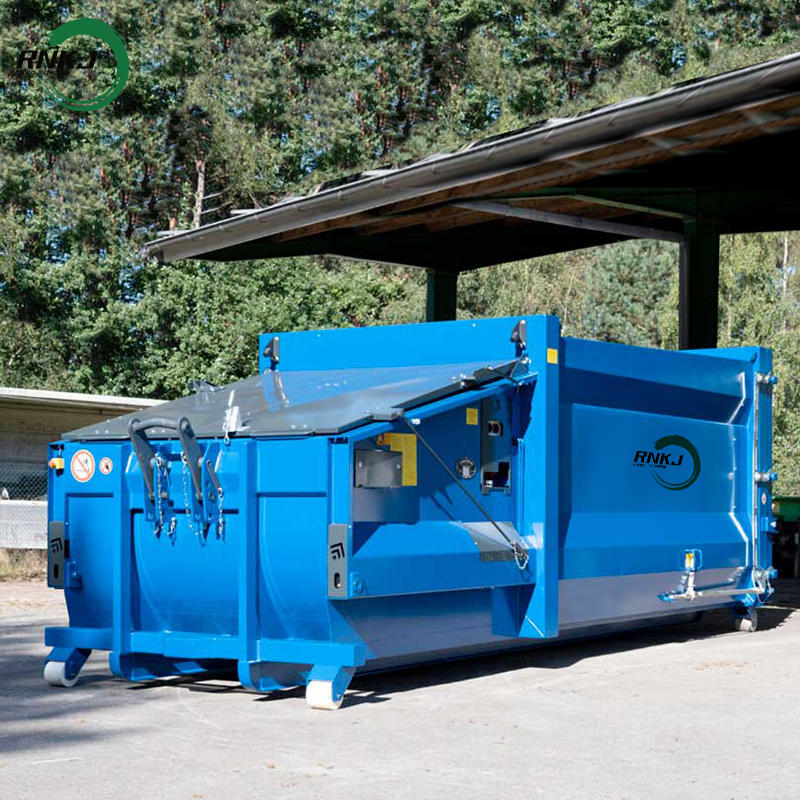
The 8 CBM mobile waste compactor represents the standard for spatial efficiency in dense environments. These units typically measure around 4.5 to 5 meters in length. They maintain a standard width to fit conventional loading bays without blocking adjacent dock doors. The average curb weight remains relatively low, usually hovering around 3,500 to 4,000 kilograms empty. This reduces the strain on the transport vehicle and the concrete pad.
You must prepare a reinforced concrete pad for installation. The 8 CBM unit requires a smaller footprint than larger models, but you still need a pad rated for at least 3000 PSI. The concrete must withstand the point load of the steel rollers when the truck drags the unit during pickup. Operators need safe access to the control panels and loading hopper. Guide rails bolted to the concrete help drivers align the unit during drop-off, preventing damage to your building walls. You also need a dedicated heavy-duty electrical connection, usually a 480V 3-phase power supply, positioned safely away from the loading zone.
| Specification | Measurement / Detail |
|---|---|
| Overall Length | Approx. 4.5 - 5.0 Meters |
| Overall Width | Standard 2.5 Meters |
| Empty Weight | 3,500 - 4,000 kg |
| Motor Size | Typically 5.5 kW to 7.5 kW |
| Cycle Time | 35 - 45 Seconds |
| Ideal Waste Application | Wet waste, food scraps, dense mixed MSW |
Agility defines the 8 CBM model. It excels in tight spaces. You will find these units in underground commercial parking garages, hospital service bays, and dense retail centers. They free up valuable real estate. You can repurpose the saved space for inventory storage or employee parking.
The lower gross vehicle weight offers a major logistical advantage. When full of compacted material, an 8 CBM unit remains well within standard weight limits. Lighter, more maneuverable trucks can transport it. These smaller trucks navigate narrow city streets easily. They avoid the turning radius issues that plague heavy-duty commercial vehicles. This flexibility often expands your options for local hauling contractors, as you do not need a specialized heavy-haul fleet.
Smaller capacity means more frequent hauling. This is the primary limitation. If your site generates more than 2 to 3 tons of uncompacted waste daily, an 8 CBM unit fills up fast. You might require multiple pickups per week. This increases your logistics scheduling complexity and increases the traffic at your loading dock.
Hopper size presents another risk. The loading aperture on an 8 CBM unit is smaller than on a 12 CBM model. Bulky items cause operational bottlenecks. Large, unbroken cardboard boxes, wooden pallets, or oversized industrial packaging can bridge across the hopper opening. The ram cannot engage the material properly when it bridges. Your staff must spend time pre-shredding or manually breaking down waste before loading. This defeats the labor-saving purpose of the machine and frustrates dock workers.
The 12 CBM mobile waste compactor handles massive waste volumes. These units stretch up to 6.5 meters in length. The increased size requires significant structural reinforcements. Manufacturers use thicker, high-tensile steel for the floor and side walls. This prevents the container from bowing under the immense pressure of 12 cubic meters of compacted material.
The curb weight of the empty unit is substantially higher, often exceeding 5,000 kilograms. The hydraulic power unit features larger cylinders, sometimes with a 6-inch bore, to push heavier loads. The volumetric advantage is clear. You can expect a much higher tonnage per haul when processing standard municipal solid waste or dry commercial refuse. The ram must work harder, but the payload maximizes the transport vehicle's physical capacity.
| Specification | Measurement / Detail |
|---|---|
| Overall Length | Approx. 6.0 - 6.5 Meters |
| Overall Width | Standard 2.5 Meters |
| Empty Weight | 5,000 - 5,500 kg |
| Motor Size | Typically 7.5 kW to 11 kW |
| Cycle Time | 45 - 55 Seconds |
| Ideal Waste Application | Dry waste, cardboard, plastics, bulky MSW |
Volume reduction drives the value of the 12 CBM unit. It drastically cuts hauling trips. Fewer trips mean lower logistics scheduling overhead. It reduces fleet emissions, directly supporting corporate environmental goals. You keep trucks off the road and minimize disruption at your facility. Every time a truck swaps a compactor, your dock is out of commission for 30 to 45 minutes. Reducing this frequency keeps your operations running smoothly.
This capacity suits high-volume generation points perfectly. Manufacturing facilities, large distribution centers, and municipal transfer stations benefit the most. These sites produce continuous streams of dry, compressible waste. The 12 CBM unit swallows large pallets, massive cardboard volumes, and continuous production scrap without bottlenecking. The larger hopper opening accommodates automated bin tippers and heavy-duty conveyor feeds easily.
Size creates logistical challenges. A 12 CBM unit demands a massive operational footprint. The concrete pad must be longer and thicker, often requiring a 4000 PSI rating with heavy rebar reinforcement. The collection vehicle requires a wide turning radius. Many older facilities or urban loading docks simply cannot accommodate the multi-axle truck required to lift this machine.
Weight compliance is the most severe risk. Volume does not equal legal weight. If you compact dense, wet waste like food scraps or organic sludge, a 12 CBM unit becomes a massive liability. It will easily exceed the legal axle load limits of standard transport trucks. It will surpass the rated load capacity of the hook lift system. If the truck is overweight, the extra volume is useless. The driver will refuse the load, or you risk severe DOT fines and structural damage to the transport vehicle. You must match the 12 CBM capacity strictly with lighter, dry waste streams.
You must measure your site accurately. An 8 CBM unit fits into standard dock bays. It requires a straight approach path of roughly 12 to 15 meters for the truck. A 12 CBM unit needs significantly more room. The truck approach path extends to 18 meters or more. You must account for the approach angle of the roll-off or hook lift vehicle. If the truck has to approach at an angle, the driver cannot align the rails properly.
Maintenance access matters. Technicians need space to open the side panels. They need to inspect hydraulic hoses, check fluid levels, and access the PLC control board. If you wedge a 12 CBM unit against a wall to save space, you block maintenance access. The 8 CBM unit leaves more buffer room in constrained environments, allowing technicians to work safely.
How you feed the waste dictates the hopper design. Ground-level manual loading works for both sizes, but the 12 CBM hopper sits higher off the ground. Workers may struggle to lift heavy bags over the lip. Dock-fed walk-on platforms require precise height alignment. You must match the compactor's deck height to your existing loading dock. A doghouse enclosure built over the hopper protects workers from the elements and prevents unauthorized access.
Integrated bin lifters change the dynamic. If your staff uses 240L or 660L wheelie bins, the compactor needs a hydraulic tipper. The 12 CBM unit handles heavy, continuous bin tipping better due to its wider hopper. Through-the-wall chute-fed systems require custom engineering. The 8 CBM unit often aligns better with standard building chutes in residential or mixed-use towers, where space inside the trash room is limited.
You need a mathematical decision matrix. Calculate your daily waste generation in cubic meters. Multiply that by the expected compaction ratio. This projects your hauling schedule.
| Operational Factor | 8 CBM Compactor | 12 CBM Compactor |
|---|---|---|
| Primary Waste Type | Wet, dense, organic, mixed MSW | Dry, bulky, cardboard, plastics |
| Hauling Frequency | Higher (requires more frequent pickups) | Lower (maximizes time between pickups) |
| Footprint Requirement | Compact (fits urban bays) | Large (requires industrial yard space) |
| Truck Compatibility | Standard medium-duty hook lift | Heavy-duty multi-axle hook lift |
| Overweight Risk | Low | High (if filled with wet/dense waste) |
Evaluate compatibility with a hook lift mobile waste compactor system. Check the rail width. Verify the hook height. Confirm the lifting capacity of your hauling contractor's fleet. A 12 CBM unit requires a heavier-duty hook system. If your local hauler only operates medium-duty trucks, you must choose the 8 CBM model regardless of your waste volume.
Material density dictates capacity choice. Dry and bulky waste favors the 12 CBM unit. Cardboard, shrink wrap, and plastic packaging contain a lot of air. The compactor crushes the air out. The resulting bale is large but relatively light. The 12 CBM unit maximizes transport efficiency for these materials.
Wet and heavy waste necessitates the 8 CBM unit. Food waste, restaurant refuse, and organic sludge are incredibly dense. They contain very little air. Compaction squeezes out some liquid, but the mass remains heavy. A full 8 CBM unit of food waste will max out a truck's legal payload. Filling a 12 CBM unit with the same material makes it illegal to transport on public roads.
Heavy machinery requires strict maintenance protocols to prevent catastrophic failure. The hydraulic cylinders endure immense pressure during every cycle. You must establish a daily and weekly inspection routine. Operators should check the hydraulic fluid reservoir sight glass daily. Low fluid levels introduce air into the system, causing the ram to shudder and lose compaction force.
Inspect the hydraulic hoses for abrasions or weeping fittings weekly. A blown high-pressure hose will spray hydraulic oil across your loading dock, creating an environmental hazard and shutting down your waste operations. Grease all moving parts, including the hopper hinges, door turnbuckles, and ground rollers. Dry rollers will drag across your concrete pad, gouging the surface and putting unnecessary strain on the truck's winch or hook system.
Clear debris from behind the compaction ram regularly. Small pieces of cardboard or plastic can slip behind the ram face during the retraction stroke. Over time, this debris builds up and prevents the ram from fully retracting. This reduces your hopper capacity and puts extreme stress on the cylinder mounts.
Investing in a custom mobile waste compactor solves specific operational challenges. Standard units work well for general refuse, but specialized applications require custom engineering. If you process high volumes of liquid-rich waste, you need custom watertight seals. Standard neoprene seals degrade quickly when exposed to acidic food waste. Custom units can feature acid-resistant seals and integrated drainage ports that connect directly to your facility's grease trap or sanitary sewer line.
Safety interlocks represent another necessary customization. If your unit is hand-fed by employees, custom safety cages and magnetic interlock switches ensure the machine cannot cycle while the hopper door is open. For automated facilities, custom hoppers can integrate properly with existing conveyor belts, using photo-eye sensors to trigger the compaction cycle automatically when the hopper is full.
Equipment durability relies on steel quality. Look for high-tensile steel construction. Manufacturers should use materials like Hardox 450 or equivalent wear-resistant steel in high-stress areas. The floor of the container and the face of the compaction ram take the most abuse. Standard mild steel will bow, warp, and eventually tear under maximum hydraulic pressure over time.
Check the structural ribbing. A reliable mobile waste compactor manufacturer welds continuous structural channels along the outside of the container. These ribs prevent the side walls from bulging when the unit is packed tight. Inspect the weld quality. Continuous, robotic welds offer better fatigue resistance than manual stitch welds. A cracked weld compromises the watertight integrity of the entire unit.
The hydraulic power unit is the heart of the machine. Demand globally sourced, easily replaceable hydraulic components. Proprietary valves or cylinders cause massive downtime when they fail. Standardized parts ensure your local technician can fix the machine quickly without waiting weeks for overseas shipping.
Electrical reliability matters in harsh environments. The electrical panels must carry a high IP rating, such as IP65, to resist dust, rain, and pressure washing. Modern units use PLC systems for automated cycling. The PLC monitors hydraulic pressure. It tells the ram to reverse if it hits an uncrushable object, like a steel beam or engine block hidden in the trash. This prevents catastrophic cylinder damage. Ensure the control panel features physical, heavy-duty push buttons, not delicate touchscreens that fail in cold weather or when operated with heavy work gloves.
Hardware is only part of the investment. You need reliable after-sales support. Evaluate the warranty terms carefully. Separate the structural warranty from the parts and labor warranty. A good manufacturer stands behind their steel for years. Verify that the manufacturer stocks replacement parts domestically. Ask about preventative maintenance programs. Routine hydraulic fluid analysis and pressure checks extend the life of the machine significantly.
Conduct a one-week waste audit to measure your uncompacted volume, identify peak generation times, and calculate the exact material density of your primary waste streams.
Verify your site dimensions, including the truck approach angles, overhead clearance, and the thickness of your existing concrete loading pad.
Consult with your local hauling contractor to confirm their truck axle weight limits, hook lift specifications, and rail width requirements.
Request detailed technical drawings and footprint requirements from a qualified manufacturer to ensure proper integration with your loading dock.
A: Compaction ratios typically range from 3:1 to 5:1. This depends heavily on the material being compacted. Dry, bulky items like cardboard achieve higher ratios because they contain more air. Dense, wet waste like food scraps yields lower ratios. The hydraulic cylinder size and system pressure of the specific unit also dictate the final compaction performance.
A: No, it requires a specialized heavy-duty truck. The vehicle must have a compatible hook lift system and the correct multi-axle configuration. It needs a sufficient Gross Vehicle Weight Rating (GVWR) to handle the heavy combined weight of the large steel compactor and the compacted waste safely and legally.
A: Custom units are necessary for unique loading workflows. If you need through-the-wall chute feeds, specialized hydraulic bin tippers, or integration with existing conveyor systems, you need a custom build. Specific liquid-tight requirements for hazardous or highly wet waste also dictate custom engineering, specialized seals, and integrated drainage solutions.
A: Yes, it is highly suitable and often preferred for food waste. Food waste is extremely dense and heavy. A smaller 8 CBM unit prevents the transport truck from exceeding legal road weight limits. The unit must feature watertight rear door seals and proper drainage to manage the high liquid content effectively.
A: Routine maintenance includes checking hydraulic fluid levels daily and inspecting high-pressure hoses for leaks. You must grease all moving parts, hinges, and ground rollers regularly. Operators must clear debris from behind the compaction ram to prevent jamming. Finally, inspect the rear door neoprene seals frequently to ensure they remain completely watertight.


