
Views: 0 Author: Site Editor Publish Time: 2026-11-07 Origin: Site


As urban populations continue to grow, waste collection facilities are facing increasing demands for better space utilization, waste sorting, and collection management. Traditional waste collection stations have been widely used in residential communities, commercial areas, public spaces, and municipal waste management projects. However, conventional ground-level collection facilities may occupy valuable public space and provide limited flexibility for separating different types of waste.
An Underground Waste Classification System offers a different approach to waste collection by placing storage containers below ground level and organizing waste into multiple independent collection compartments. Instead of relying on several conventional garbage bins arranged in an open collection area, this system integrates multiple waste collection units into an underground structure.
With its underground installation design, multi-bin configuration, and independent waste storage arrangement, an underground waste classification station provides a practical solution for projects that require organized waste sorting and efficient collection.
So, what exactly makes an underground waste classification system different from a traditional waste collection station? Understanding their structural differences, operating methods, and application scenarios can help project developers and municipal buyers choose the right waste collection equipment.
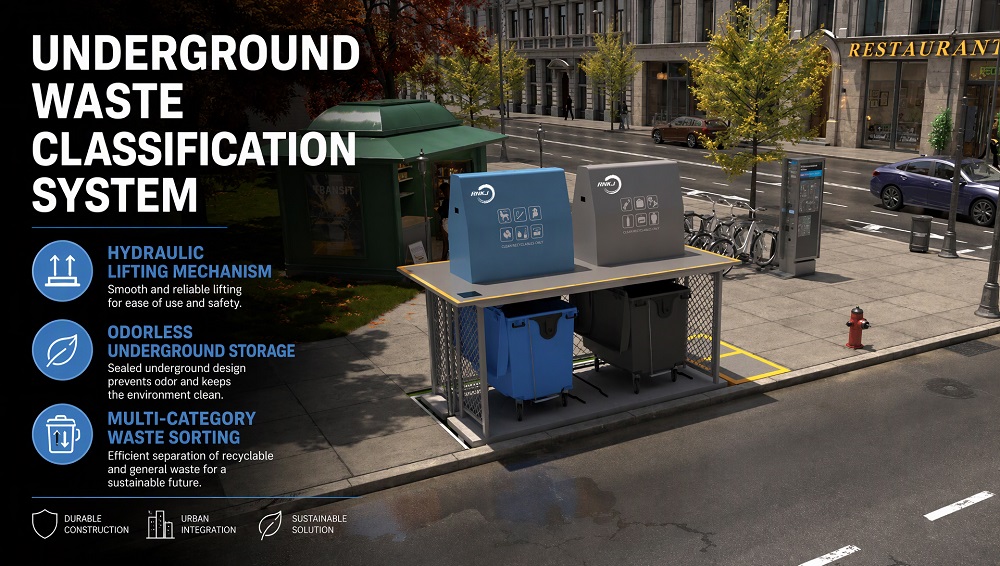
One of the most noticeable differences between an underground waste classification system and a traditional waste collection station is the installation method.
Traditional waste collection stations usually place garbage bins or collection containers directly on the ground. These facilities are relatively straightforward to install, but multiple bins can occupy considerable surface space, especially in locations where several waste categories need to be collected.
An underground waste classification system uses an underground installation structure to accommodate its waste collection containers. The main storage units are positioned below ground level, while the waste disposal openings and operating interfaces remain accessible from the surface.
Key differences include:
Installation location: Traditional stations use ground-level containers, while underground systems place their main storage containers below the surface.
Surface space utilization: Underground installation can reduce the amount of ground space occupied by waste storage facilities.
Visual appearance: Underground collection equipment can provide a more organized appearance in residential communities and public areas.
Site planning: Underground systems require excavation, foundation preparation, drainage arrangements, and sufficient underground installation space.
For residential developments, municipal landscaping projects, and commercial complexes, an underground waste classification system can help integrate waste collection facilities into the surrounding environment.
However, the underground installation design requires more careful site planning than conventional ground-level garbage bins.
Another important difference is the waste storage configuration.
Traditional waste collection stations may use several independent garbage bins for different waste categories. In some facilities, different bins are simply placed next to each other. Their arrangement, capacity, and collection methods may vary depending on the project.
An underground waste classification system can integrate multiple waste collection containers into one coordinated underground installation.
Each container is designed to collect and store a designated waste category. Depending on project requirements, the system can be configured with different numbers of classification compartments.
For example, a project may require separate collection containers for:
Recyclable waste
Residual household waste
Food waste
Other designated waste categories
The number and arrangement of containers can be adjusted according to local waste classification regulations and the actual requirements of the collection site.
Unlike a basic collection point with scattered garbage bins, an Underground Garbage Classification System provides a more integrated arrangement for different waste streams.
This configuration is particularly useful for residential communities, municipal sanitation projects, public facilities, and areas with centralized waste collection requirements.
Waste separation is only effective when different categories can be stored independently after disposal.
In traditional waste collection stations, separate bins are commonly used for sorting. However, when collection facilities are poorly organized or container arrangements are insufficient, different waste categories may become mixed during daily disposal and collection operations.
An underground waste classification system addresses this requirement through independent storage containers.
Each collection bin serves a designated waste category, allowing different types of waste to remain separated during temporary storage.
The independent storage design provides several practical advantages:
Separate waste storage
Different waste categories are stored in their corresponding containers rather than sharing one common collection space.
Organized collection management
Each container can be identified and managed according to its designated waste category, making collection arrangements easier to organize.
Flexible container configuration
The container quantity, capacity, and arrangement can be customized according to the daily waste volume and classification requirements of the project.
Support for subsequent waste handling
Separately collected waste can be transferred to the corresponding transportation or treatment facilities according to local waste management procedures.
It is important to note that an underground waste classification system is primarily designed for waste sorting and temporary storage. It does not necessarily include a waste compaction function. If a project requires waste compression, a separate underground garbage compactor or integrated compaction solution may be more appropriate.
The way waste containers are accessed and emptied is another important difference.
Traditional ground-level garbage collection stations generally allow sanitation workers or collection vehicles to access containers directly. Depending on the bin design, waste may be transferred manually or collected using compatible lifting equipment.
An underground waste classification station can incorporate a mechanical lifting system to raise underground storage containers to ground level when collection is required.
A typical collection process includes the following steps:
Waste disposal: Residents or users place different waste categories into their corresponding disposal openings.
Separate storage: Waste enters the designated underground collection containers.
Container storage: Each container independently stores its assigned waste category below ground level.
Mechanical lifting: When a container needs to be emptied, the lifting mechanism raises the corresponding storage unit to the surface.
Waste collection: Sanitation workers or compatible collection equipment remove the waste.
Container reset: After collection, the empty container is returned to its underground position.
The mechanical lifting arrangement reduces the need to manually access deep underground storage areas and makes the container collection process more structured.
For projects with specific lifting requirements, the equipment configuration can be designed according to container dimensions, lifting loads, installation depth, and site conditions.
Although underground waste classification systems offer an integrated storage arrangement, their installation requirements are different from those of traditional waste collection stations.
Traditional garbage bins usually require a relatively flat placement area with sufficient access for users and collection vehicles. Their installation is generally less complicated because they do not require underground pits or lifting structures.
An underground waste classification system requires more detailed engineering preparation before installation.
Important considerations include:
Installation Factor | Underground Waste Classification System | Traditional Waste Collection Station |
|---|---|---|
Installation position | Below-ground storage structure | Mainly ground-level |
Foundation | Requires underground foundation and pit preparation | Usually simple ground preparation |
Drainage | Requires consideration of underground drainage and water protection | Generally simpler |
Lifting equipment | May include mechanical or hydraulic lifting mechanisms | Usually not required |
Space planning | Requires underground and surface space planning | Mainly surface space |
Container arrangement | Integrated multi-bin configuration | Individual bins or containers |
Installation complexity | Relatively higher | Relatively lower |
Before purchasing an underground waste classification system, project owners should evaluate underground utility pipelines, groundwater conditions, foundation dimensions, drainage arrangements, and vehicle access.
These factors directly influence equipment configuration and installation feasibility.
Traditional waste collection stations remain suitable for many locations where simple waste storage and collection are sufficient.
However, underground waste classification systems are particularly suitable for projects that require multiple waste categories to be collected within a relatively organized and space-conscious facility.
Common application scenarios include:
Residential communities generate different types of household waste every day. An underground waste classification system can provide separate storage containers for designated waste categories while keeping the main storage units below ground.
This arrangement is suitable for newly developed residential areas, large apartment complexes, and community waste sorting facilities.
Municipal waste management projects often require standardized collection points across different districts. Underground waste classification equipment can be configured according to local waste sorting policies, collection capacity requirements, and site conditions.
Shopping centers, office parks, and commercial developments generate different waste streams from daily operations. An integrated underground collection station can provide designated storage containers for different waste categories.
Public parks and landscaped areas often need waste collection facilities that fit the surrounding environment. Underground installation can help reduce the visual impact of multiple ground-level storage containers.
Yes. Different municipal and commercial projects have different requirements for waste classification, storage capacity, installation dimensions, and lifting configurations.
A professional Underground Waste Classification System Manufacturer should be able to provide equipment configurations based on the actual project requirements.
Common customization options include:
Number of Classification Containers
The system can be designed with different numbers of independent collection bins according to the waste categories that need to be separated.
Container Capacity
Storage capacity can be selected according to the estimated daily waste volume, collection frequency, and available installation space.
Underground Structure Dimensions
The overall dimensions and underground installation depth should match the site layout and foundation conditions.
Mechanical Lifting Configuration
The lifting mechanism can be designed according to container weight, lifting height, operating requirements, and project specifications.
Material and Structural Design
The equipment structure and container materials can be selected according to loading requirements, environmental conditions, and expected service conditions.
Control and Safety Configuration
Depending on the project, the system can incorporate suitable electrical controls, operation interfaces, and safety protection devices.
For large-scale municipal projects, customization is particularly important because the underground collection facility must fit both the waste classification plan and the construction conditions.
The right solution depends on the project's waste management requirements, available installation space, construction budget, and operating conditions.
Comparison | Underground Waste Classification System | Traditional Waste Collection Station |
|---|---|---|
Main design | Underground integrated storage | Ground-level collection |
Waste sorting | Multiple independent storage containers | Depends on individual bin arrangement |
Surface appearance | More organized underground arrangement | Containers remain visible |
Space utilization | Reduces above-ground storage footprint | Requires surface placement space |
Collection method | May use mechanical lifting | Direct access or conventional handling |
Construction | More demanding | Relatively simple |
Customization | Multi-bin and lifting configuration | Mainly bin quantity and size |
Choose an underground waste classification system if:
Your project requires multiple waste categories to be stored separately.
Ground-level space is limited or needs to remain more organized.
The project involves residential communities or municipal infrastructure.
You need integrated underground storage with a mechanical lifting arrangement.
The equipment needs to be customized according to a specific site layout.
Choose a traditional waste collection station if:
The project only requires basic garbage collection and temporary storage.
Installation conditions do not support underground construction.
The available budget is limited.
Simple container placement and direct waste collection are sufficient.
Neither solution is suitable for every project. The best choice depends on the actual waste collection process and site requirements.
Selecting the right manufacturer is just as important as choosing the equipment structure.
For municipal buyers, engineering contractors, and waste management companies, it is important to evaluate whether the manufacturer can provide a suitable configuration rather than simply offering standard garbage collection containers.
Before requesting a quotation, consider the following questions:
Can the manufacturer customize the number of waste classification containers?
Are different container capacities available?
What type of mechanical lifting structure is used?
Can the equipment dimensions be adjusted to match underground installation conditions?
What materials are used for the main structure and storage containers?
Does the manufacturer provide installation guidance and technical support?
Can the equipment configuration meet local project requirements?
A manufacturer with experience in underground waste collection equipment can help evaluate project specifications and recommend a suitable configuration.
At Shandong RNKJ Environmental Technology Co., Ltd., we focus on the development and manufacturing of waste collection and compaction equipment. Our underground waste classification solutions can be configured according to container quantity, storage capacity, lifting structure, and project installation requirements.
Whether you are planning a residential community waste sorting project, a municipal sanitation facility, or a commercial waste collection station, selecting the appropriate equipment configuration is essential for long-term operation.
The main difference between an Underground Waste Classification System and a traditional waste collection station lies in their structural design, installation method, and waste storage arrangement.
Traditional collection stations mainly rely on ground-level garbage bins or containers, while underground classification systems integrate multiple independent storage containers below ground level and can incorporate mechanical lifting equipment for waste collection.
For projects that require organized waste sorting, independent storage, and better utilization of above-ground space, an underground waste classification system can provide a more integrated collection solution.
Choosing the right equipment requires careful consideration of waste categories, container capacity, underground installation conditions, and lifting requirements.
Looking for a customized Underground Waste Classification System for your municipal or commercial project?
Contact us to discuss your project requirements. We can provide customized equipment configurations based on your waste classification needs, container capacity, installation dimensions, and lifting requirements.
Request a quotation now and find a suitable underground waste collection solution for your project!


