
Views: 0 Author: Site Editor Publish Time: 2026-11-05 Origin: Site


Municipal waste collection requires reliable equipment that can handle large volumes of daily garbage while meeting the space, environmental, and operational requirements of urban areas. As cities continue to develop, traditional garbage collection methods may face challenges such as limited storage capacity, frequent waste transportation, overflowing collection points, and insufficient space for waste handling facilities.
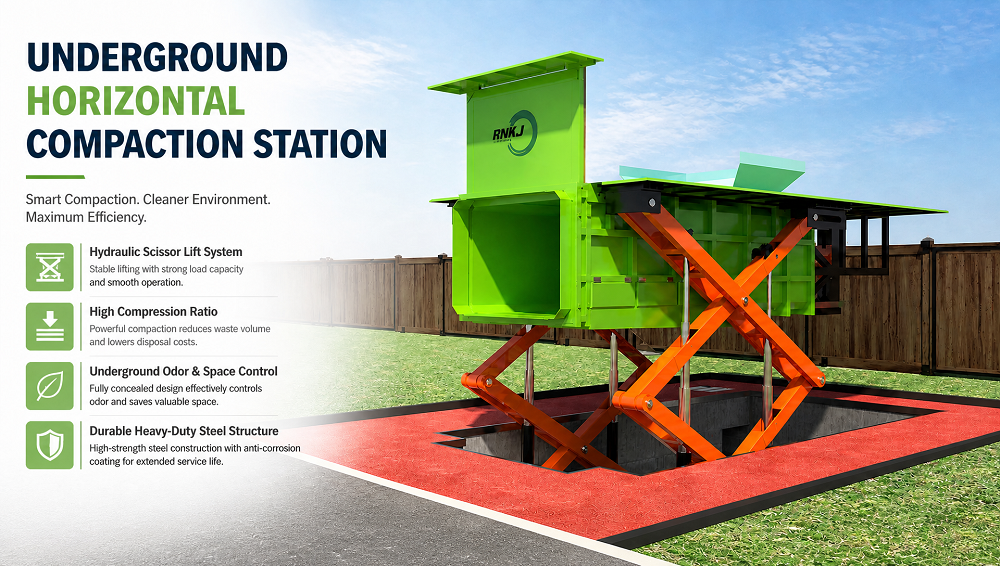
An Underground Horizontal Compaction Station offers an integrated solution for municipal solid waste collection and preliminary compaction. By combining underground installation, horizontal hydraulic compression, and a lifting system, this equipment provides a practical way to collect and store municipal waste in a relatively compact area.
For municipalities, sanitation departments, residential communities, and public infrastructure projects, an underground horizontal garbage compaction station can be customized according to waste volume, site conditions, and collection requirements.
But is this equipment suitable for municipal waste collection? Understanding its structure, working process, application scenarios, and configuration options can help project planners make a more informed decision.
Municipal waste management involves collecting household garbage, commercial waste, and other general solid waste from different locations before transporting it to transfer stations or disposal facilities.
In densely populated urban areas, conventional garbage collection points may encounter several problems.
Limited Space for Waste Storage
Urban residential areas, public squares, commercial districts, and municipal facilities often have limited available space. Installing large above-ground garbage collection equipment may affect pedestrian access, vehicle movement, and the surrounding environment.
An underground waste compaction station places its main equipment and waste storage structure below ground level, helping reduce the amount of equipment occupying the visible ground area.
Frequent Garbage Collection and Transportation
Municipal waste is generated continuously. When garbage is stored without compaction, collection containers can fill up quickly, requiring more frequent transportation.
A hydraulic waste compaction system compresses loose garbage into a denser mass, allowing the collection chamber to accommodate more waste within its available volume. The actual storage capacity depends on waste composition, moisture content, compression force, and equipment configuration.
Environmental and Sanitation Requirements
Garbage collection areas need to be managed carefully to reduce exposure to waste, unpleasant odors, scattered garbage, and liquid leakage.
An appropriately designed underground horizontal compaction station can incorporate an enclosed compression chamber, sealed collection structure, and liquid collection arrangements where required.
These features help improve the management of municipal waste collection points.
An Underground Horizontal Compaction Station uses a horizontal hydraulic compression structure to compact municipal solid waste inside an underground chamber.
Unlike ordinary garbage containers, it integrates waste loading, mechanical compression, temporary storage, and lifting functions into one system.
Its operation generally includes the following stages:
Step 1: Municipal Waste Loading
Garbage is delivered to the designated feeding opening through collection vehicles, waste bins, or other compatible feeding arrangements.
The feeding structure can be configured according to the waste collection method used by the municipality.
Step 2: Horizontal Hydraulic Compression
After entering the compression chamber, the waste is pushed by a hydraulic compression mechanism.
The horizontal pushing structure applies hydraulic pressure to move and compress the garbage inside the chamber. Repeated feeding and compression operations gradually build up the stored waste mass.
Step 3: Underground Waste Storage
After compression, the waste remains inside the designated collection chamber.
The underground installation helps keep the main equipment and waste storage structure below ground level, making the collection point more suitable for urban environments where ground space and appearance are important.
Step 4: Hydraulic Lifting and Waste Removal
When the collection chamber reaches its preset loading level, the lifting mechanism raises the relevant equipment or collection structure to the ground for waste removal.
Depending on the project design, the station can use a scissor lift system or another suitable hydraulic lifting configuration.
Step 5: Waste Transportation
After the waste is removed, the equipment returns to its working position and continues receiving municipal garbage.
The specific unloading and transportation method should be determined according to the station structure and the municipality's waste transportation arrangements.
The horizontal compression design is an important feature of an Underground Horizontal Compaction Station.
For municipal waste collection projects, the equipment needs to process different types of everyday solid waste while maintaining a stable and organized compression process.
Several structural characteristics make horizontal compaction worth considering.
The horizontal compression chamber uses a hydraulic pushing mechanism to move waste in one direction.
This arrangement provides a defined compression path and allows the equipment to compact garbage within the designed chamber.
For municipal projects that handle mixed household waste, packaging materials, and general commercial garbage, the compression configuration can be selected according to the expected waste composition.
An Integrated Underground Horizontal Compaction Station combines the main compression equipment, underground installation structure, hydraulic system, and lifting mechanism into a coordinated solution.
The integrated design helps simplify equipment arrangement and allows project engineers to plan the installation space, operating position, and maintenance access together.
A scissor lift mechanism is an optional lifting configuration for underground horizontal compaction equipment.
Its crossed support arms extend and retract under hydraulic control, producing vertical lifting movement.
The scissor lift structure can provide a stable lifting arrangement when properly engineered for the equipment's rated load, lifting height, and operating conditions.
For municipal waste collection projects, the lifting system should be designed according to the underground pit dimensions, equipment weight, required lifting stroke, and available installation space.
Municipal waste collection points are often located close to residential buildings, roads, commercial facilities, and public spaces.
An enclosed collection structure helps contain waste within the designated chamber. Additional sealing and liquid collection configurations can be considered according to the waste characteristics and local environmental requirements.
An Underground Horizontal Compaction Station is suitable for different municipal and public waste collection applications, particularly where underground installation and centralized garbage collection are required.
Residential communities generate daily household waste from apartments, residential buildings, and shared public areas.
An underground horizontal garbage compaction station can serve as a centralized collection point for multiple residential buildings.
Its underground arrangement helps reduce the visible footprint of garbage collection equipment, while hydraulic compaction allows waste to be stored more densely before transportation.
Urban roads, public squares, parks, and pedestrian areas require organized garbage collection facilities.
Installing underground waste compaction equipment in designated locations can help municipalities manage waste without placing large collection equipment above ground.
Before installation, project planners should evaluate underground pipelines, traffic access, pedestrian safety, and maintenance space.
Shopping centers, supermarkets, restaurants, and commercial buildings generate considerable amounts of packaging waste and general garbage.
An underground horizontal compaction station can be configured as a centralized waste collection facility for these locations.
The feeding opening, chamber capacity, and compression configuration should match the waste generation volume and daily collection schedule.
Some municipal sanitation projects require intermediate waste collection points before garbage is transported to a larger transfer station or treatment facility.
An Underground Horizontal Compaction Station can provide preliminary waste compaction and temporary storage at these locations.
Its capacity and unloading configuration should be coordinated with the available waste transportation vehicles.
Capacity is one of the most important considerations when selecting a Municipal Waste Compaction Station.
An undersized station may require frequent unloading, while an oversized unit may increase equipment investment and occupy unnecessary underground space.
For municipal projects, the capacity should be evaluated according to several factors.
Daily Waste Generation
Estimate the total amount of garbage produced at the collection point every day.
For example, a residential community with several thousand residents may require a different storage configuration from a small public facility or commercial complex.
Waste Composition
Household garbage, packaging materials, commercial waste, and wet waste have different physical properties.
Waste density, moisture content, and compressibility directly affect the practical loading capacity of the equipment.
Waste Collection Frequency
The interval between waste removal operations influences the required storage volume.
Projects with longer transportation intervals may need a larger collection chamber or a higher effective storage capacity.
Available Installation Space
The underground pit dimensions, lifting height, equipment layout, and vehicle access must be considered before determining the final model.
For different municipal sanitation projects, our underground horizontal compaction stations can be customized with capacities ranging from 6 CBM to 30 CBM, depending on the equipment design and project requirements.
The final capacity should be selected after evaluating actual waste volume, compression performance, and collection arrangements.
Different municipalities have different waste collection standards, site conditions, and operating requirements.
A standard configuration may not be suitable for every project. Therefore, an Underground Horizontal Compaction Station should be designed according to the actual application.
Common customization options include:
1. Equipment Capacity
The collection chamber can be designed according to the required storage volume, with project-specific capacity options within the 6–30 CBM range.
2. Hydraulic Compression System
The hydraulic power unit, compression mechanism, operating pressure, and control configuration can be evaluated according to the waste type and required operating performance.
3. Hydraulic Lifting Structure
A scissor lift system or another suitable hydraulic lifting arrangement can be selected based on the required lifting height, installation pit dimensions, and equipment load.
4. Underground Chamber Dimensions
The equipment dimensions and underground installation structure should be coordinated with the available construction space.
Civil engineering requirements, foundation conditions, drainage, and underground utility locations must also be considered.
5. Feeding Configuration
The feeding opening and loading arrangement can be designed according to the garbage collection method, including compatible waste bins or other project-specific feeding equipment.
6. Safety and Environmental Features
Optional configurations may include safety interlocks, emergency stop devices, protective covers, enclosed collection structures, and liquid collection systems.
The final configuration should comply with applicable local safety and environmental standards.
When planning a municipal waste collection facility, project managers may compare underground compaction equipment with conventional garbage containers and above-ground collection stations.
The main differences are related to waste storage, compression, installation, and equipment arrangement.
| Comparison | Underground Horizontal Compaction Station | Traditional Garbage Collection Container |
|---|---|---|
| Installation | Underground installation | Usually above ground |
| Waste compression | Hydraulic horizontal compression | Usually no integrated compression |
| Storage | Enclosed compression and collection chamber | Container storage volume |
| Space arrangement | Main equipment installed below ground | Container occupies ground space |
| Waste handling | Integrated mechanical compaction | Conventional loading and collection |
| Customization | Capacity, lifting, and hydraulic configuration | Mainly container dimensions and volume |
| Application | Municipal and centralized waste collection | General waste collection points |
A traditional garbage container may be sufficient for locations with relatively low waste generation or simple collection requirements.
However, for municipal projects that require centralized collection, mechanical compaction, and underground equipment installation, an underground horizontal compaction station may provide a more suitable solution.
The selection should ultimately depend on project budget, waste volume, site conditions, and operational requirements.
Choosing the right Underground Horizontal Compaction Station requires more than comparing equipment capacity or purchase price.
Municipal buyers should evaluate the following details before requesting a quotation.
Daily Waste Volume: How much municipal garbage needs to be processed each day?
Waste Characteristics: Does the project mainly handle household garbage, commercial waste, packaging materials, or wet waste?
Compression Requirements: What compression configuration is appropriate for the expected waste composition?
Lifting Height: How deep is the underground installation pit, and what lifting stroke is required?
Installation Conditions: Are the foundation, drainage, underground pipelines, and maintenance access properly planned?
Transportation Method: How will compacted waste be removed and transported?
Maintenance Requirements: Can the hydraulic system and mechanical components be inspected and serviced conveniently?
Customization Requirements: Does the project need special feeding arrangements, liquid collection, or additional safety configurations?
Providing these details to an Underground Horizontal Compaction Station Manufacturer will help the supplier evaluate the project and recommend a more appropriate equipment configuration.
Municipal waste collection projects often involve multiple operating conditions, including different daily waste volumes, site dimensions, transportation arrangements, and environmental requirements.
A customized underground horizontal compaction station allows the equipment structure to be matched to these actual conditions.
With a configurable capacity range, horizontal hydraulic compression mechanism, and optional scissor lift design, the equipment can be developed for different municipal sanitation applications.
As a professional waste compaction equipment manufacturer, we provide customized underground horizontal compaction solutions for municipal waste collection, residential communities, commercial complexes, and centralized sanitation facilities.
Our equipment configuration can be evaluated according to:
6–30 CBM customized capacity
Integrated underground installation structure
Horizontal hydraulic compression mechanism
Optional scissor lift hydraulic lifting system
Customized feeding and collection arrangements
Project-specific hydraulic and control configurations
Optional enclosed structure and liquid collection arrangements
Whether you are planning a new municipal waste collection point or upgrading an existing garbage collection facility, selecting the appropriate equipment configuration is essential for long-term operation.
Yes. An Underground Horizontal Compaction Station can be a suitable solution for municipal waste collection projects that require centralized garbage storage, hydraulic compression, and underground equipment installation.
Its horizontal compression mechanism, enclosed collection structure, and optional scissor lift system make it adaptable to different urban sanitation projects.
However, the right equipment should always be selected according to daily waste generation, waste composition, underground installation conditions, lifting requirements, and transportation arrangements.
If you are looking for a Municipal Waste Compaction Station for a residential community, commercial district, or municipal sanitation project, a customized underground horizontal compaction solution can be developed to match your project requirements.


