
Views: 0 Author: Site Editor Publish Time: 2026-11-04 Origin: Site


When planning a municipal waste collection station, residential waste management facility, or commercial garbage disposal project, understanding the cost of an underground garbage compactor is an important part of the purchasing process. Different projects require different equipment configurations, storage capacities, hydraulic systems, and lifting mechanisms. As a result, the price of an underground garbage compactor can vary significantly depending on its design and technical specifications.
An underground garbage compactor is not simply a standard garbage container installed below ground. It is an integrated waste collection and handling system that may include a storage container, hydraulic compression unit, lifting platform, electrical control system, and safety protection components. Each configuration affects the manufacturing cost, installation requirements, and overall project investment.
If you are comparing underground garbage compactor suppliers or preparing a purchasing budget, it is important to understand what determines the equipment price. This guide explains the major factors affecting the cost of an underground garbage compactor and how to select a suitable configuration without paying for unnecessary features.
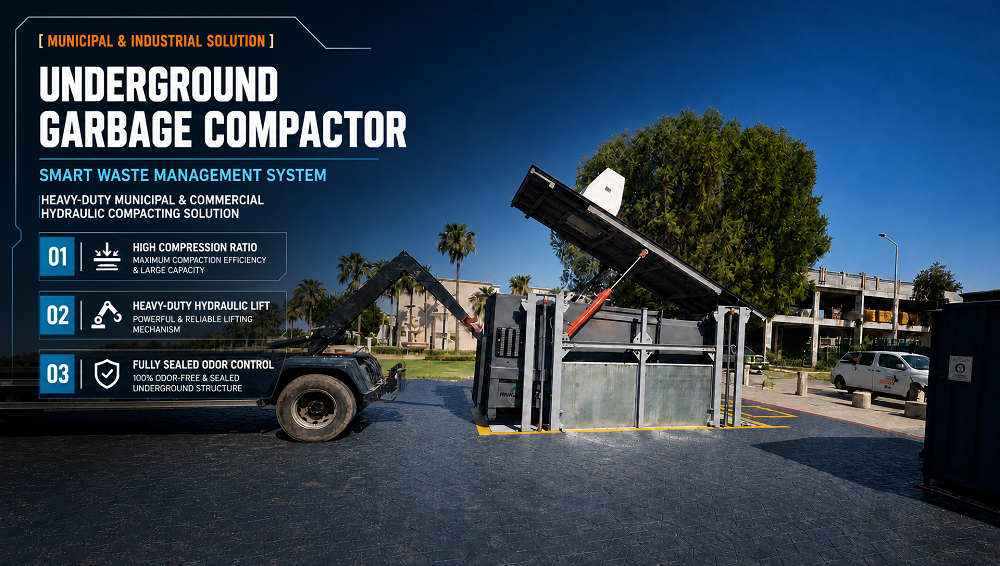
One of the most important factors affecting the cost of an underground garbage compactor is its storage capacity.
Different waste collection projects generate different amounts of daily waste. A residential community may require a relatively compact underground waste collection unit, while a large commercial complex or municipal sanitation project may need a larger container to handle higher waste volumes.
The capacity directly affects the dimensions, steel consumption, structural reinforcement, and manufacturing workload of the equipment.
For example, a larger underground garbage compactor generally requires:
A larger waste storage container.
More structural steel for the container body.
A stronger supporting frame.
A suitable hydraulic lifting mechanism.
Additional design considerations for equipment stability and load distribution.
For projects with limited underground space, container dimensions and lifting height must also be considered rather than focusing only on nominal capacity.
When requesting a quotation, buyers should provide the expected daily waste volume, required storage capacity, available installation dimensions, and waste collection frequency.
A professional underground garbage compactor manufacturer can recommend an appropriate capacity based on the actual project conditions instead of simply offering the largest available model.
The hydraulic compression system is another major component influencing the cost of an underground garbage compactor.
For equipment designed with hydraulic compression, the system typically includes hydraulic cylinders, an oil pump, a hydraulic power unit, control valves, pipelines, and related components. These components work together to generate the pressure required for waste compaction.
Different hydraulic configurations can result in different manufacturing costs.
Important factors include:
The cylinder diameter, stroke length, working pressure, and load requirements determine the hydraulic cylinder configuration. Equipment designed for larger waste volumes or more demanding operating conditions may require stronger hydraulic components.
The hydraulic power unit provides the pressure and flow required by the compression and lifting mechanisms. Its motor power, pump specifications, and operating configuration affect the overall equipment cost.
Control valves, hydraulic pipelines, sealing components, and pressure protection devices also contribute to the system cost. Component quality and configuration should be evaluated together rather than focusing only on the motor power.
The design of the compression chamber and pushing mechanism also affects the hydraulic requirements. Different equipment structures may require different cylinder arrangements and pushing forces.
When comparing quotations, buyers should ask for details about the hydraulic system, including its main components, operating pressure, cylinder specifications, and control configuration.
Choosing a suitable hydraulic system is more important than simply selecting the equipment with the highest advertised pressure.
Unlike conventional above-ground waste compactors, an underground garbage compactor often requires a lifting mechanism to raise the underground container or equipment platform to ground level for waste removal and maintenance.
The lifting structure is therefore an important factor in the overall equipment price.
Different projects may require different lifting heights, platform dimensions, lifting capacities, and structural arrangements.
The main cost-related considerations include:
Lifting Height: The required lifting distance depends on the underground installation depth and ground-level layout.
Load Capacity: The lifting structure must support the combined weight of the container, stored waste, and associated equipment.
Hydraulic Lifting Cylinders: Cylinder specifications depend on the lifting load and platform movement requirements.
Supporting Frame: The frame must provide sufficient structural strength and stability during lifting and lowering operations.
Safety Protection: Mechanical locking devices, limit switches, and other protective components may be included according to the project requirements.
A deeper underground installation or a larger container may require a more substantial lifting structure, which can increase the manufacturing cost.
Before purchasing, buyers should confirm the underground pit dimensions, required platform height, container weight, and lifting method. These details help manufacturers design a lifting system that matches the actual installation conditions.
The container body is another important part of the underground garbage compactor and has a direct influence on equipment durability and manufacturing costs.
Because the container is designed for waste storage and may operate in an underground environment, material selection and structural design should be considered carefully.
Common material options include carbon steel grades such as Q235 and Q345. The final material selection depends on the equipment structure, load requirements, operating environment, and customer specifications.
Several factors influence the container manufacturing cost:
Different steel grades have different mechanical properties and purchasing costs. Higher-strength materials may be considered for components that require additional load-bearing capacity.
The thickness of the bottom plate, side plates, reinforcing plates, and supporting structures affects material consumption and structural strength.
Reinforcing ribs, support beams, and additional structural components may be required for larger containers or demanding operating conditions.
Cutting, forming, welding, assembly, and surface treatment all contribute to manufacturing costs. Consistent welding quality is particularly important for container strength and long-term service performance.
For projects with special environmental requirements, buyers may also request customized surface coatings or corrosion protection treatments.
It is important to balance material specifications with actual operating requirements. Excessive material thickness can increase equipment weight and cost without necessarily providing additional practical value.
The cost of an underground garbage compactor also depends on its equipment structure and functional configuration.
Not every underground waste collection project requires the same equipment arrangement. Some projects need a basic underground collection and lifting system, while others require integrated hydraulic compression and additional waste handling functions.
Typical configuration differences include:
A basic underground collection system mainly focuses on waste storage, lifting, and container removal. Its structure and functional requirements differ from those of a compression-equipped system.
This configuration integrates hydraulic compression into the underground waste handling process. It requires additional compression components, hydraulic controls, and related structural arrangements.
A fully enclosed design focuses on covering and enclosing the waste storage area. The enclosure structure, sealing arrangements, and access design may influence manufacturing costs.
For projects requiring waste sorting, multiple independent collection containers may be incorporated into the system. The number of classification compartments, container arrangement, and lifting structure affect the final configuration and price.
When selecting equipment, buyers should first determine whether the project requires waste collection only, hydraulic compression, or multiple waste classification functions.
Selecting the correct equipment type helps avoid unnecessary investment in features that are not required for the project.
Customization is another important factor affecting the cost of an underground garbage compactor.
Standard equipment configurations can help simplify manufacturing and reduce design work. However, many municipal and commercial waste management projects have specific site conditions that require customized equipment.
Common customization options include:
Customized container capacity and external dimensions.
Different underground installation depths.
Customized lifting platform dimensions and lifting heights.
Different hydraulic cylinder and power unit configurations.
Customized compression chamber dimensions.
Special container materials and plate thicknesses.
Customized electrical control systems.
Additional safety protection and operating functions.
Customized access covers and ground-level platform arrangements.
For example, a project with restricted underground space may require a specially designed container and lifting platform. A municipal waste collection station with higher daily waste volumes may need a larger storage capacity and a different hydraulic configuration.
These non-standard requirements can increase engineering design time, material consumption, and manufacturing costs.
To obtain an accurate quotation, it is recommended that buyers provide drawings, installation dimensions, equipment requirements, or project photographs whenever possible.
A manufacturer with in-house engineering and production capabilities can evaluate these requirements and provide a more suitable customized solution.
The electrical control system is responsible for coordinating equipment operation and controlling the hydraulic mechanisms.
Depending on the project requirements, an underground garbage compactor may use a basic control configuration or a more advanced electrical control system.
The price may be affected by:
Control cabinet specifications.
Electrical components and control circuit design.
Manual or automatic operating modes.
Limit switches and position detection.
Emergency stop functions.
Overload and pressure protection.
Safety interlocks for lifting and lowering operations.
For equipment installed in public areas, safety-related configurations should receive particular attention.
The lifting platform and hydraulic mechanisms need appropriate operating controls and protection devices to reduce the risk of incorrect operation.
Buyers should confirm which electrical and safety components are included in the quotation instead of assuming that all suppliers provide identical configurations.
Although the equipment manufacturing price is an important part of the purchasing budget, installation conditions can also influence the total project investment.
An underground garbage compactor normally requires a suitable underground pit, supporting foundation, lifting space, and necessary electrical connections.
Depending on the project, additional installation work may include:
Excavation and foundation construction.
Underground pit preparation.
Drainage arrangements.
Electrical power supply.
Equipment positioning and installation.
Hydraulic and electrical connections.
Commissioning and operational testing.
The actual installation cost depends on the construction conditions, soil characteristics, underground utilities, site accessibility, and local labor costs.
In some projects, the equipment supplier may provide the machinery only, while civil engineering and on-site installation are handled by the local contractor.
Therefore, buyers should clarify whether the quotation includes equipment manufacturing, transportation, installation guidance, commissioning, and other project-related services.
Understanding the division of responsibilities helps prevent unexpected expenses during project implementation.
Transportation and after-sales services are also worth considering when evaluating the total cost of an underground garbage compactor.
Because underground garbage compactors contain large steel structures and hydraulic components, transportation arrangements depend on equipment dimensions, weight, and delivery destination.
The quotation may be influenced by:
Equipment packaging and loading requirements.
Transportation distance and shipping method.
Export packaging and documentation.
Spare parts and accessories.
Installation guidance.
Technical support and after-sales service.
For international buyers, it is important to confirm the shipping terms, delivery location, estimated production lead time, and scope of technical support.
A supplier offering a lower equipment price may not necessarily provide the same delivery arrangements or after-sales services as another manufacturer.
Comparing the complete quotation is more useful than evaluating the initial equipment price alone.
If you are planning to purchase an underground garbage compactor, providing detailed project information is the most effective way to obtain an accurate quotation.
Instead of requesting a price based only on the product name, buyers should communicate their technical requirements and installation conditions.
The following information is particularly useful:
| Information Required | Details to Confirm |
|---|---|
| Equipment Type | Underground garbage compactor, collection system, or classification system |
| Storage Capacity | Required container capacity and daily waste volume |
| Installation Dimensions | Underground pit length, width, and depth |
| Lifting Requirements | Platform dimensions, lifting height, and load capacity |
| Compression System | Required compression configuration and hydraulic specifications |
| Container Material | Q235, Q345, or other customized materials |
| Electrical Control | Manual or automatic control and safety requirements |
| Project Application | Municipal sanitation, residential communities, commercial complexes, or industrial facilities |
| Delivery Location | Destination country, port, or project site |
With this information, the manufacturer can evaluate the required structure, hydraulic configuration, material specifications, and production requirements.
This makes it easier to provide a project-specific quotation rather than a general estimated price.
The cost of an underground garbage compactor is determined by multiple factors, including equipment capacity, hydraulic compression configuration, lifting structure, container material, functional design, customization requirements, and installation conditions.
A lower initial price does not always mean better purchasing value. Equipment that does not match the actual project requirements may result in additional modifications, installation difficulties, or unnecessary maintenance expenses.
For municipal sanitation projects, residential communities, commercial complexes, and other waste collection applications, selecting the right equipment configuration is essential for controlling investment and achieving reliable operation.
As an experienced underground garbage compactor manufacturer, Shandong RNKJ Environmental Technology Co., Ltd. provides customized underground waste compaction and collection equipment according to different project requirements.
We can evaluate container capacity, hydraulic systems, lifting structures, steel material specifications, and other technical details to develop a suitable solution for your application.
Looking for an underground garbage compactor that matches your project budget and installation requirements?


