
Views: 0 Author: Site Editor Publish Time: 2026-11-03 Origin: Site


In industrial and municipal waste management, handling large amounts of waste efficiently requires more than a conventional compression machine. Many waste collection facilities, manufacturing plants, commercial properties, and municipal sanitation projects need equipment that can process waste continuously without frequent manual intervention or repeated loading cycles.
A Screw Waste Compactor is designed to meet these requirements through a mechanical screw conveying and compression system. Unlike conventional waste compactors that mainly rely on a hydraulic pushing plate to compress waste in batches, a screw waste compactor uses a rotating screw mechanism to move waste forward while applying pressure during the conveying process.
This working principle makes an Industrial Screw Waste Compactor a suitable option for waste handling operations that require continuous feeding, controlled material movement, and relatively stable processing.
But what exactly makes this equipment suitable for continuous waste processing? How does its screw mechanism work, what types of waste can it handle, and what should buyers consider when selecting a suitable machine?
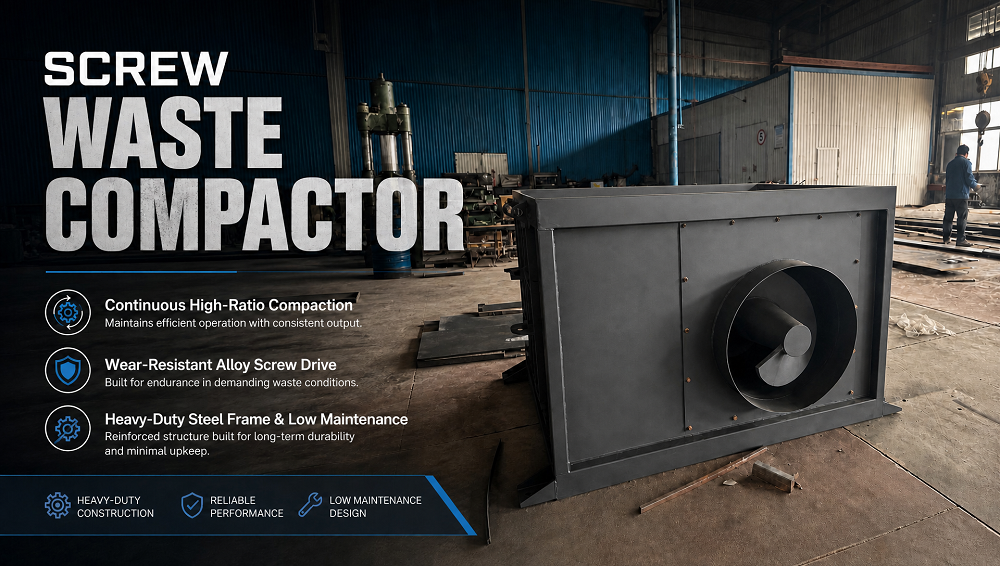
A Screw Waste Compactor, also known as a Screw Garbage Compactor or Screw Type Waste Compactor, is a mechanical waste handling machine that uses a rotating helical screw to convey and compress waste materials.
The main working component is a heavy-duty screw shaft installed inside a specially designed conveying and compression chamber. When the motor and drive system operate, the screw rotates and pushes incoming waste toward the discharge end.
As waste moves through the chamber, the available space and mechanical resistance create compression pressure. The waste gradually becomes more compact before being discharged or collected in a designated container.
A typical industrial screw waste compactor may include the following components:
Feeding Hopper: Receives waste materials from manual loading, conveyor systems, or other feeding equipment.
Screw Conveyor Assembly: Uses a rotating spiral blade to transport waste continuously through the machine.
Compression Chamber: Provides the enclosed working space where waste is conveyed and compressed.
Drive Motor and Gearbox: Supplies the rotational power required to operate the screw mechanism.
Discharge Section: Guides the compressed material toward a collection container or downstream handling system.
Electrical Control System: Controls equipment operation and coordinates the motor, feeding system, and safety devices.
Supporting Frame: Provides structural support for the entire machine during operation.
The screw diameter, pitch, shaft structure, chamber dimensions, motor power, and discharge configuration can be evaluated according to the waste characteristics and required processing capacity.
The main advantage of a screw waste compactor is its conveying-based compression process.
Instead of stopping after every compression cycle to receive another load, the rotating screw can continuously move incoming material through the machine while compression takes place along the conveying path.
The process begins when waste enters the feeding hopper.
Depending on the project configuration, materials can be supplied through a conveyor belt, feeding hopper, automatic loading equipment, or other compatible feeding systems.
Once the waste enters the machine, the rotating screw blade pushes it forward along the compression chamber.
This arrangement allows the feeding process and material conveying process to operate continuously, provided that the upstream feeding equipment supplies waste at a suitable rate.
For industrial facilities with a relatively stable waste output, this design can help establish a more organized waste handling workflow.
As the screw rotates, its spiral blade generates forward movement and applies mechanical pressure to the waste.
The material is gradually transported toward the discharge section, where the chamber structure and discharge resistance influence the compression process.
Unlike a traditional hydraulic compactor that relies primarily on reciprocating pushing movements, a Continuous Screw Waste Compactor integrates material conveying and compression into one operating process.
The actual compression performance depends on several factors, including:
Screw diameter and pitch
Rotational speed
Motor power and torque
Compression chamber design
Waste density and composition
Material moisture content
Discharge resistance
These parameters should be matched to the actual waste handling requirements rather than selected only according to the machine's overall dimensions.
After passing through the compression section, processed waste moves toward the discharge outlet.
The discharge configuration can be designed according to the downstream collection method. For example, the machine may discharge materials into a collection container or connect with another waste handling system.
A suitable discharge arrangement helps maintain the connection between feeding, compression, and waste collection.
For projects requiring long operating periods, the feeding capacity, screw conveying speed, compression conditions, and discharge capacity should be properly coordinated.
The screw assembly is the central working component of an industrial screw garbage compactor. Its design directly affects material transportation, compression performance, and operating stability.
The screw mechanism works through rotational movement rather than repeated forward-and-backward pushing cycles.
As long as the drive system operates within its designed working conditions, the screw can continuously transport incoming waste toward the discharge end.
This makes it suitable for production environments where waste is generated throughout the day.
A screw waste compactor combines two important functions within one machine:
Conveying waste from the feeding section to the discharge section.
Applying mechanical pressure during material movement.
This integrated structure can reduce the need for separate conveying and compression operations in appropriately designed projects.
Different waste materials have different physical characteristics.
For example, loose packaging waste, industrial production residues, and wet organic waste may require different screw configurations.
The screw diameter, spiral pitch, blade thickness, shaft strength, and rotational speed can be evaluated according to the material being processed.
For applications involving bulky or irregular waste, the feeding opening and screw structure should also be designed to reduce material accumulation and feeding difficulties.
A properly matched screw assembly helps the machine maintain a more consistent material conveying process.
An Industrial Screw Waste Compactor can be considered for different waste handling applications, but its suitability depends on the physical characteristics of the incoming materials and the machine configuration.
Common applications include:
Municipal waste collection facilities often handle mixed household waste, packaging materials, and other daily solid waste.
A screw garbage compactor can be integrated into a centralized waste handling system to convey and compress compatible materials before collection or further processing.
For municipal projects, buyers should evaluate waste composition, daily processing volume, feeding arrangements, and the required discharge configuration.
Shopping centers, supermarkets, hotels, office buildings, and large commercial properties generate waste throughout their operating hours.
A continuous screw waste compactor may be suitable for projects that require a centralized feeding and waste collection arrangement.
It can help organize the movement of compatible waste materials from the feeding point to the designated collection area.
Manufacturing facilities may generate packaging waste, production residues, and other industrial solid waste.
An industrial screw waste compactor can be configured to process suitable materials according to their size, density, moisture content, and conveying characteristics.
For industrial applications, it is particularly important to check whether the waste contains oversized objects, long strips, hard materials, or components that could cause screw blockage or excessive mechanical wear.
Some packaging materials occupy considerable storage space despite having relatively low weight.
Depending on the material structure and machine configuration, a screw waste compactor can be used to convey and compress compatible packaging waste.
The feeding opening, screw geometry, and discharge arrangement should be selected according to the actual material dimensions and required processing results.
Wet waste and organic waste require additional consideration because of their moisture content and material consistency.
For these applications, the machine may need a specially evaluated screw structure, sealed conveying chamber, corrosion-resistant material options, and liquid collection arrangements where necessary.
Not every standard screw compactor is suitable for wet waste. The actual material condition should be assessed before determining the equipment configuration.
Both screw waste compactors and conventional hydraulic waste compactors are used to reduce waste volume, but their mechanical structures and operating processes are different.
| Comparison | Screw Waste Compactor | Conventional Hydraulic Waste Compactor |
|---|---|---|
| Main working mechanism | Rotating screw assembly | Hydraulic compression cylinder and pushing plate |
| Material movement | Continuous screw conveying | Reciprocating pushing movement |
| Compression process | Conveying and compression along the chamber | Compression through individual pushing cycles |
| Feeding arrangement | Can support continuous feeding | Usually receives waste according to the compression cycle |
| Operating mode | Designed for continuous material processing | Commonly operates through repeated compression cycles |
| Typical configuration | Screw shaft, motor, gearbox, chamber, discharge | Hydraulic station, cylinder, compression chamber, pushing plate |
| Application focus | Continuous conveying and processing | Batch or cycle-based waste compression |
The main difference is the way materials move through the equipment.
A screw waste compactor uses rotational movement to transport waste through the chamber, while a conventional hydraulic waste compactor generally uses a hydraulic pushing plate to compress accumulated waste.
For facilities with a relatively continuous waste output and compatible materials, a screw waste compactor may provide a suitable processing arrangement.
For projects that mainly require periodic collection and compression of large batches of waste, a hydraulic waste compactor may be more appropriate.
The right choice depends on waste characteristics, daily output, site layout, and the required waste collection process.
When selecting a High Capacity Screw Waste Compactor, processing capacity is one of the most important technical considerations.
However, the actual capacity cannot be determined by the machine model or motor power alone.
Several parameters need to be considered together.
Different materials behave differently during screw conveying and compression.
Loose waste may occupy a large volume but contain relatively little mass. Denser materials may require greater driving torque and stronger structural components.
Therefore, equipment selection should begin with an understanding of the actual waste composition.
The screw diameter determines the available conveying space, while the spiral pitch affects how material moves along the shaft.
A larger screw diameter does not automatically mean higher effective processing capacity.
The screw geometry must match the material characteristics, required throughput, and compression conditions.
The motor and gearbox provide the driving force for the screw assembly.
Their specifications should be selected according to the expected material resistance, screw dimensions, rotational speed, and operating requirements.
For heavy-duty industrial applications, sufficient torque and appropriate transmission protection are important considerations.
The feeding system directly influences the actual operating output.
If the feeding equipment cannot supply materials consistently, the screw compactor cannot operate at its intended processing rate.
For automated installations, the feeding conveyor, hopper dimensions, and control system should be coordinated with the main machine.
The discharge section must be able to handle the processed material without creating unnecessary accumulation.
The collection container or downstream equipment should also have sufficient capacity to support the required operating period.
A complete system evaluation should consider feeding, conveying, compression, discharge, and collection as one integrated process.
Yes. A Custom Screw Waste Compactor can be configured according to project requirements, waste characteristics, and site conditions.
Different customers may have different processing targets, feeding arrangements, installation spaces, and automation requirements.
A customized machine can be evaluated in several aspects.
The machine can be designed according to the expected daily waste volume and required processing rate.
For projects with higher waste output, the screw dimensions, drive configuration, and feeding system may need to be adjusted accordingly.
The feeding hopper can be designed to connect with different upstream equipment.
Possible configurations include:
Manual feeding openings
Conveyor belt feeding
Automatic hopper feeding
Integrated feeding systems
Customized feeding interfaces
The feeding opening should be suitable for the size and shape of the incoming materials.
The screw shaft and spiral blade can be evaluated according to waste composition and mechanical loading conditions.
Different screw pitches, diameters, blade thicknesses, and structural designs may be considered to accommodate different materials.
For abrasive or heavy materials, wear-resistant material options may also be evaluated.
The drive system can be selected according to the required operating conditions.
Depending on the project, optional configurations may include variable-frequency speed control, automatic start and stop functions, overload protection, and coordinated control with upstream feeding equipment.
These functions can help match the equipment operation with the actual production workflow.
The discharge section can be adapted to the required material collection method.
Depending on the site layout, the machine may be connected to a waste collection container, conveyor system, or other downstream processing equipment.
The installation height, outlet dimensions, and connection positions should be confirmed before manufacturing.
An automatic screw waste compactor can be integrated with an upstream feeding system to reduce the need for frequent manual loading.
In a properly configured installation, the feeding equipment supplies waste to the hopper, while the screw assembly transports and compresses the incoming materials.
The electrical control system can coordinate the operation of the feeding equipment and the main machine.
For example, the system may use level sensors or other control signals to regulate feeding according to the material level and operating conditions.
Potential benefits of an automatic feeding configuration include:
More consistent material supply.
Reduced manual feeding requirements.
Better coordination between feeding and conveying.
More organized waste handling procedures.
Easier integration with centralized waste processing systems.
However, automation does not mean that the machine can operate without monitoring or maintenance.
The feeding rate must remain compatible with the screw compactor's actual processing capacity. Overfeeding may cause material accumulation, excessive load, or blockage.
For continuous operation, the entire system should be designed around a coordinated feeding and discharge process.
Choosing the right Industrial Screw Waste Compactor requires more than comparing equipment prices or external dimensions.
Before requesting a quotation, buyers should prepare the following project information.
Describe the waste materials that need to be processed, including their size, density, moisture content, and composition.
Provide the estimated daily waste output and the required processing rate. This information helps determine the appropriate equipment capacity.
Confirm whether the machine will receive waste through manual loading, conveyor belts, automatic feeding equipment, or another system.
Specify whether the machine needs to operate intermittently, for several hours per day, or continuously during production periods.
Provide the available installation dimensions, including machine length, width, height, maintenance clearance, and feeding and discharge positions.
Explain how the processed waste should be collected, transferred, or connected to downstream equipment.
Confirm the available power supply, voltage, frequency, and any local electrical standards.
Determine whether the project requires automatic feeding, variable-speed control, sensor-based operation, or integration with an existing production line.
Providing these details allows the manufacturer to evaluate the machine configuration more accurately and recommend a suitable solution.
A standardized machine may not meet every project's specific waste handling requirements.
For municipal waste stations, industrial facilities, and commercial waste collection projects, equipment configuration should be based on the actual working environment.
A customized screw waste compactor can be evaluated according to:
Required processing capacity.
Waste material characteristics.
Screw diameter and structural design.
Motor power and transmission configuration.
Feeding hopper dimensions.
Automatic feeding requirements.
Discharge and collection arrangements.
Installation conditions and electrical specifications.
For projects involving different waste materials or relatively high daily waste output, these configuration details are particularly important.
Working with an experienced Screw Waste Compactor Manufacturer also allows buyers to discuss the complete equipment structure, technical parameters, and project-specific requirements before production.
Rather than selecting a machine based only on its advertised capacity, buyers should evaluate whether the entire system can support their actual waste handling process.
If your facility generates waste continuously and requires an organized conveying and compression solution, an industrial screw waste compactor may be worth considering.
Our company provides customized waste compaction equipment for different municipal, commercial, and industrial applications.
We can evaluate screw structure, processing capacity, motor configuration, feeding hopper design, and discharge arrangements according to your project requirements.
Whether you need an automatic feeding screw garbage compactor, a continuous operation screw waste compactor, or a customized industrial screw compactor, the equipment configuration can be discussed based on your actual waste materials and installation conditions.
Contact us to discuss your screw waste compactor project and request a customized quotation.
To help us recommend a suitable configuration, please provide:
Waste type and material characteristics
Estimated daily waste volume
Required processing capacity
Feeding method
Expected operating hours
Installation dimensions
Discharge and collection requirements
Our team can evaluate your requirements and provide an equipment solution for your waste handling application.


