Views: 4 Author: Site Editor Publish Time: 2026-04-07 Origin: Site


The Hydraulic Hopper Garbage Compactor is an integrated, all-in-one compression device with a compact structure, convenient operation, and flexible mobility. It is mainly suitable for scenarios with small garbage production volumes and limited operation areas, such as urban residential areas, community streets, and small-scale garbage transfer stations in towns. The device integrates functions of material feeding, compression, storage, and sealed storage. The entire box can be lifted and transported as a whole by a garbage truck with a boom arm, without the need for disassembly and assembly of a separate structure. The entire process is carried out in a sealed manner, effectively preventing problems such as garbage spillage, sewage leakage, and odor diffusion. The entire operation process has a high degree of automation and is simple to maintain.
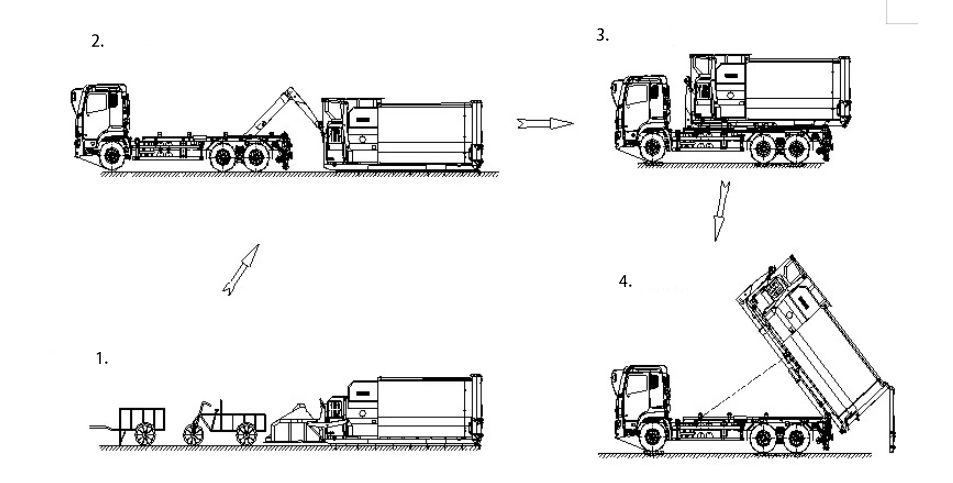
The Hydraulic Hopper Garbage Compactor relies on the on-board hydraulic power system to complete the entire process of box transportation, loading and unloading. With a set of linked hydraulic mechanisms, it realizes the three core processes of garbage box separation hoisting, vehicle loading, and lifting and dumping. It is a mainstream equipment in the field of urban waste collection and transportation. The entire operation process can be divided into four consecutive steps, and it achieves automated operation through the mechanical linkage of hydraulic cylinders and boom lifting mechanisms.

Before the operation, the empty-load boom-type sanitation transfer vehicle travels to the designated operation area of the garbage transfer station. The vehicle precisely aligns and stops, applying the brakes for parking. The operator starts the on-board hydraulic control system and controls the hydraulic lifting arm mechanism to move slowly, precisely hooking onto the special lifting ears of the compressed box body, smoothly lowering the integrated empty compressed box body from the vehicle body. The entire process is carried out at a constant speed, avoiding any collision or tilt of the box body. After the box body lands, manual assistance is provided to adjust its position to ensure it is level and aligned with the operation ground, guaranteeing stable and error-free subsequent feeding and compression operations of the equipment. Once the box body is fully positioned and fixed, the on-board boom arm mechanism is retracted, and the boom arm vehicle leaves the operation area and parks at the designated standby position, waiting for the full-box transfer instruction, completing the equipment positioning preparation before the operation.
The daily cleaning and collection of domestic garbage in residential areas and towns are uniformly collected by sanitation tricycles, electric cleaning collection vehicles, and small garbage collection vehicles. They then proceed orderly to the operation area and collectively pour various types of household garbage and lightweight debris into the inverted feeding hopper at the front of the equipment. This allows for the complete and batch collection and feeding of garbage in one operation. After the feeding is completed, the operators manually operate through the equipment control panel or activate the fully automatic operation mode, starting the hydraulic cylinder of the feeding hopper to work. The hydraulic cylinder moves the feeding hopper at a constant speed, causing it to smoothly flip upward and lift, completely pouring all the garbage in the hopper into the compression chamber inside the box. There is no residue or spillage. After the garbage is dumped, the hydraulic cylinder automatically resets, causing the feeding hopper to slowly fall back to the initial horizontal position, locking in place, and waiting for the next round of garbage feeding operation, completing the garbage loading process in a cycle.
After the feeding process is completed, the equipment enters the core compression operation stage. It supports both PLC automatic intelligent operation and manual operation. It can be flexibly switched according to the amount of waste and operational requirements. After starting the hydraulic pump station, the entire hydraulic system supplies stable oil, driving the horizontal-arranged compression pusher oil cylinders inside the box to extend at a uniform speed, driving the high-strength wear-resistant push plate to advance smoothly forward, and conducting all-round compression, consolidation and volume reduction on the loose domestic waste in the compression bin. Through mechanical pressure compression, the volume of the waste pile is significantly reduced, effectively increasing the storage capacity of the box for waste, and solving the problem of large space occupation by loose waste and high frequency of transfer.
After a single compression is completed, the pusher oil cylinder automatically retracts and resets, leaving a new space for feeding. Staff can re-dispose waste, repeating the feeding, pushing, and retraction cycle operations, continuously conducting layered compaction of the waste. During the compression process, the filtrate and sewage contained in the waste will be separated under the pressure effect, and they will be uniformly discharged into the sewage collection pool provided by the site through the fine sewage drainage guide holes and sewage pipelines at the bottom of the box, achieving efficient solid-liquid separation of the waste, avoiding sewage accumulation in the box. At the same time, the equipment adopts an all-enclosed box structure. During the operation, there is no garbage exposure or sewage dripping, which can effectively prevent the spread of garbage odors and improve the working environment and reduce environmental pollution.
With multiple cycles of compression operations, the garbage inside the container continues to accumulate and be compressed, gradually reaching the rated loading volume and weight standard of the equipment. The equipment is equipped with high-precision travel sensors and full-load sensing devices, which can monitor the filling height and compression status of the container inside the box in real time. When the garbage fills the preset volume and reaches the full-load standard, the sensor immediately triggers a signal, and the equipment starts the sound and light full-box alarm system, alerting that the box is full and stopping the feeding operation.
At the same time, the equipment control system automatically triggers the shutdown protection mechanism. The hydraulic pump station stops working, the compression push head fully retracts and returns to its position, and is locked in place to prevent empty-load air compression and equipment overload operation. Subsequently, the dedicated hydraulic locking mechanism for the rear door of the box automatically starts, and seals and locks the rear door in all directions to ensure a tight fit, completely eliminating the scattering of garbage during transfer, leakage of sewage, and leakage of odors, and ensuring the sealed state of the full-box container.
After the equipment is fully loaded and the locking process is completed, the standby boom sanitation transfer vehicle re-enters the operation area, precisely backs up and aligns with the full-box compressed box body. The vehicle smoothly parks and brakes. The operator controls the on-board hydraulic system, adjusts the angle and position of the boom arm, so that the lifting hook precisely engages with the dedicated load-bearing hook ears of the box body. After confirming that the hook is securely locked without any risk of loosening or falling off, the on-board hydraulic lifting mechanism is activated. Through hydraulic power, the entire compressed box body is smoothly lifted, and the fully loaded garbage box is slowly hoisted to the fixed position on the sanitation vehicle body. The loading and fixation of the box body are completed. After confirming that the box body is installed stably and locked in place, the transfer vehicle can depart fully loaded, directly transporting the sealed full-box garbage box to the designated waste disposal site. The entire process is carried out in a sealed manner, ensuring cleanliness and environmental protection.
After the transfer vehicle arrives at the waste disposal site and parks at the designated loading area, it needs to be securely parked. The operators then sequentially unlock the hydraulic locking devices of the box door, open the loading gate of the box, and subsequently start the on-board hydraulic lifting system. They gradually lift the front end of the box, using the self-unloading principle to make the box tilt. The compacted garbage inside, relying on gravity, is completely and automatically discharged. The loading process is clean and thorough, with no residue left.
After the garbage inside the box has been completely unloaded and emptied, the operators reset the box door and lock it in place. Then, the transfer vehicle transports the empty and compressed box back along the original route to the community or township waste transfer station, and repositions and fixes it. The equipment completes a full cycle of operation, returns to the standby state, and can again carry out waste feeding, compression, and storage operations, achieving round-the-clock continuous work.