
English
Views: 0 Author: Site Editor Publish Time: 2026-09-28 Origin: Site


Waste handling projects often require more than simply reducing the volume of garbage. The right compaction equipment needs to match the waste source, loading method, collection capacity, transportation system, operating environment, and daily waste volume.
Two commonly considered solutions are the Mobile Trash Compactor and the Bucket Trash Compactor. Although both are designed to compress waste and improve collection efficiency, they are built around different operating concepts.
A mobile trash compactor generally focuses on flexible waste collection, compression, storage, and transportation as a complete mobile unit. A bucket trash compactor, on the other hand, is designed around a bucket or container loading configuration, allowing waste to be loaded through a compatible bin or bucket before compaction.
Understanding the differences between these two systems can help municipalities, industrial facilities, commercial properties, waste contractors, and other users select equipment that better fits their waste management process.
A Mobile Trash Compactor is a waste compaction machine designed for flexible collection and transportation. Its compacting mechanism and waste storage body are integrated into a mobile configuration, allowing the complete unit to be moved when necessary.
Depending on the equipment design, the unit can be transported by a suitable hook lift truck or another compatible transportation system.
The primary purpose of a mobile trash compactor is to reduce the volume of collected waste before transportation. By compressing loose waste into a denser mass, the equipment can make better use of the available storage space.
Mobile trash compactors are commonly considered for:
Municipal solid waste collection
Commercial waste management
Industrial waste handling
Construction and renovation waste
Large commercial properties
Temporary waste collection points
Waste transfer operations
Centralized collection facilities
The mobile configuration is particularly useful when the waste collection point needs to be changed or when the entire compaction unit must be transferred between locations.
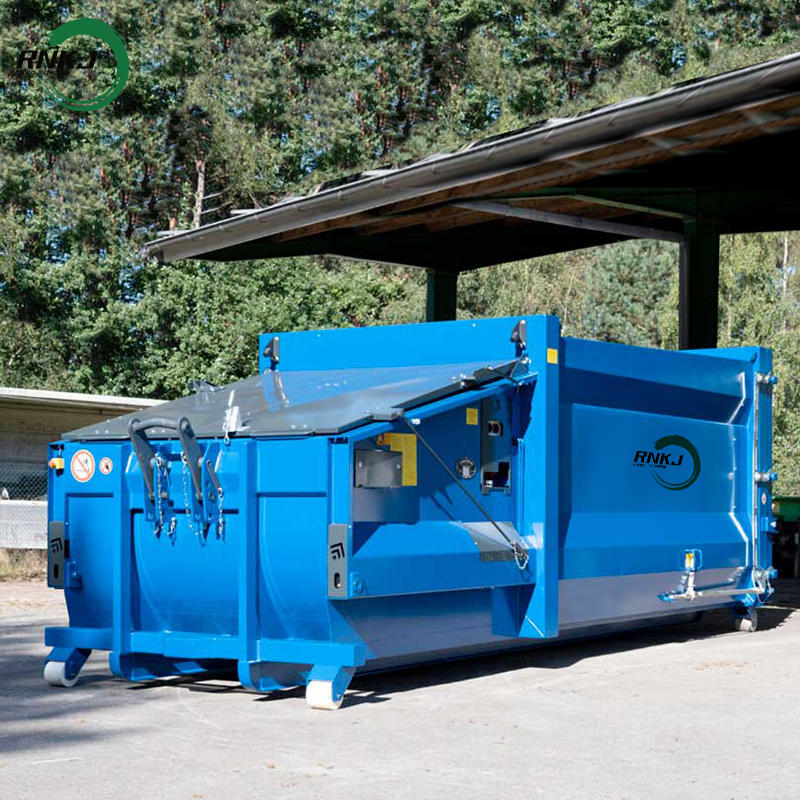
A Bucket Trash Compactor is a compaction system designed for waste loading through a compatible bucket or waste bin.
Instead of relying primarily on manual loading or direct dumping into an open chamber, the system can work with commonly used waste containers. Depending on the configuration, compatible bin capacities may include 240L, 660L, and 1100L.
The loading process allows collected waste to be transferred from the bucket or bin into the compaction chamber. The hydraulic compression mechanism then reduces the volume of the material.
This type of equipment can be useful where waste is already collected in standardized bins and the existing collection process needs to be connected with a larger compaction system.
Typical applications include:
Municipal waste collection
Residential communities
Commercial buildings
Public facilities
Industrial sites
Waste collection stations
Property management projects
Centralized waste transfer points
The main characteristic is not simply mobility, but the compatibility between the loading system and the waste bins used at the collection point.

Although both machines perform waste compaction, their practical differences become clearer when comparing their loading method, mobility, storage configuration, and application requirements.
| Feature | Mobile Trash Compactor | Bucket Trash Compactor |
|---|---|---|
| Main concept | Mobile waste collection and compaction | Bin/bucket-based waste loading and compaction |
| Loading method | Depends on machine configuration | Compatible bucket or waste bin |
| Typical bin compatibility | Configuration dependent | Commonly 240L / 660L / 1100L |
| Mobility | Designed for mobile operation | Mobility depends on the complete configuration |
| Main advantage | Flexible collection and transportation | Convenient integration with standardized waste bins |
| Suitable waste source | Bulk or centralized waste collection | Waste collected in bins or buckets |
| Transportation | Complete unit can be transferred in suitable configurations | Depends on the equipment and transportation arrangement |
| Customization | Capacity, hydraulic system, dimensions, etc. | Bin compatibility, capacity, loading structure, etc. |
The two solutions therefore should not be regarded as identical machines with different names. Their differences mainly come from how waste enters the machine and how the equipment fits into the overall collection process.
One of the most important differences is the loading method.
A mobile trash compactor can be configured for different loading arrangements. Waste may be loaded into the designated receiving area manually, mechanically, or through another compatible collection method depending on the model.
A bucket trash compactor is more closely associated with bin or bucket-based loading. Waste can be collected in standardized containers and then transferred into the compaction chamber.
For example, a project may use 240-liter, 660-liter, or 1100-liter waste bins. Instead of requiring workers to transfer the waste manually, the appropriate lifting or tipping mechanism can move the bin contents into the machine.
This can make the bucket-based configuration particularly relevant to waste collection systems that already depend on standardized containers.
Mobility is another important consideration.
A mobile trash compactor is specifically designed around the concept of flexible positioning and transportation. In suitable configurations, the entire unit can be transferred using a hook lift truck.
This means the compactor does not necessarily have to remain permanently installed at one location.
For projects involving multiple temporary collection points, centralized waste storage areas, or periodic transportation, this configuration can provide operational flexibility.
A bucket trash compactor may also be mobile depending on its specific design. However, its defining feature is generally the bucket or bin loading arrangement, rather than mobility alone.
Therefore, mobility should be evaluated separately from loading configuration when comparing these two types of equipment.
The two systems can also fit into different waste collection workflows.
A mobile trash compactor is suitable when the compactor itself forms an important part of the collection and transportation process. Waste is collected, compressed, stored, and the unit can subsequently be moved for further handling.
A bucket trash compactor is often more closely integrated with an existing bin collection system.
For example:
Waste generation → waste bin collection → bin lifting/tipping → compaction → temporary storage → transportation
This workflow can be useful for municipalities, communities, commercial properties, and facilities that already use standardized garbage bins.
The appropriate choice therefore depends not only on the machine itself but also on how waste is collected before it reaches the compactor.
Storage capacity is an important factor when selecting waste compaction equipment.
Mobile trash compactors can be manufactured in different capacities according to the waste volume and transportation requirements of a project. The compacted waste remains within the designated storage section until the unit is transported or emptied according to the system design.
Bucket trash compactors can also be customized for different capacities, but the upstream collection process is more closely related to the size and type of waste bins.
For projects using 240L, 660L, or 1100L containers, compatibility between the lifting mechanism and the selected bin size should be considered before equipment selection.
The transportation method should also be confirmed in advance. For example, if the complete unit needs to be moved by a hook lift truck, the overall dimensions, lifting points, structural strength, and truck compatibility should be considered during customization.
Mobile trash compactors and bucket trash compactors can both be used in municipal and commercial waste management, but their application priorities can be different.
Mobile configurations can be considered for:
Municipal waste transfer points
Industrial facilities
Construction projects
Commercial waste collection
Temporary waste handling locations
Large centralized collection areas
Projects requiring flexible equipment relocation
They are especially useful when waste collection locations may change or when the complete compaction unit needs to be transported.
Bucket-based configurations can be considered for:
Residential communities
Municipal garbage collection
Commercial buildings
Shopping areas
Public facilities
Industrial sites using standardized bins
Waste stations with centralized bin collection
They are particularly suitable when waste is already collected in compatible garbage bins and the project wants to connect bin handling with mechanical compaction.
There is no single configuration suitable for every waste management project. The selection should be based on the actual workflow rather than the product name alone.
Consider a Mobile Trash Compactor when:
The compactor needs to be relocated between collection points.
The complete unit needs to be transported after collection.
The project handles relatively centralized or bulk waste.
Flexible waste storage and transportation are important.
The project uses a hook lift truck or another suitable transportation system.
Consider a Bucket Trash Compactor when:
Waste is primarily collected in standardized garbage bins.
The project requires mechanical bin lifting or tipping.
240L, 660L, or 1100L bins are commonly used.
The loading process should connect directly with the existing bin collection system.
The project needs a customized compactor compatible with specific container dimensions.
The final selection should also consider waste type, daily waste generation, required capacity, available installation space, loading height, transportation equipment, and operating frequency.
Waste collection systems are rarely identical from one project to another. Even when two projects use the same type of compactor, their required capacity, loading height, bin dimensions, hydraulic configuration, and transportation method can be different.
For this reason, customized waste compactors can be developed according to specific project requirements.
Important customization factors may include:
The storage and compaction capacity should correspond to the expected daily waste volume and collection frequency.
For bucket trash compactors, the dimensions and lifting requirements of the existing waste bins should be confirmed before production.
The hydraulic system can be configured according to the required compression force, operating frequency, and working environment.
The overall length, width, and height should match the available operating area and transportation requirements.
For mobile units, the lifting points and structural configuration should be compatible with the intended transportation equipment.
Depending on the project, the machine can be configured with appropriate electrical and hydraulic controls to support convenient operation.
The primary function of both systems is to compress waste before transportation or further processing.
Loose waste often contains a considerable amount of empty space. Hydraulic compaction reduces this void space and creates a denser waste mass.
This can provide several operational benefits:
Better utilization of available storage volume
Fewer interruptions caused by rapidly filling containers
More organized waste collection
Reduced loose-waste accumulation around collection points
More efficient coordination between collection and transportation
Better adaptation to centralized waste handling
However, actual performance depends on the waste composition, moisture content, material characteristics, compaction force, machine capacity, and operating conditions.
Before selecting equipment, project managers can evaluate the following factors:
Determine whether waste arrives as loose material, bulk waste, or standardized garbage bins.
The loading method can significantly influence equipment configuration.
If the compactor needs to be transported between locations, mobile configuration and truck compatibility become important.
For bucket-type systems, confirm whether the equipment needs to handle 240L, 660L, 1100L, or another customized container size.
Capacity should be selected according to actual waste generation and collection intervals.
The selected machine should match the existing hook lift truck or other transportation system.
Available space, loading height, access roads, and installation conditions can affect the final equipment design.
The main difference between a Mobile Trash Compactor and a Bucket Trash Compactor lies in their operating configuration.
A mobile trash compactor emphasizes flexible waste collection, compaction, storage, and transportation, while a bucket trash compactor emphasizes integration with compatible waste bins or buckets for mechanical loading and compaction.
A mobile configuration may be appropriate for projects that require the complete compactor to be relocated or transported. A bucket-based configuration may be more suitable for projects that already use standardized garbage bins and want to integrate bin handling with hydraulic waste compaction.
For customized waste management projects, factors such as waste volume, bin size, loading method, transportation system, available space, and operating workflow should be evaluated together.
Choosing the equipment based on the complete waste collection process rather than a single specification can help create a more practical and adaptable waste compaction solution.


