
Views: 2 Author: Site Editor Publish Time: 2026-05-18 Origin: Site


By using ground-based discharge, underground sealed storage, hydraulic lifting and transportation, and intelligent sensing control, the four types of garbage are physically divided and sealedly collected. The trash cans can be lifted up and down hydraulically. The sensors monitor the garbage volume in real time. Throughout the process, the garbage is not compressed or squeezed. Only classification storage and mechanized collection are carried out. The garbage is always in a sealed space.
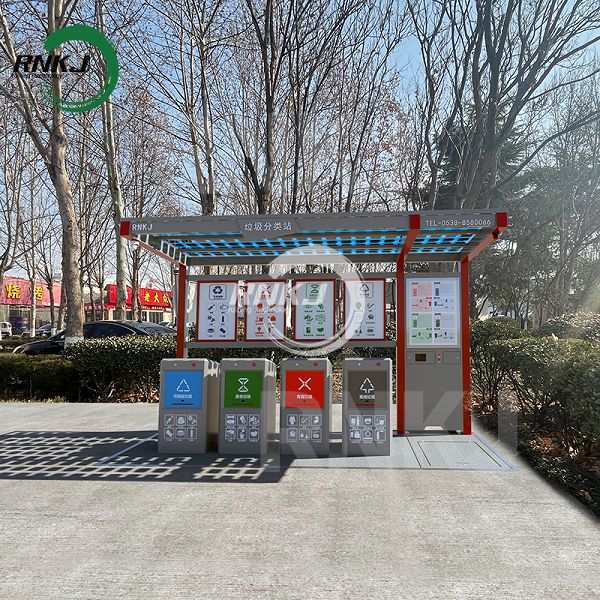
I. Garbage Disposal Principle
Four independent disposal ports are set on the ground, corresponding to recyclable waste, kitchen waste, hazardous waste, and other waste. These ports are matched with four independent trash bins underground.
The disposal ports can be opened manually or opened automatically through infrared sensing. The garbage falls vertically through the vertical discharge channel and directly drops into the corresponding trash bins underground.
The disposal ports are equipped with a closing structure. Once the disposal is completed, they will automatically close. The entire container is sealed, preventing odors and mosquitoes from spreading from underground to the surface.
The four trash bins are completely physically separated. This avoids mixed disposal of garbage at the source and enables mandatory classification.
II. Underground Sealed Storage Principle
All trash bins are placed inside underground sealed containers. The containers are treated for waterproofing, anti-seepage, and anti-corrosion;
The garbage is naturally piled up inside the bins without being compressed or squeezed. It is temporarily stored directly by large-capacity trash bins;
The containers are protected from light and rain to prevent the garbage from being exposed to sunlight and soaked by rainwater; A waterproof layer is set at the bottom of the container to prevent sewage from seeping into the soil and groundwater;
Complementary drainage system: Water accumulation at the bottom of the container automatically flows into the sump, and a submersible pump automatically discharges it to prevent the garbage from rotting and generating a large amount of leachate.
III. Intelligent Monitoring and Warning Principle
An ultrasonic overflow sensor is installed above each trash can to continuously monitor the height of the garbage inside the can;
When the garbage reaches 80% - 90% of the can's capacity, the sensor transmits the signal to the electrical control box;
The system triggers local audible and visual alarms to notify the sanitation workers to clear the garbage in time;
Additional sensors simultaneously monitor: water level, equipment tilt, temperature, etc. Abnormal situations will trigger automatic alarms to ensure safety.
IV. Hydraulic lifting and transportation principle
The trash can is fixed on a hydraulic lifting platform underground. The lifting is driven by a hydraulic pump station and hydraulic cylinders. It has no compression function and only performs lifting and lowering:
Lifting: The sanitation worker operates the remote control, and the platform smoothly lifts upwards, raising the 4 trash cans as a whole to the ground, making them level with the height of the garbage collection vehicle;
Transportation: The sanitation vehicle directly picks up the trash cans and disposes of the garbage. The entire process is mechanized and no manual handling is required;
Recession: After the garbage is emptied, the lifting platform smoothly descends, and the empty trash cans are returned to the underground sealed storage area;
It is equipped with limit, overload, and emergency stop protection. The lifting speed is stable, and there is no shaking or overturning.
V. Supporting System Working Principles
Ventilation System: Slight ventilation underground to remove a small amount of odors and maintain air circulation;
Disinfection System: Automatically sprays disinfectant in a mist form at regular intervals, killing bacteria and suppressing odors;
Sealing System: Multiple seals at the discharge ports to prevent mosquitoes and rainwater from entering;


