
Views: 0 Author: Site Editor Publish Time: 2026-08-19 Origin: Site


Managing high-liquid organic waste in commercial environments creates a massive operational drain. Standard open dumpsters simply cannot handle the sheer volume of moisture generated in commercial kitchens and supermarkets. Relying on inadequate infrastructure leads directly to toxic leakage across loading docks, severe odor complaints, and rapid pest infestations. Businesses utilizing standard bins face inflated hauling fees, effectively paying transport companies to haul heavy water weight. Modernizing waste infrastructure aligns directly with corporate sustainability goals. Upgrading equipment reduces overall landfill volume, facilitates better material segregation, and cuts transport emissions by minimizing truck trips. Transitioning to specialized, sealed waste management solutions mitigates severe hygiene risks, ensures strict regulatory compliance regarding stormwater runoff, and optimizes hauling schedules. Implementing a dedicated wet waste compactor transforms a hazardous liability into a controlled, streamlined operational workflow.
Self-contained architecture is a non-negotiable requirement for high-liquid waste streams; stationary units will leak and fail health inspections.
Return on Investment (ROI) is primarily driven by a 4:1 (or higher) compaction ratio, which directly reduces hauling frequency, associated fuel/transport surcharges, and labor costs.
Successful implementation relies heavily on facility prerequisites, including concrete pad specifications, drainage access, and 3-phase electrical infrastructure.
When vetting a wet waste compactor manufacturer, the primary differentiators are the engineering of their liquid seals, integrated odor control, and local service response times.
Failing to properly contain organic waste introduces immediate hygiene and pest control failures. Unsealed organic matter decomposes rapidly, accelerating bacterial growth and generating intense odors. This environment acts as a massive vector attraction point, drawing rodents, flies, and other pests to your loading dock. Once pests establish a presence near your waste area, they inevitably migrate toward the facility interior. Health inspectors routinely cite facilities for pooling liquid waste and inadequate pest exclusion, leading to operational shutdowns and permanent brand damage. The biological breakdown of putrescible waste creates a highly acidic leachate that eats through standard painted steel, rapidly degrading basic dumpsters and creating even more avenues for leakage.
Beyond hygiene, uncompacted waste creates a massive financial drain through inefficient hauling. Standard waste hauling economics dictate that businesses are billed per pickup based on container volume. When throwing uncompacted food scraps into a standard dumpster, you fill the bin with air pockets and heavy liquid. Haulers charge overweight surcharges for the water content, and you pay for frequent pickups because the bin fills up quickly with uncrushed material. You are literally paying to haul air and water. A standard roll-off truck has a maximum gross vehicle weight limit on local roads. If your uncompacted bin is full of water, the hauler maxes out their legal payload long before the bin is actually full of solid waste.
Improper containment also triggers strict regulatory and environmental compliance risks. Municipalities enforce severe regulations regarding liquid runoff into storm drains. If the acidic, bacteria-rich liquid from decomposing food waste leaks from a standard dumpster and enters the municipal stormwater system, facilities face heavy fines from environmental protection agencies. The negative environmental impact extends to the landfill. Uncompacted waste consumes excessive landfill capacity, and the frequent truck trips required to haul uncompacted bins generate unnecessary carbon emissions.
Stormwater contamination fines levied by local environmental agencies.
Health department citations for inadequate vector control and pooling leachate.
Overweight hauling surcharges applied by waste management contractors.
Premature degradation of asphalt and concrete surfaces due to acidic runoff.
Handling high-moisture organic material requires a specific engineering approach known as self-contained architecture. In this design, the compactor ram and the receiver container are permanently attached. They form a single, continuous, liquid-tight unit. There are no gaps, hinges, or separation points between the crushing chamber and the storage box where liquid could escape during operation. The structural integrity relies on continuous seam welding across the entire floor and lower side walls, utilizing heavy-duty steel plate to withstand the immense pressure of the hydraulic cylinders.
Because the unit is permanently sealed, the entire machine must be loaded onto the roll-off truck for emptying. The driver pulls the complete assembly onto the truck bed using a heavy-duty cable winch, transports it to the disposal site, empties it, and returns the same unit to your concrete pad. This prevents any separation on-site, entirely eliminating the risk of liquid spills across your loading dock during the hauling process. The rear door features heavy-duty hinges and a ratchet binder system that locks the door tight against a thick rubber gasket.
A high-quality wet refuse compactor features specialized internal engineering to handle excess moisture. As the hydraulic ram crushes organic material, it squeezes out massive amounts of water. Built-in liquid sumps located at the bottom of the container collect this runoff. Specialized liquid diversion mechanisms, including sloped floors and internal baffles, channel the fluid away from the mechanical components and into these holding reservoirs. This prevents the hydraulic cylinders from operating submerged in acidic liquid, which would rapidly degrade the cylinder seals.
Operators manage this accumulated fluid through dedicated drain ports. Before the hauling truck arrives, staff connect a hose to the drain port and safely release the excess liquid directly into an approved sanitary sewer cleanout or grease interceptor. Draining the liquid on-site drastically reduces the overall weight of the container. This eliminates overweight hauling surcharges and ensures that no liquid sloshes out during highway transport.
Verify the compactor is locked out and the ram is in the fully retracted position.
Attach a heavy-duty cam-lock hose to the primary drain port on the lower sump.
Route the discharge end of the hose directly into an approved sanitary sewer drain or grease trap.
Open the ball valve and allow all accumulated leachate to drain completely.
Close the valve, disconnect the hose, and secure the secondary drain cap before the hauler arrives.
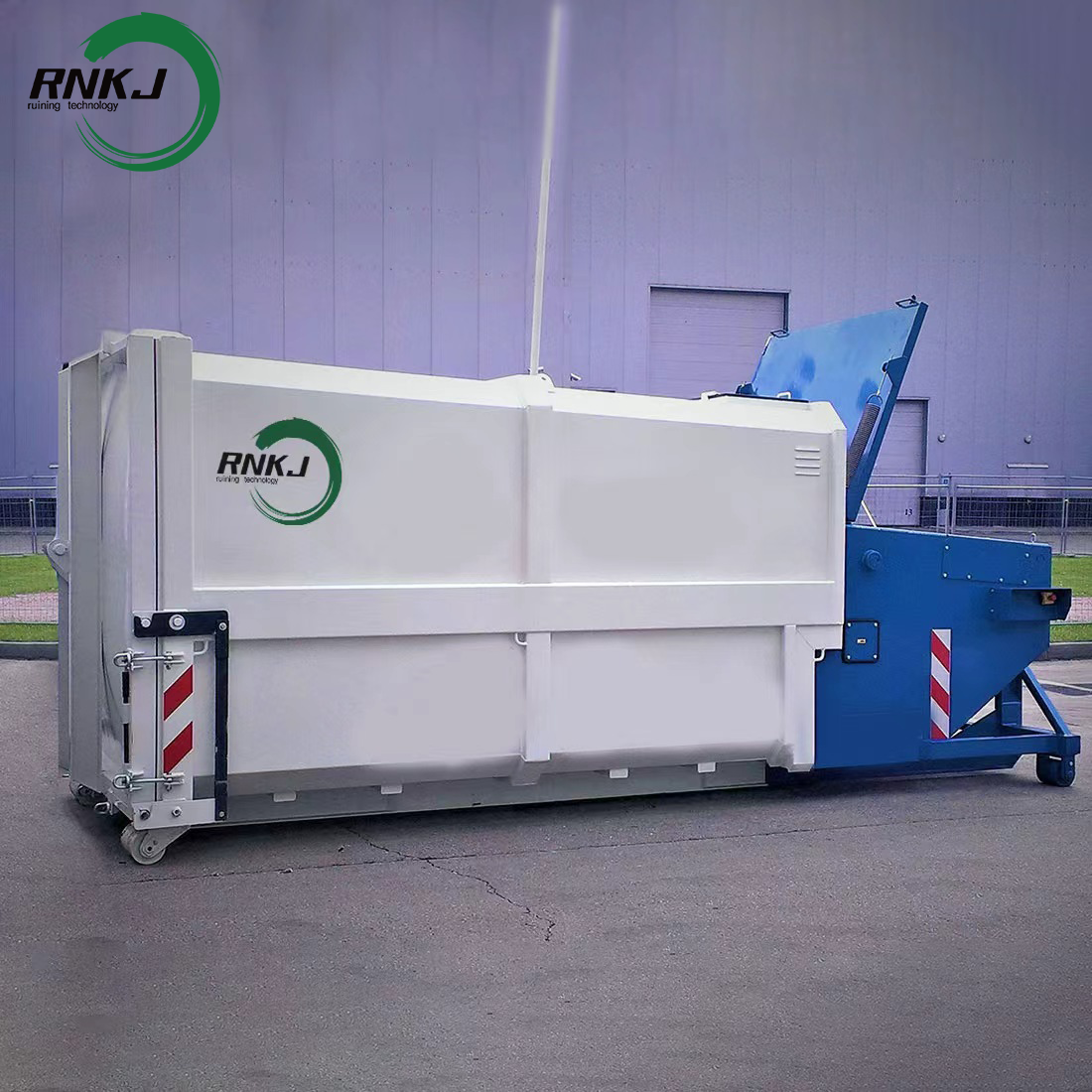
Stationary compactors operate by bolting the crushing mechanism directly to the concrete pad. Only the receiver box detaches and gets hauled away. While excellent for dry cardboard or manufacturing waste, these units fail catastrophically in commercial kitchens. The critical flaw lies in the connection point. There is an inherent gap between the stationary ram and the detachable container. Operators use turnbuckles and ratchet binders to pull the box against the compactor, but when crushing high-liquid food waste, fluid inevitably escapes through this joint, flooding the concrete pad with toxic, foul-smelling runoff.
The sealed wet waste compactor stands as the only viable solution for supermarkets, food processors, and large commercial kitchens. These units utilize continuous seam welding throughout the entire lower structure, ensuring zero liquid penetration. Heavy-duty, liquid-tight rear door seals lock the moisture inside the container. This design guarantees that even under immense hydraulic pressure, the acidic food waste liquid remains entirely contained within the steel shell. The hydraulic power unit is often mounted remotely or enclosed in a weather-proof housing to protect it from the harsh operating environment.
Facilities lacking the footprint for a massive horizontal roll-off unit often utilize sealed vertical compactors. These machines serve as a high-efficiency alternative for urban restaurants, commercial premises, and facilities with limited alleyway or dock space. Vertical units pack the waste downwards into a front-loading or rear-loading container. They feature a specialized liquid-retention basin at the bottom. While their overall capacity is smaller than horizontal models, they provide the necessary liquid containment in a fraction of the footprint, often fitting within a standard parking space.
Waste generation starts on the prep line. Point-of-generation indoor stainless steel units allow staff to compress food scraps immediately. A dedicated kitchen waste compactor reduces the number of trips staff must make to the outdoor dock. For high-volume operations, facilities often bridge the gap using chute-fed systems. Through-the-wall configurations allow kitchen staff to load waste into an indoor chute that drops directly into an outdoor self-contained unit. This minimizes staff exposure to harsh weather, keeps the dock doors closed, enhances building security, and maintains strict pest control boundaries.
Waste Compactor Configuration Comparison
| Equipment Type | Liquid Containment | Ideal Application | Footprint Requirement |
|---|---|---|---|
| Self-Contained Compactor | Excellent (100% Sealed) | Supermarkets, Large Kitchens, Food Processing | Large (Requires roll-off truck clearance) |
| Stationary Compactor | Poor (Leaks at connection) | Dry Waste, Cardboard, Plastics | Large (Requires roll-off truck clearance) |
| Vertical Compactor | Good (Bottom basin) | Urban Restaurants, Tight Alleys | Small (Fits standard parking spaces) |
| Indoor Stainless Unit | Good (Bagged/Sealed) | Point-of-generation prep lines | Minimal (Fits under counters or in corners) |
Evaluating a food market garbage compactor requires analyzing its hydraulic power. You must match the hydraulic cylinder size and ram pressure to the specific density of your organic waste. Food waste is heavy and dense, requiring significant continuous pressure to squeeze out air and liquids. Acceptable compaction ratios typically range from 3:1 to 5:1. This ratio fluctuates depending on the specific mix of bones, shells, fibrous vegetables, and liquid content. Higher ram pressure ensures maximum payload density, directly reducing the number of hauls required per month. Look for systems that operate at a minimum of 2000 PSI normal system pressure to ensure adequate crushing force.
Raw compaction force means nothing if the unit cannot hold the resulting liquid. Detail the materials used in the rear door seals. High-quality units utilize specialized nitrile rubber gaskets, which offer superior resistance to fats, oils, and greases (FOG) compared to standard neoprene. Adjustable door hinges allow operators to tighten the seal as the rubber naturally compresses over months of use. Secondary odor mitigation is equally critical. Look for units equipped with integrated ozone generators that neutralize airborne bacteria. Carbon filtration exhaust systems and automated deodorizer spray systems provide additional layers of defense against neighborhood odor complaints.
Your facility layout dictates the loading configuration. Walk-on decks with OSHA-compliant 42-inch safety rails allow staff to dump carts directly into the hopper from an elevated position. Dock-level loading configurations sit flush with your existing loading dock, allowing seamless transfer from pallet jacks or tilt trucks. Ground-level doghouses provide enclosed, secure loading from the pavement, keeping unauthorized personnel out of the machine. Custom hopper designs can be tailored to accept specific waste streams, such as automated cart tippers that lift and dump heavy 64-gallon or 96-gallon bins without manual lifting, drastically reducing workplace injury claims.
Acquiring heavy waste infrastructure requires evaluating the investment structure. Purchasing the equipment outright requires a larger initial capital expenditure but allows the facility to claim depreciation on the asset over its useful life. Leasing options preserve working capital and often bundle preventative maintenance into a single monthly operational expense. Facilities must weigh the long-term asset value against the immediate cash flow benefits of a lease agreement. Regardless of the acquisition method, the equipment must be viewed as a utility infrastructure upgrade rather than a simple operational purchase.
The primary driver of operational efficiency is the drastic reduction in hauling frequency. Calculate the break-even point by comparing current monthly hauling invoices against projected compacted hauling schedules. If a supermarket currently requires four open dumpster pickups per week, a self-contained unit operating at a 4:1 compaction ratio can often reduce that schedule to a single pickup per week. This eliminates three transport surcharges, three fuel fees, and the associated environmental fees every single week. Over a fiscal year, this reduction in hauling traffic generates massive operational savings.
Calculate the labor hours saved by reducing staff trips to outdoor bins and streamlining the loading process. Every trip a kitchen worker makes to an outdoor dumpster takes an average of five to ten minutes. Multiply that by dozens of trips per day, and the labor sink becomes obvious. Optimizing waste management workflows keeps kitchen staff focused on core operations rather than waste handling. Automated cart tippers and through-the-wall chutes eliminate the physical strain of lifting heavy bags, directly reducing fatigue and improving overall kitchen output.
Factor in the hidden operational requirements: regular interior washdowns, hydraulic fluid maintenance, and the periodic replacement of liquid seals. A machine handling organic waste requires strict sanitation protocols to prevent biological buildup. Budget for quarterly preventative maintenance visits from certified technicians to change hydraulic filters, grease guide shoes, and inspect electrical relays. Ignoring these basic maintenance requirements leads to catastrophic hydraulic failures and emergency service calls during peak operational hours.
Commercial hydraulic power units demand robust electrical infrastructure. You must provide dedicated 3-phase power to operate the heavy-duty motors required for high-pressure compaction. Standard single-phase power will not suffice. The electrical panel requires a fused disconnect switch mounted within line of sight of the machine for safety compliance. The placement of the remote power pack requires careful planning. Position the electrical components and hydraulic reservoir away from direct weather exposure and heavy washdown moisture. Mounting the power pack inside the building and running hydraulic hoses through the wall to the outdoor compactor offers the highest level of protection. Ensure the system includes phase monitor relays to prevent the motor from running backwards if the utility company drops a phase.
The physical footprint requires strict site preparation. The concrete pad must meet extreme weight-bearing requirements. You must account for the combined weight of the steel compactor, tons of liquid-dense organic waste, and the massive roll-off collection truck that must drive onto the pad to retrieve the unit. Standard asphalt will crack and sink under this load, creating dangerous uneven surfaces. Install steel-reinforced, 3000 PSI concrete pads with a minimum depth of six to eight inches. Incorporate #4 rebar on 12-inch centers for maximum tensile strength.
Excavate the installation area to a depth of at least 10 inches, ensuring a compacted gravel sub-base.
Form the pad dimensions, adding an extra 10 feet of length for the truck approach apron.
Install the rebar grid, elevating it on chairs to sit in the middle third of the concrete slab.
Pour 3000 PSI concrete, ensuring a slight grade to direct surface water toward approved catch basins.
Install steel guide islands and protective bollards before the concrete fully cures to protect adjacent building walls.
Operator error presents a significant implementation risk. Comprehensive staff training must cover strict lockout/tagout procedures before anyone attempts to clean or clear jams. Emphasize safe loading practices to avoid pinch-point injuries around the hopper and ram. Establish rigorous material segregation protocols. Keep rigid recyclables, heavy metals, and wooden pallets out of the food waste compactor. Cross-contamination damages the hydraulic ram, punctures the liquid seals, and ruins the organic waste stream for potential composting or anaerobic digestion off-site.
When evaluating vendors, scrutinize their engineering standards. Instruct buyers to look for continuous seam welding rather than stitch welding. High-grade steel thickness on the floor and ram face prevents warping under pressure. Acidic food waste rapidly eats through standard paint. Demand corrosion-resistant primers and industrial-grade epoxy paints designed specifically for harsh, wet environments. The structural integrity of the container directly dictates its lifespan. Inspect the design of the hydraulic cylinders; they should feature hardened chrome rods to resist pitting and corrosion.
Equipment breaks down, usually during peak operational hours. Emphasize the importance of evaluating the manufacturer's local dealer network and parts availability. A reliable wet waste compactor manufacturer provides strict Service Level Agreements (SLAs) for emergency repairs. You need guaranteed response times for blown hydraulic hoses, failed electrical relays, or torn door seals. Regular preventative maintenance, including hydraulic fluid filtering and seal inspections, prevents these emergencies from occurring. Verify that the vendor stocks proprietary parts locally rather than relying on overseas shipping for basic replacement components.
A sealed wet waste compactor serves as a mandatory infrastructure upgrade for maintaining strict hygiene, optimizing labor workflows, and ensuring regulatory compliance in high-volume food operations. Relying on open dumpsters for liquid-heavy organics guarantees operational failure and environmental fines. Decision-makers must prioritize liquid-tight integrity over raw compaction force, match the container capacity to peak seasonal waste generation, and rigorously verify facility infrastructure before vendor selection.
Conduct a comprehensive waste audit to measure daily volume, liquid percentage, and material segregation opportunities.
Measure your loading dock footprint and verify the availability of 3-phase electrical power.
Request site surveys from specialized manufacturers to determine the optimal loading configuration and hopper design.
Establish a strict preventative maintenance schedule focusing on hydraulic fluid health and door seal integrity.
A: A stationary compactor bolts the crushing ram to the ground, and only the receiver box detaches for hauling. This creates a gap that leaks liquids. A self-contained compactor permanently attaches the ram and container into a single, liquid-tight unit. The entire machine is hauled away, preventing any liquid spills on your property.
A: The required investment varies based on the unit's physical size, hydraulic compaction force, and necessary loading customizations. Factors driving the initial capital include specialized loading hoppers, integrated odor control systems like ozone generators, and mandatory site preparations such as pouring reinforced concrete pads and upgrading to 3-phase electrical power.
A: These units easily handle the incidental liquids found in food scraps, soups, and produce runoff. However, they are not designed for bulk liquid disposal. Used fryer oil and bulk grease must be collected separately in dedicated rendering tanks to comply with municipal regulations and prevent hydraulic system damage.
A: Hauling schedules depend entirely on your waste volume and the unit's compaction ratio, rather than standard weekly pickups. Because the unit crushes waste at a 4:1 ratio and seals in odors, many facilities reduce their hauling frequency from multiple times a week to just a few times a month.
A: Routine maintenance includes inspecting the heavy-duty nitrile door seals for tears, checking hydraulic fluid levels, and greasing moving parts. Operators must also perform regular interior washdowns to prevent organic buildup and ensure the internal liquid drain ports remain clear of debris.
A: Yes. Commercial hydraulic power units require dedicated 3-phase electrical power to generate the massive force needed to crush dense organic waste. Standard single-phase power cannot support the heavy-duty motors used in these industrial machines.
A: Yes. Vertical compactors are designed specifically for tight footprints. They pack waste downwards into a specialized container with a liquid-retention basin at the bottom. These units fit into standard parking spaces or narrow alleys where large horizontal roll-off trucks cannot maneuver.


