
Views: 0 Author: Site Editor Publish Time: 2026-08-25 Origin: Site


Inefficient waste management in high-traffic retail environments creates a massive operational drain. Escalating hauling fees, pest control issues, loading dock congestion, and negative impacts on brand image quickly erode profit margins. Grocery and retail waste streams present specific, demanding challenges. Supermarkets generate high volumes of wet organic waste that decompose rapidly. Shopping centers produce massive amounts of bulky, mixed-dry waste that consumes valuable space. Addressing these distinct material profiles requires targeted heavy equipment.
Deploying a commercial trash compactor for supermarkets and malls reduces hauling frequency, improves sanitation, secures waste from scavenging, and reclaims operational space on the loading dock. Facility managers must move away from open-top dumpsters to control operational expenditures. You will learn how to match equipment to specific waste streams, calculate precise space requirements, and evaluate critical features for long-term reliability.
Waste Stream Matching is Critical: Self-contained units are non-negotiable for supermarkets dealing with wet waste, while stationary units and complementary balers offer higher capacity for dry mall waste.
Measurable ROI: Implementing the right commercial waste compression station typically reduces hauling frequency by 50% to 80%, directly offsetting capital expenditures and lowering overall collection costs.
Site Preparation Dictates Success: Installation requires strict adherence to spatial constraints (from 2-yard vertical units to 40-yard roll-offs), electrical (typically 3-phase power), and structural (reinforced concrete pad) prerequisites.
Vendor Support Outweighs Initial Cost: Partnering with a reliable commercial waste compactor manufacturer ensures minimal downtime through robust Service Level Agreements (SLAs) and preventative maintenance.
A successful waste management strategy for large-scale retail focuses heavily on cost reduction, safety, and aesthetic curb appeal. Clean loading docks prevent workplace accidents and keep customers returning to the property. Facility managers must view waste handling as a core operational workflow. When trash piles up, it obstructs delivery trucks, creates fire hazards, and invites municipal health citations. Efficient processing keeps the back-of-house operations invisible to the retail consumer.
Grocery stores handle immense quantities of spoiled produce, expired dairy, and meat trimmings daily. The produce department constantly culls wilted greens, while the butcher shop discards fat and bone trim. This high moisture content accelerates organic decomposition, especially during warmer months. The resulting liquid runoff, known as leachate, creates severe environmental and sanitation hazards.
Stringent health department compliance demands leak-proof containment to prevent foul odors and aggressive pest infestations. Flies, rodents, and seagulls flock to unsecured food waste, creating a highly unsanitary perimeter around the store. You must contain this wet waste completely to maintain health code compliance. If leachate leaks onto the concrete and runs into the municipal storm drain, facility managers face immediate fines and potential site shutdowns.
Mall environments generate massive volumes of dry materials rather than wet organics. Cardboard boxes, plastic pallet wrap, styrofoam packaging, and mixed tenant refuse fill standard dumpsters rapidly. Apparel retailers, electronics stores, and home goods shops constantly discard large protective packaging after seasonal inventory resets. A single shoe store can fill an entire open-top dumpster with empty cardboard in one afternoon.
This bulky waste contains lots of empty air space. Without compaction, this material overflows bins within hours of a major delivery cycle. Managing this dry waste requires maximizing volume reduction rather than focusing on liquid containment. The goal is to crush the air out of the boxes and plastic wrap to maximize the payload weight for the hauling truck.
Open-top dumpsters hide massive operational costs. Haulers charge fees based on air volume rather than actual material weight. You pay to transport empty space when throwing away uncrushed boxes. Wind-blown litter damages property aesthetics and invites fines from local authorities. Unauthorized dumping remains a constant threat, as outsiders fill your unsecured bins with residential trash overnight.
Retail shrinkage presents another major financial risk. Employees sometimes throw perfectly good merchandise into open dumpsters with the intent to retrieve it after their shift. Store managers must crush damaged or expired goods immediately to prevent dumpster diving and organized pilferage from the loading dock. Heavy compaction destroys the merchandise instantly, eliminating the incentive for theft.
Selecting the correct machine requires understanding the mechanical differences between equipment types. Installing the wrong unit leads to mechanical failure, environmental fines, and frustrated staff. You must match the machine's architecture to your specific waste profile.
These machines feature a specialized liquid-tight design. The compaction ram and the receiver container remain permanently attached as a single unit. When the container reaches capacity, the roll-off hauling truck takes the entire machine to the landfill, empties it, and returns it to the dock. This unified structure prevents organic leakage onto the concrete.
It stands as the only viable supermarket waste compactor for stopping odor and pest infestations. Heavy-duty door seals, heavy ratchet binders, and liquid catch basins ensure that foul leachate never escapes. The hopper is typically enclosed in a "doghouse" structure to prevent rain from entering the chamber and adding unnecessary water weight to the hauling payload.
These systems separate the compaction unit from the receiver box. The heavy ram section stays bolted firmly to the concrete pad. The hauler only removes the detachable full box. This setup serves as the optimal shopping mall trash compactor for bulky, dry materials. Because the unit separates, it cannot hold liquids effectively; any wet waste will leak at the seam between the ram and the box.
Pairing this machine with a commercial cardboard baler maximizes recycling revenue. Balers compress clean cardboard into dense, marketable cubes, keeping recyclable materials out of the main waste stream and saving valuable dock space. A dedicated baler allows facility managers to sell the cardboard to recycling mills rather than paying a hauler to take it to a landfill.
Vertical compactors provide the ideal solution for retail nodes with highly restricted footprints. Small 2-yard to 8-yard front-load units fit directly into tight alleys or small corrals. They compress waste vertically, taking up a fraction of the space required by horizontal models. Standard front-load garbage trucks service these units by sliding their forks into the side pockets and lifting the entire machine to dump it.
Chute-fed systems serve multi-level shopping centers perfectly. They allow upper-level tenants to dispose of waste safely through wall-mounted doors. The trash drops down the internal building shaft directly into the compaction chamber. This eliminates the need for tenants to transport leaking trash bags through public elevators or access the main ground-level loading dock.
Sprawling retail footprints often require waste consolidation from multiple tenant zones. A mobile commercial trash compactor moves easily across large properties to gather refuse efficiently. Maintenance teams can drive or tow these wheeled units to different collection points, compacting waste on the go before dumping the consolidated load into a master roll-off container.
Specific loading dock configurations benefit from specialized material handling. A bucket garbage compactor utilizes an integrated lifting mechanism for ground-level feeding. This design eliminates the need for elevated docks or custom-built ramps. Workers simply roll standard 96-gallon waste carts into the bucket. The operator presses a button, and the hydraulic arm hoists the cart and dumps the material automatically into the hopper, preventing back injuries from manual lifting.
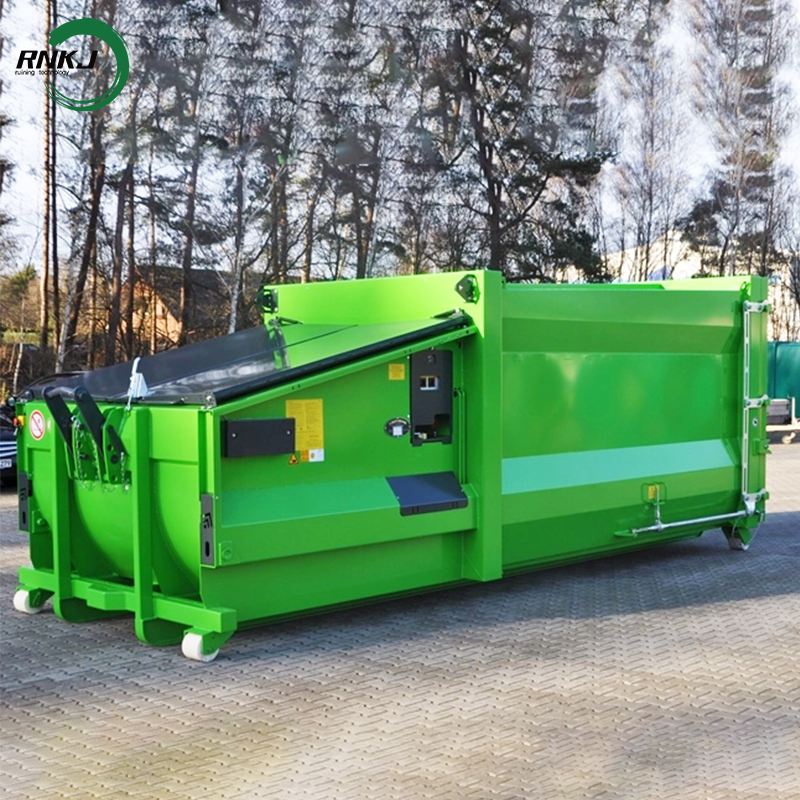
Evaluating equipment requires looking past basic specifications to understand operational outcomes. The right features directly impact daily workflows, regulatory compliance, and overall site hygiene.
Wet waste generates severe odors quickly, especially in summer heat. Advanced machines utilize ozone generators and carbon filtration systems to neutralize airborne bacteria. These systems pipe ozone directly into the enclosed hopper, destroying odor molecules rather than just masking them with chemical sprays.
Specialized neoprene door seals prevent liquid seepage during compaction cycles. These features ensure strict regulatory compliance with local environmental laws. They maintain a sanitary customer environment and protect the facility's public image from the stigma of a foul-smelling exterior. Regular inspection of these seals is mandatory, as acidic food waste can degrade standard rubber over time.
You must analyze loading dock dimensions carefully before ordering equipment. Measure turning radiuses for 40-foot roll-off hauling trucks. Check vertical clearance requirements for overhead canopies, power lines, and building overhangs. The truck needs significant overhead space to tilt the rails and winch the container onto the chassis.
Compare available space against equipment footprints. Small 2-yard vertical units require minimal room and allow standard front-load trucks to service them in tight alleys. Massive 20- to 40-yard self-contained roll-off units demand significant concrete real estate and a wide, unobstructed approach path. If the truck cannot align perfectly with the guide islands, the driver cannot load the machine.
Compaction ratios typically range from 4:1 to 5:1 depending on the material. This metric indicates actual waste volume reduction across virtually any waste material. For example, 100 cubic yards of loose trash compresses down to just 20 cubic yards. Evaluate motor horsepower and cylinder size in relation to peak operational hours.
End-of-day store cleanouts require fast cycle times. A standard machine might feature a 10 HP motor with a 4-inch cylinder bore, yielding a 45-second cycle time. High-volume locations might upgrade to a 20 HP motor with twin 6-inch cylinders for a 30-second cycle. If a machine takes too long to cycle, staff will leave trash bags on the ground, defeating the purpose of the equipment.
Equipment Spatial and Utility Requirements
| Machine Category | Primary Waste Material | Truck Service Type | Power Requirement |
|---|---|---|---|
| Self-Contained | Wet, organic waste, food scraps | Roll-Off Hoist Truck | 3-Phase, 208/230/460V |
| Stationary | Dry, bulky waste, mixed plastics | Roll-Off Hoist Truck | 3-Phase, 208/230/460V |
| Vertical | Mixed dry waste, light trash | Front-Load Fork Truck | Single or 3-Phase |
| Mobile/Towable | Consolidated tenant refuse | Manual transfer to master bin | Battery or Single-Phase |
Procuring heavy machinery involves balancing immediate budgets against long-term operational savings. Facility managers must analyze both the financial structures and the mechanical durability of the proposed equipment.
Purchasing equipment requires a significant upfront capital expenditure. Leasing options spread the cost over time but increase long-term outlay through interest and fees. Model the ROI timeline based on the reduction of weekly hauling pulls. Fewer pickups mean drastically lower commercial waste collection costs.
A well-sized commercial waste compression station pays for itself rapidly through operational savings. When you reduce hauling frequency from five days a week to once a week, the monthly savings accumulate quickly to offset the initial purchase. You also save on the labor hours previously wasted by employees breaking down boxes manually or sweeping up wind-blown litter from overflowing dumpsters.
Cheaper, lighter-duty machines save money initially during the procurement phase. However, heavy-duty models feature thicker AR400 steel plating, reinforced floor panels, and premium hydraulics. These robust machines withstand continuous daily abuse from retail staff throwing heavy, rigid objects into the hopper.
Consider the long-term cost implications carefully. Hydraulic fluid viscosity breakdown, hose degradation, and structural wear quickly consume early savings on budget models. Investing in heavier steel prevents the ram from warping under maximum pressure over a ten-year lifespan. You must grease the zerk fittings on the hinges and turnbuckles monthly to prevent metal-on-metal friction from destroying the moving parts.
Installing industrial waste equipment requires precise site preparation. Skipping these steps leads to severe structural damage, electrical failures, and dangerous workplace conditions.
Heavy machinery demands a solid, engineered foundation. You need a reinforced concrete pad rated at 3000 PSI minimum, usually poured over a crushed stone base with a heavy rebar grid. This pad withstands both the machine's static weight and the hauling truck's massive dynamic stress during loading and unloading. Asphalt will sink and crack under the steel rollers of a 40-yard container.
Standard electrical requirements typically mandate 208, 230, or 460-volt, 3-phase power. Single-phase power rarely provides enough torque for heavy compaction. Underestimating electrical retrofitting costs often derails installation budgets. Always consult a licensed commercial electrician to install a dedicated, weather-proof disconnect switch within line of sight of the machine.
Verify the exact footprint dimensions and truck approach angles with the equipment vendor.
Excavate the existing asphalt and pour a 3000 PSI reinforced concrete pad.
Install steel guide islands to ensure the hauling truck aligns the container perfectly during return drops.
Run liquid-tight electrical conduit from the main breaker panel to a dedicated exterior disconnect switch.
Schedule a joint commissioning day with the electrician and the equipment installer to test motor rotation and hydraulic pressure.
Workplace safety requires strict OSHA compliance. Implement rigorous lockout/tagout procedures for all maintenance and clearing activities. Ensure all safety interlock switches function correctly, preventing the machine from operating while hopper doors remain open. If an interlock fails, take the machine out of service immediately.
Train operators on realistic dos and don'ts. Workers must avoid throwing prohibited hazardous materials, flammable liquids, or solid steel objects into the hopper. They must learn techniques to prevent equipment jamming, such as breaking down exceptionally long items before tossing them in. Secure the unit with key switches to prevent unauthorized user access and severe workplace injuries.
The reliability of your equipment depends entirely on the engineering standards of the builder. Selecting the right partner ensures your loading dock remains operational year-round.
Identify key indicators of a reputable manufacturer. Look for strict ANSI Z245.2 safety compliance on all models. Verify domestic parts availability to avoid massive shipping delays when a hydraulic cylinder or directional valve fails. Demand a proven track record in demanding retail environments.
Partnering with an experienced commercial waste compactor manufacturer guarantees operational stability. Assess the importance of preventative maintenance programs. Fast emergency response times keep your docks clear during peak holiday shopping seasons. Comprehensive warranty coverage protects your capital investment against premature component failure, specifically covering the structural welds and the hydraulic power unit.
Take these actionable next steps to begin your facility upgrade:
Schedule a professional waste audit to analyze your current volume, material types, and hauling frequency.
Conduct a comprehensive site survey to determine exact sizing, vertical clearances, and spatial limitations for the concrete pad.
Verify your electrical readiness and panel capacity with a licensed commercial electrician to ensure 3-phase power availability.
Request accurate ROI projections from equipment vendors based on your specific reduced hauling schedules.
A: A self-contained compactor features a unified design where the compaction ram and receiver box remain permanently attached, making it liquid-tight. A stationary compactor bolts the compaction ram to the ground, while the hauler only removes the detachable receiver box. Stationary units handle dry waste, while self-contained units handle wet waste.
A: Compaction ratios of 4:1 or 5:1 drastically reduce hauling frequency. A supermarket that previously emptied open-top dumpsters daily or multiple times a week can often reduce pickups to once a week or bi-weekly. This schedule depends entirely on the machine's cubic yard capacity and seasonal store traffic.
A: Mixing waste streams creates severe complications. Wet food waste dictates the use of a liquid-tight self-contained unit, even if cardboard is present. However, mixing ruins the recycling value of the cardboard. Malls should deploy a self-contained unit for food court waste and a separate baler for clean cardboard.
A: Most industrial compactors require robust power supplies. The standard requirement is 208, 230, or 460-volt, 3-phase power. Single-phase options exist for smaller vertical units but operate slower. Installations also mandate dedicated electrical disconnects mounted within line of sight of the machine for safety and maintenance compliance.
A: These compactors utilize an integrated lifting mechanism to hoist and dump standard waste carts directly into the hopper. This design provides a massive spatial advantage for ground-level loading docks. It eliminates the need for manual lifting, reduces worker strain, and consolidates waste efficiently without requiring an elevated dock platform.
A: Routine maintenance ensures longevity and safe operation. Technicians must perform regular hydraulic fluid checks and inspect hoses for leaks or degradation. Operators should grease all pivot points and moving parts monthly. Finally, daily inspections of safety interlocks and emergency stop buttons are critical to prevent workplace accidents.


