
Views: 0 Author: Site Editor Publish Time: 2026-08-11 Origin: Site


As cities, industrial facilities, commercial properties, and residential communities generate increasing amounts of solid waste, traditional waste collection methods are becoming less efficient. Large waste volumes require frequent transportation, more labor, and additional collection vehicles, which can increase operating costs and put pressure on municipal waste management systems.
A Mobile Garbage Compactor with Hook Lift Transport provides a flexible solution by combining high-efficiency waste compaction with convenient container transportation. The garbage compactor can compress loose waste inside the container, significantly reduce its volume, and then be transported as a complete unit using a hook lift truck when the container reaches the required filling level.
This mobile design is particularly suitable for municipal waste collection, commercial waste management, industrial facilities, residential communities, construction areas, transfer stations, and other locations where flexible waste transportation is important.
A Mobile Garbage Compactor is a waste compression machine designed to collect and compact solid waste in a relatively large-capacity container. Unlike a traditional fixed garbage compactor, a mobile model can be moved between different collection points.
When equipped with a hook lift transport system, the entire garbage compactor can be loaded onto a compatible hook lift truck for transportation.
The basic operating concept is simple:
Waste Collection → Waste Compression → Container Filling → Hook Lift Loading → Transportation → Disposal or Transfer
The compression system reduces the volume of loose waste before transportation. Once the container reaches its designated capacity, the hook lift truck can lift and transport the complete unit to a waste transfer station, landfill, incineration facility, recycling facility, or other designated disposal location.
This combination creates a practical solution for businesses and municipalities that need both waste compaction and flexible transportation.
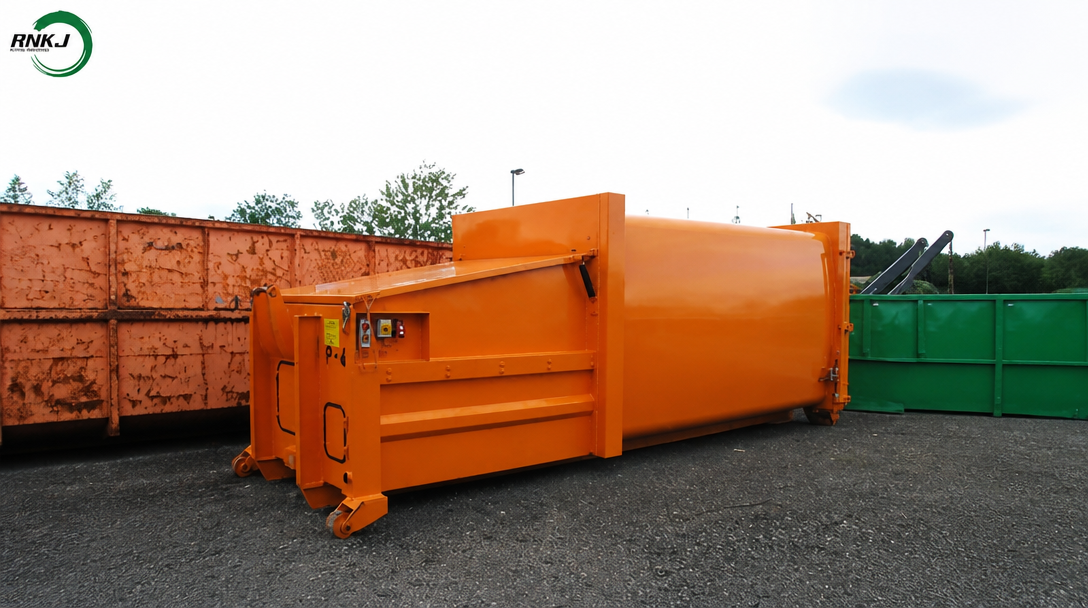
The working process of a mobile garbage compactor is designed to simplify the collection and transportation of solid waste.
Waste is loaded into the receiving area of the mobile garbage compactor. Depending on the equipment configuration, waste can be loaded manually, through garbage bins, or using compatible lifting and feeding equipment.
Common waste streams may include:
Municipal solid waste
Household waste
Commercial waste
Industrial general waste
Packaging materials
Cardboard and paper
Plastic waste
Lightweight bulky waste
Non-hazardous solid waste
The exact material suitability depends on the machine configuration and project requirements.
After waste enters the compaction chamber, the hydraulic compression mechanism pushes the material forward.
The compression process reduces the volume of loose waste and allows more material to be stored in the same container space.
Compared with storing uncompacted waste, compression can help increase the effective utilization of container capacity and reduce the frequency of transportation.
The machine can continue collecting and compressing waste during normal operation.
This makes it suitable for locations where waste is generated continuously, such as:
Residential communities
Shopping centers
Factories
Warehouses
Markets
Hotels
Public facilities
Municipal collection points
When the mobile garbage compactor reaches its required filling level, a hook lift truck can connect to the designated lifting structure.
The truck hooks onto the container, hydraulically lifts the complete unit, and transports it to the next destination.
This eliminates the need to manually unload compacted waste before transportation.
After arriving at the designated facility, the compacted waste can be discharged according to the equipment configuration and local waste management process.
The truck can then return the equipment to the collection location or move another unit as required.
One of the main advantages of a mobile garbage compactor is its ability to compress waste before transportation.
Loose waste can contain a large amount of empty space. Hydraulic compaction reduces this unused volume, allowing more waste to be stored within the same container.
For waste management operators, this can mean:
Better container utilization
Fewer transportation trips
More efficient collection routes
Reduced handling frequency
Improved overall logistics efficiency
The actual volume reduction depends on the waste type, moisture content, compression pressure, and machine configuration.
Transportation is one of the largest operational costs in many waste management systems.
If loose waste is transported before being compacted, trucks may spend significant time moving relatively low-density material.
A mobile garbage compactor changes this process by compressing waste before transportation.
More waste can be transported per trip, which can help reduce unnecessary collection trips and improve vehicle utilization.
For municipalities and commercial operators managing multiple collection points, this can be particularly valuable.
The hook lift transport system is one of the most important features of this type of mobile waste compactor.
A hook lift truck is designed to load, transport, and unload compatible containers using a hydraulic hook mechanism.
For a mobile garbage compactor, this means the complete equipment can be transported without transferring the waste into another vehicle.
The basic logistics chain becomes:
Collection Site → Hook Lift Truck → Transfer Station → Disposal Facility
This makes the equipment highly suitable for waste management projects where collection and transportation locations frequently change.
A fixed garbage compression station normally requires a permanent installation area.
A mobile garbage compactor offers greater flexibility.
It can be deployed at different locations according to waste generation patterns and operational requirements.
For example, a municipal waste management company may use mobile compactors at different temporary collection points. Industrial companies can also deploy mobile compactors near production or warehouse areas.
This flexibility is especially useful for:
Temporary waste collection projects
Large construction projects
Industrial parks
Commercial developments
Residential communities
Municipal sanitation projects
Events and temporary facilities
Traditional waste collection often relies on garbage bins or open containers. Waste is collected and transported to a transfer station or disposal facility.
While this method is simple, it can become inefficient when waste volumes are high.
A mobile garbage compactor adds an important intermediate step: compression before transportation.
| Feature | Traditional Waste Container | Mobile Garbage Compactor |
|---|---|---|
| Waste compression | Limited or none | Hydraulic compression |
| Waste volume | Relatively high | Reduced through compaction |
| Transportation efficiency | Moderate | Higher potential efficiency |
| Hook lift transportation | Possible depending on container | Designed for hook lift transport |
| Mobility | High | High |
| Space utilization | Lower | Better |
| Suitable for high-volume waste | Limited | Yes |
| Collection logistics | Basic | More integrated |
The right solution depends on waste generation volume, transportation distance, site conditions, and local disposal requirements.
Another important consideration is whether to choose a mobile or fixed waste compression system.
A fixed garbage compression station is generally installed at a permanent location and connected to a dedicated waste collection and transportation system.
A mobile garbage compactor, on the other hand, integrates waste collection, compaction, storage, and transportation into a movable unit.
Best suited for:
Multiple collection locations
Flexible waste collection routes
Temporary projects
Industrial facilities
Remote waste collection points
Projects using hook lift trucks
Best suited for:
Permanent transfer stations
Large municipal facilities
Centralized waste collection
High-volume fixed waste generation
Locations with permanent infrastructure
Choosing between the two depends on the project's operational model.
If flexibility and transportation are major concerns, a mobile garbage compactor with hook lift transport can be an effective choice.
A high-quality mobile garbage compactor normally consists of several major systems.
The hydraulic system provides the force required to compress waste.
It typically includes hydraulic cylinders, hydraulic valves, hydraulic pipes, a hydraulic pump, and related control components.
The hydraulic design directly influences compression performance, operating stability, and equipment reliability.
The compression chamber is the main working area where waste is compacted.
Its internal dimensions and structural design should be matched with the expected waste type and required capacity.
The receiving section allows waste to enter the compaction system.
Its design can be customized according to the waste loading method, including manual loading, garbage bin lifting, or mechanical feeding.
The container provides storage space for compacted waste.
Depending on project requirements, container capacity, dimensions, materials, doors, discharge structure, and surface treatment can be customized.
The hook lift structure provides the connection between the garbage compactor and the hook lift truck.
It must be designed according to the truck's hook height, lifting capacity, container dimensions, and relevant transportation requirements.
The control system manages the hydraulic compression cycle and operating functions.
Depending on the configuration, the equipment can include manual controls, automatic control functions, emergency stop systems, sensors, alarms, and other safety features.
Mobile garbage compactors are commonly used for general non-hazardous solid waste.
Typical applications include:
Household and community waste can be collected and compacted before transportation.
Shopping centers, supermarkets, hotels, restaurants, and commercial buildings can use compactors to manage daily waste generation.
Factories and warehouses may generate large quantities of packaging materials, plastic, cardboard, and general solid waste.
Certain lightweight and non-hazardous construction-related waste streams may be compacted, depending on equipment specifications.
Heavy materials such as concrete, large metal components, or materials unsuitable for the compaction mechanism should not be loaded unless the machine is specifically designed for them.
The flexibility of hook lift transportation makes mobile garbage compactors suitable for many applications.
Municipal sanitation departments can use mobile compactors at decentralized waste collection points.
They can help connect local waste collection with centralized transfer or disposal facilities.
Large residential developments can generate substantial daily household waste.
A mobile garbage compactor can provide a centralized waste collection point while reducing the volume of waste that needs to be transported.
Factories and industrial parks often generate waste at multiple locations.
A mobile system can be positioned close to the waste generation area and transported when full.
Shopping malls, markets, warehouses, and logistics centers can benefit from compacting packaging and general commercial waste before transportation.
Construction sites can have changing waste collection requirements.
A mobile waste compactor can provide a flexible waste management solution without requiring a permanent compression station.
The hook lift system creates a direct connection between the waste compactor and transportation vehicle.
Instead of transferring waste from one container to another, the complete compactor can be loaded onto the truck.
This can provide several operational benefits.
Hydraulic hook lift systems can load compatible containers efficiently.
Operators do not need to manually transfer large quantities of compacted waste between containers.
The same truck can potentially serve multiple compatible containers according to the project requirements.
The compactor can be removed from a site for transportation, maintenance, cleaning, or repositioning.
The compactor and hook lift truck form a more integrated waste collection and transportation system.
Before purchasing a mobile garbage compactor, several factors should be evaluated.
Different waste materials have different compression characteristics.
The supplier should understand whether the equipment will handle household waste, commercial waste, industrial waste, packaging waste, or other materials.
Container capacity should be selected according to daily waste generation and collection frequency.
Common capacity configurations can vary depending on the project.
Compression force and compression ratio should match the target waste stream.
Higher compression is not always better if the equipment is not properly matched to the waste material.
This is critical.
The garbage compactor must match the hook lift truck in terms of:
Hook height
Container length
Overall dimensions
Lifting capacity
Hydraulic system requirements
Locking structure
Transportation regulations
The equipment should be evaluated according to available space, ground conditions, climate, access roads, and local operating requirements.
A reliable hydraulic system, durable steel structure, accessible components, and convenient maintenance design can help reduce long-term operating difficulties.
Hydraulic technology is widely used in modern waste compactors because it can provide substantial compression force while maintaining controlled movement.
A hydraulic garbage compactor can use hydraulic cylinders to drive the compression plate or ram.
The compression cycle can be adjusted according to the equipment design.
Compared with simple mechanical compression systems, hydraulic systems provide greater flexibility for designing different compression forces, operating cycles, and equipment configurations.
For commercial and municipal applications, hydraulic waste compaction can help create a more efficient waste collection process.
A Mobile Garbage Compactor with Hook Lift Transport offers a practical approach to modern waste collection by integrating waste storage, hydraulic compaction, and flexible transportation into one system.
By compacting waste before transportation and using a compatible hook lift truck to move the complete unit, waste management operators can improve container utilization, simplify collection logistics, and create a more flexible waste transportation process.
For projects looking for a mobile waste compactor, hydraulic garbage compactor, hook lift garbage compactor, mobile waste compression station, or municipal waste management solution, this type of equipment can be configured according to waste characteristics, capacity requirements, truck specifications, and application environment.
Choosing the right equipment starts with understanding the complete waste management process—not simply the size of the container. A properly designed mobile garbage compactor can help connect waste collection, compression, storage, and transportation into a more efficient and manageable system.


