
Views: 0 Author: Site Editor Publish Time: 2026-08-05 Origin: Site


A bucket-type garbage compactor compresses loose waste into dense blocks, cutting waste volume by up to 75% compared with a traditional waste container. It also eliminates manual bin lifting, reduces collection frequency by up to 5x, and contains odor inside a sealed chamber. For supermarkets, restaurants, apartment buildings, and factories producing 0.5–10 m³ of waste per day, the switch typically pays for itself within 12–18 months through lower hauling and labor costs alone.
If your facility still stores loose garbage in open containers, this guide explains exactly what a bucket-type garbage compactor is, how the hydraulic system works, the seven measurable advantages, how to size one correctly, and what it really costs to run.
A bucket-type garbage compactor (also called a bucket garbage compactor or hydraulic bucket compactor) is a self-contained, electrically powered waste unit with a hydraulic bucket-lift arm. Instead of staff lifting or dragging heavy bins to a dumpster, operators wheel a standard mobile waste bin to the machine — the hydraulic arm does the rest.
The operating cycle takes three steps:
Load — wheel the four-caster mobile bin to the unit and position it under the lifting arm.
Lift & dump — the hydraulic articulating arm grips the bin, lifts it, and tips the contents into the loading chamber. No manual handling at any point.
Compact & store — the hydraulic ram compresses the waste into the sealed container, where it stays until the scheduled collection.
An operator only presses the control panel — typically a start button with a digital display — and the cycle completes automatically. An emergency stop and lockable mode switch are standard, making the machine safe for staff with minimal training.
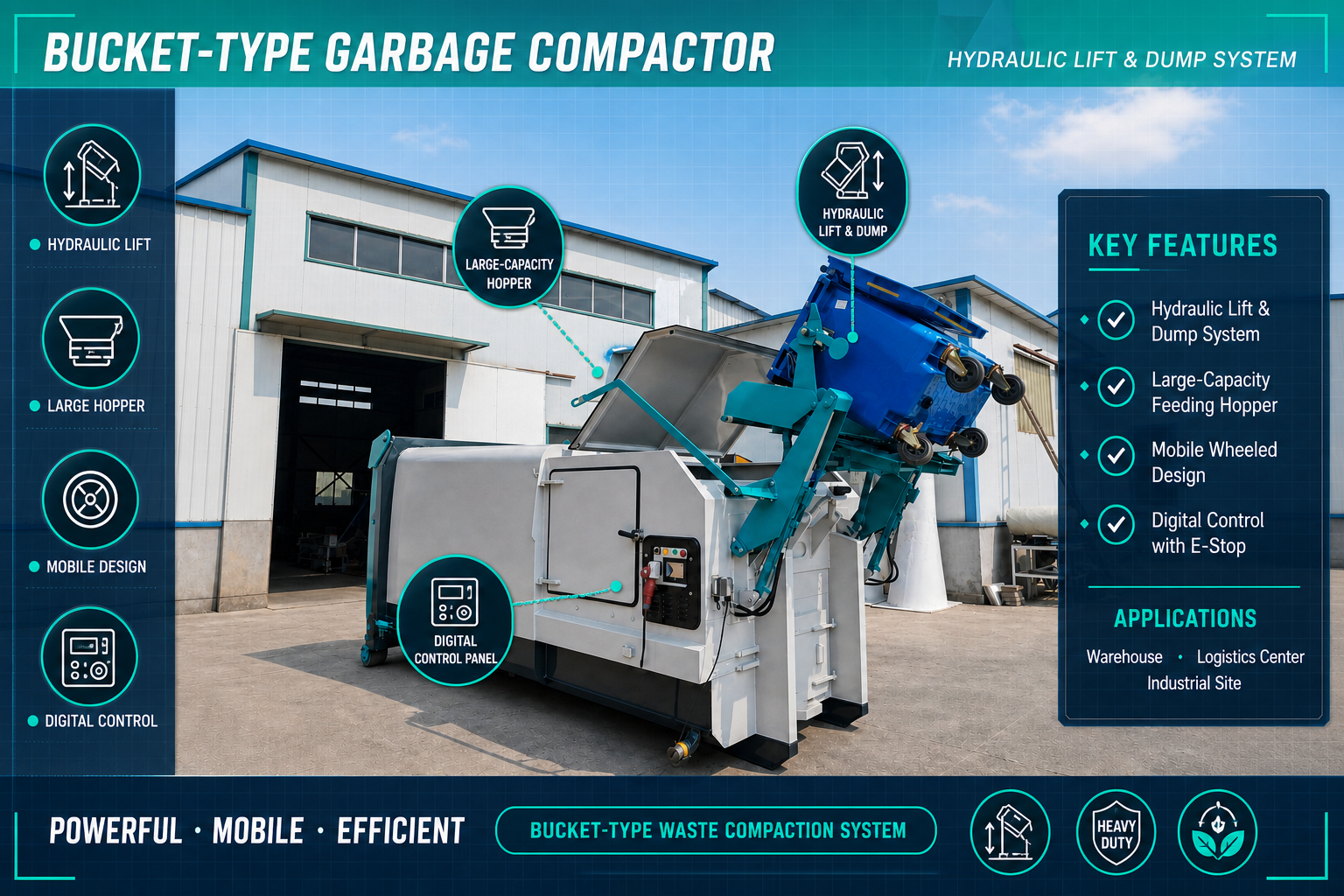
The performance of any trash compactor comes down to its hydraulic system. In a bucket-type compactor:
A hydraulic pump drives oil through high-pressure hoses to two working cylinders — one powers the bucket-lift arm, one powers the compaction ram.
The bucket-lift arm raises the bin to a tipping angle and dumps the waste into the loading chamber.
The compaction ram then pushes the waste to the end of the chamber under sustained pressure, packing it into a dense block.
The compaction ratio — the ratio of loose waste volume to compacted volume — is the single most useful specification to compare. Typical bucket-type compactors reach 3:1 to 5:1, meaning 3 to 5 m³ of loose waste becomes 1 m³ of compacted waste.
What affects the ratio in practice:
Cardboard, paper, and plastic film compact extremely well — often at the high end of the range.
Mixed general waste typically compacts at 3:1 to 4:1.
Wet food waste and dense glass compact less — expect ratios closer to 2:1 to 3:1.
This is why a bucket-type garbage compactor is an especially strong fit for retail, restaurants, and residential sites, where packaging and mixed household waste dominate.
A traditional container stores loose waste at a 1:1 ratio. A bucket-type compactor uses a hydraulic ram to reach typical compaction ratios of 3:1 to 5:1 — one compactor holds what three to five open containers hold. Less volume means fewer containers, less space, and less material sent to landfill. For any business tracking waste reduction targets, this is the fastest, most visible win available in waste management.
Haulers charge per trip and per ton. Fewer trips is the single biggest saving a compactor delivers.
Take a supermarket producing about 6 m³ of loose waste daily. With two open containers, collection happens once or twice a day. With a bucket-type compactor at a 4:1 ratio, the same waste occupies just 1.5 m³ — one collection every two to three days. That is roughly a 70–80% cut in collection frequency. With typical commercial collection fees of $50–150 per trip depending on region and container size, the monthly hauling bill can drop by hundreds of dollars — before labor is even counted.
Manual handling of heavy waste bins is a leading cause of back injuries in retail, hospitality, and property management. The bucket-type design removes the risk entirely: the hydraulic arm lifts and tips the bin, and the loading opening is guarded. Standard safety features — an emergency stop, an interlock that prevents the ram from cycling while the opening is uncovered, and clear warning signage — protect both operators and bystanders. Lower injury risk also means lower insurance and workers' compensation costs.
Open containers leak odor and attract flies, rodents, and birds. A bucket-type compactor seals waste inside a closed compaction chamber, holding in odor and containing liquid. This matters most for food businesses, hospitals, and residential communities, where a smelly waste area quickly becomes a complaint and a compliance issue. Facilities that switch typically report a visible difference in waste-room hygiene within the first weeks.
A traditional open container absorbs rain — adding weight, accelerating rot, and generating leachate that stains and smells. Wind scatters loose litter across the site and into drains. The covered, sealed design of a bucket-type compactor keeps waste dry, contained, and tidy in all weather, indoors or outdoors.
Because compacted waste takes a fraction of the area, the compactor needs far less ground space than the equivalent number of containers. This is decisive in urban sites, basements, loading docks, and small waste rooms where every square meter is expensive. One bucket-type compactor can replace a whole row of open containers and free up space for parking, storage, or operations.
An enclosed, organized waste area improves the look of your facility and simplifies compliance with commercial waste management standards. It also supports sustainability and ESG reporting: less waste volume sent to landfill is a measurable environmental metric you can publish. As more municipalities tighten waste regulations and haulers raise fees, compactors are moving from "optional upgrade" to "standard equipment" for commercial facilities.
| Feature | Bucket-Type Garbage Compactor | Traditional Waste Container |
|---|---|---|
| Storage capacity | Up to 5x (3:1–5:1 compaction ratio) | 1:1, loose waste |
| Collection frequency | 3–5x fewer trips | Daily or every other day |
| Manual lifting | None — hydraulic arm | Frequent, heavy handling |
| Odor control | Sealed chamber | Open or loose-fitting lid |
| Weather protection | Fully covered | Exposed to rain and wind |
| Space required | Compact footprint | Large area per ton stored |
| Safety features | Emergency stop, guards, interlock | Limited |
| Power source | Standard three-phase industrial supply | None required |
| Upfront cost | Higher | Low |
| Running cost (hauling + labor) | Low | High |
| Lifespan | 10+ years with routine service | Varies; frequent replacement of bins |
| Landfill volume | Up to 75% less | Uncompacted |
The honest comparison between a compactor and open containers includes both costs:
Upfront. A bucket-type garbage compactor is a capital purchase — higher than the cost of a few containers. But it is a one-time investment with a 10+ year service life, not a recurring expense.
Operating. The monthly savings come from three lines:
Hauling fees — 70–80% fewer collection trips.
Labor — no manual loading, lifting, or double-handling of waste.
Containers and liners — fewer bins to buy, replace, and clean.
Most facilities recover the investment in 12–18 months. Facilities in high-fee regions, or those generating more than 6 m³ daily, often see payback within the first year. After that, the savings are pure margin — every month, indefinitely.
Bucket-type compactors are often compared with two other commercial waste machines:
Bucket-type (bucket garbage compactor) — hydraulic arm tips a mobile bin into the loading chamber. Best for 0.5–10 m³ of daily waste, multi-point collection (several bins), and sites without a loading dock.
Stationary compactor — a fixed unit that rams waste directly into a detachable roll-off container. Best for 10+ m³ daily, single-point, high-volume sites with truck access.
Self-contained compactor — compaction mechanism and storage container are one sealed unit, hauled away whole. Best for wet waste and sites where the container must travel with the waste.
If your team already collects waste in wheeled bins — typical in supermarkets, restaurants, and residential complexes — a bucket-type garbage compactor is almost always the least disruptive, fastest-payback upgrade.
Myth 1: "Compactors are only for huge facilities." False. Bucket-type compactors are designed for exactly the 0.5–10 m³ daily range that small and mid-size businesses produce.
Myth 2: "They are too expensive." Compare total cost, not sticker price. A 12–18 month payback on hauling and labor makes the compactor cheaper than the containers over its lifespan.
Myth 3: "They are hard to maintain." Routine maintenance is a monthly fluid and hose check plus an annual service — less work than managing a fleet of broken, leaking containers.
Myth 4: "They smell worse than open containers." The opposite. A sealed compaction chamber contains odor and liquid; an open container releases both continuously.
If your facility still stores loose waste in open containers, you are paying for volume you never use — in hauling fees, labor, space, and hygiene risk. A bucket-type garbage compactor converts that wasted volume into measurable monthly savings, from the first week of operation.
Send us your daily waste volume and current collection schedule, and we will recommend the right compactor model — with a free waste audit and a factory-direct quote.


