
Views: 0 Author: Site Editor Publish Time: 2026-09-21 Origin: Site


Waste collection projects rarely have exactly the same requirements. Municipal waste, commercial refuse, industrial solid waste, and high-volume public-area waste can differ significantly in material characteristics, daily volume, collection frequency, site conditions, and transportation arrangements. For this reason, a standard waste compaction machine may not always provide the most suitable configuration.
A Customized Separate-type Garbage Compression Station offers a flexible approach by combining a dedicated compression unit with a separate waste container. Instead of treating the compactor and container as one fixed structure, the two components are designed to work together while remaining physically separate after the waste-loading and compression process.
This configuration allows the equipment to be adapted to different container capacities, installation conditions, waste volumes, and transportation requirements. It can be particularly useful for waste transfer points, municipal sanitation projects, commercial facilities, industrial sites, and other locations where waste needs to be compacted before transportation.
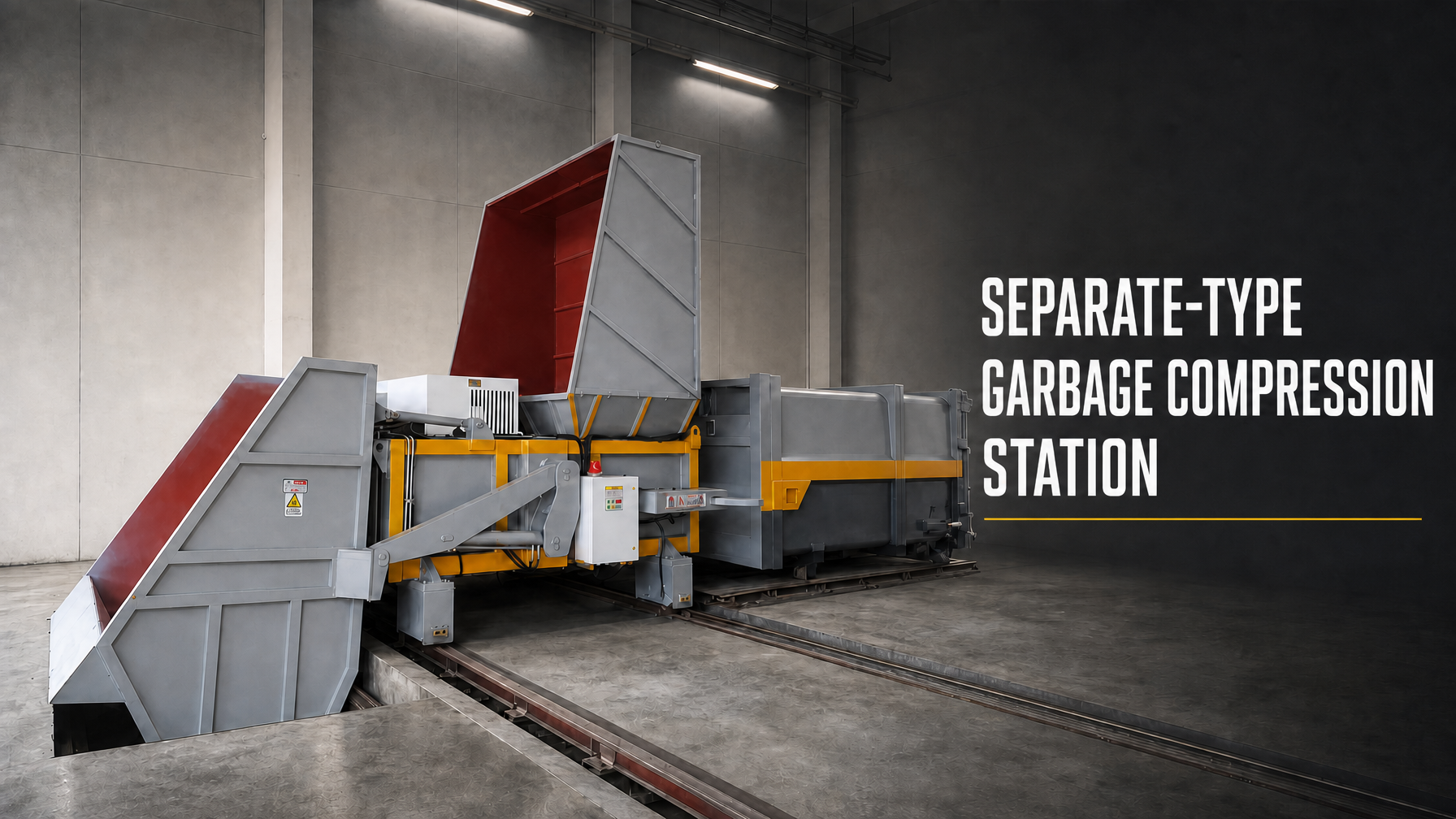
A Separate-type Garbage Compression Station consists primarily of two working sections: the garbage compression unit and the waste collection container.
The compression unit receives waste and uses a hydraulic compression mechanism to push the material into the container. As waste accumulates, the compression process reduces its occupied volume and allows more material to be loaded into the available container space.
Unlike an integrated compactor-container structure, the compression body and container are independently arranged. Once the container reaches its required filling level, the full container can be separated from the compression equipment and transported away. An empty container can then be positioned for continued operation.
This working arrangement creates a practical separation between the compaction process and the waste transportation process.
The basic operating process can be organized into several stages:
Waste is delivered to the station through the designated loading area. Depending on the project configuration, waste may come from municipal collection vehicles, commercial facilities, public areas, or internal waste handling systems.
The compression unit activates its hydraulic mechanism to move the compaction plate or ram. The waste is pushed toward the container and compressed into a denser mass.
The container gradually receives compacted waste. The station can continue its operating cycle according to the control system and project requirements.
When the container is full or reaches the designated replacement point, the container can be separated from the compression unit.
The filled container is transferred by the appropriate transport vehicle, while another empty container can be installed for continued waste collection.
This arrangement allows the compression equipment to remain at the waste collection point while the filled container moves through the transportation cycle.
The main advantage of a customized system is that the equipment does not have to follow one universal configuration. Different projects can select different technical parameters according to their operating conditions.
Container capacity is one of the most important factors when designing a garbage compression station.
A project with relatively low daily waste generation may require a smaller container, while a municipal transfer location or industrial facility may need a considerably larger waste storage volume.
The container can therefore be designed according to factors such as:
Expected daily waste generation
Waste collection frequency
Available installation area
Transportation capacity
Required operating cycle
Type of waste being handled
Choosing an appropriate container volume helps balance the available site space with the required waste storage capacity.
Waste characteristics can vary considerably from one application to another.
Municipal solid waste may contain household refuse, packaging, food-related waste, and other mixed materials. Commercial waste may include cartons, plastic packaging, and general refuse, while industrial facilities can generate larger quantities of process-related solid waste.
A customized Separate-type Garbage Compression Station can be configured according to the characteristics of the target material.
Important considerations may include:
Waste density
Moisture content
Particle size
Expected daily volume
Presence of bulky materials
Corrosive or abrasive characteristics
The compression system, container structure, sealing arrangements, and material selection can be evaluated according to the intended application.
The container is an important part of a separate-type station because it is responsible for holding the compacted waste during transportation.
Different projects may require different container dimensions, opening arrangements, reinforcement structures, discharge configurations, or connection details.
For example, a container intended for municipal waste may emphasize loading capacity and convenient transportation, while an industrial application may require heavier structural construction.
Customization can include:
Container dimensions
Effective volume
Steel material
Wall thickness
Reinforcement structure
Loading opening
Discharge arrangement
Sealing configuration
Surface treatment
This allows the container to be designed around the project's actual operating environment rather than relying on a fixed standard size.
One of the key characteristics of this equipment is the separation between the compression body and the waste container.
When the container is full, the container can be removed for transportation while the compression equipment remains at the collection station.
This can create a more flexible operating arrangement for projects where waste needs to be transferred frequently.
Instead of moving the complete compression equipment each time waste needs to be transported, the project can focus transportation operations on the filled container.
The exact transportation method depends on the container design and project requirements. For suitable configurations, the full container can be handled using a hook lift truck, allowing the container to be loaded, transported, unloaded, and replaced according to the established waste transfer process.
For waste collection facilities operating continuously, container replacement can be an important consideration.
A separate-type configuration allows the project to organize containers around the compression station according to its waste generation and transportation schedule.
For example, a project may use:
One container in operation
One container being transported
One empty container prepared for replacement
The exact number depends on the project's waste volume and logistics plan.
This arrangement can help separate the timing of waste compaction from the timing of waste transportation. The compression station can remain in place while filled containers enter the transportation cycle.
Site conditions are another major factor in equipment selection.
Waste collection stations may be installed at municipal service areas, residential communities, commercial facilities, industrial plants, logistics centers, public institutions, or other locations.
Each site can have different requirements regarding:
Available floor space
Vehicle access
Loading direction
Container positioning
Power supply
Drainage
Maintenance access
Waste loading height
Transportation routes
A customized design can take these conditions into account before manufacturing.
For example, a site with limited installation space may require a more compact arrangement, while a high-volume waste facility may prioritize larger container capacity and faster loading cycles.
Hydraulic power is central to the compression process.
The hydraulic system supplies the force required to move the compression mechanism and push waste into the container. Its configuration can be selected according to the required compression force, operating frequency, waste characteristics, and equipment size.
Important hydraulic components may include:
Hydraulic cylinders
Hydraulic pump
Hydraulic valves
Hydraulic oil tank
Hydraulic pipelines
Control components
For projects with frequent operation, the hydraulic system can be designed for repeated compression cycles. For heavier waste applications, the compression force and structural strength need to be considered together.
The hydraulic system should therefore be matched with the compression chamber, ram structure, container size, and expected waste characteristics rather than selected independently.
Yes. The control system can be configured according to the operating requirements of the project.
A basic control arrangement may include manual operating functions, while more advanced configurations can incorporate automatic or semi-automatic control sequences.
Possible control functions include:
Compression cycle control
Hydraulic system operation
Container-full monitoring
Safety interlocks
Emergency stop
Operating status indication
Automatic cycle settings
For municipal or commercial applications, a straightforward control interface may be sufficient. Projects with more complex waste handling procedures may require additional sensors and control functions.
Safety is an important part of garbage compression equipment because the station contains moving hydraulic components and handles large quantities of waste.
Depending on the equipment configuration, safety considerations may include:
Emergency stop functions
Hydraulic pressure protection
Electrical protection
Mechanical safety interlocks
Access-area protection
Controlled compression cycles
Maintenance access provisions
The specific safety configuration should be determined according to the equipment design, operating environment, applicable standards, and local project requirements.
The flexible structure allows this type of waste compression equipment to serve different applications.
Municipal sanitation projects can use separate-type stations to collect and compact mixed municipal solid waste before transportation to a larger transfer or treatment facility.
Shopping centers, office complexes, hotels, markets, and other commercial facilities may generate substantial amounts of daily waste. A customized station can be configured according to the available space and waste generation pattern.
Industrial sites may require stronger containers and larger capacities to handle high-volume solid waste. Container material, thickness, reinforcement, and dimensions can be adjusted according to the application.
Residential waste collection areas can use compact waste compression equipment where the available site area is limited but regular waste transfer is required.
Schools, hospitals, transportation facilities, public service centers, and other institutions may require organized waste collection and transportation solutions based on their specific site layouts.
Before manufacturing a customized station, several project parameters should be clearly defined.
Determine the approximate amount of waste generated per day or per operating cycle. This provides a starting point for selecting the appropriate container volume and compression capacity.
Identify whether the waste is mixed municipal waste, commercial refuse, industrial solid waste, packaging material, or another category.
Determine how the filled container will be transported. If a hook lift truck is planned, the container structure and lifting interface should be coordinated with the vehicle specifications.
Measure the installation area and consider the movement paths required for waste-loading vehicles and container transportation vehicles.
A station operating several times per day may require a different hydraulic and control configuration from a system used only intermittently.
The equipment should be designed and manufactured with applicable local safety, electrical, environmental, and transportation requirements in mind.
A standard machine can be suitable when the project's waste volume, container size, site arrangement, and transportation method closely match the manufacturer's standard configuration.
However, customized equipment can be considered when the project has specific requirements.
| Project Factor | Standard Configuration | Customized Configuration |
|---|---|---|
| Container size | Fixed or limited options | Designed according to project |
| Installation conditions | General site requirements | Adapted to actual site |
| Waste characteristics | Common applications | Specific waste conditions |
| Transportation method | Standard arrangement | Coordinated with vehicle |
| Hydraulic capacity | Standard configuration | Selected according to workload |
| Control system | Basic functions | Optional control requirements |
| Container structure | Standard design | Custom dimensions and reinforcement |
The purpose of customization is not simply to make the machine larger or more powerful. Instead, it is about coordinating the compression unit, container, site, waste characteristics, and transportation process into one practical operating solution.
The main value of a customized separate-type station lies in its modular operating concept.
The compression equipment can remain at the waste collection location, while the container participates in the transportation cycle. This allows the two parts of the waste handling process to be managed according to different schedules.
For projects with changing waste volumes or specific transportation requirements, customization provides additional flexibility in areas such as container capacity, hydraulic performance, structural dimensions, control functions, and site arrangement.
Instead of selecting equipment solely according to a catalog model, project parameters can be considered from the beginning of the design process.
A Customized Separate-type Garbage Compression Station can be adapted to a wide range of waste management projects by separating the compression equipment from the waste container and allowing key parameters to be configured according to actual requirements.
Container capacity, structural design, hydraulic performance, control functions, waste characteristics, site dimensions, and transportation methods can all influence the final equipment configuration.
For projects that require continuous waste compaction combined with flexible container transportation, this design provides a practical way to organize the collection and transfer process.
The most suitable configuration ultimately depends on the project's waste generation, operating schedule, available space, transportation equipment, and local requirements. By evaluating these factors before manufacturing, a separate-type garbage compression station can be developed around the actual workflow of the facility rather than forcing the project to adapt to a fixed machine configuration.


