
Views: 0 Author: Site Editor Publish Time: 2026-10-24 Origin: Site


Choosing the right Roll Off Container is an important step in building an efficient industrial waste collection system. Manufacturing facilities, construction sites, recycling centers, warehouses, and waste management companies often handle different types and volumes of waste. A suitable container needs to match the waste material, loading requirements, available space, transportation equipment, and expected service conditions.
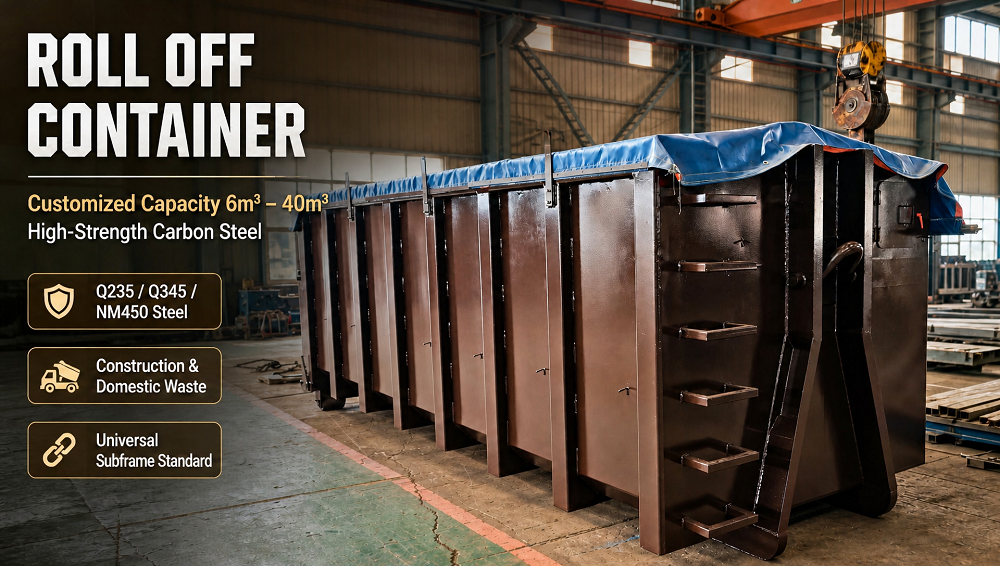
An industrial roll off container is designed to collect, store, and transport solid waste in a durable steel structure. Depending on the application, it can be customized in capacity, dimensions, steel material, plate thickness, and structural configuration. These options allow businesses to select a container that fits their actual waste handling requirements rather than relying on a standard design that may not suit their operations.
So, how do you choose the right roll off container for industrial waste collection? The following factors can help you evaluate your options and identify a practical solution for your project.
The first step in selecting a suitable roll off waste container is to identify the type of material it will handle. Different waste materials have different weights, shapes, loading characteristics, and requirements for container strength.
Choosing a container based only on its volume may result in an unsuitable configuration. For example, a container that works well for lightweight packaging waste may not be appropriate for dense metal scrap or heavy construction debris.
Construction and demolition waste may include concrete fragments, bricks, wood, drywall, and other building materials. These materials can be bulky, abrasive, or extremely heavy.
For this application, a heavy-duty roll off container should be evaluated based on its structural strength, bottom plate thickness, sidewall design, and loading method. Reinforced construction may be appropriate when the container is expected to handle dense materials or repeated heavy loading.
Factories and metalworking facilities often collect steel offcuts, metal scraps, rejected components, and other manufacturing residues.
A metal scrap roll off container should be designed around the weight and shape of the collected materials. Sharp metal edges can cause localized wear, while dense scrap can create significant loads even when the container is not completely full.
Depending on the application, a reinforced floor, suitable steel grade, and durable welded joints may be considered during customization.
General industrial solid waste may include packaging materials, production residues, discarded components, and mixed non-hazardous waste.
A standard industrial roll off container may be suitable for many of these applications, provided that its dimensions, loading capacity, and structure match the material being collected. Facilities handling mixed waste should also consider whether the container needs an open top, a cover, or other features suited to their collection process.
Before requesting a quotation, prepare a list of the waste materials, their approximate density, daily output, and loading method. This information helps the manufacturer recommend a more suitable container configuration.
Capacity is another major factor when selecting a roll off container for industrial waste collection. The container needs enough usable volume for the waste generated between collection or transportation cycles, while remaining compatible with the equipment used to move it.
Industrial roll off containers can be manufactured in different capacities. For projects requiring flexible specifications, custom roll off containers in approximately 6–40 m³ can be considered, depending on the application and manufacturer’s design capabilities.
The right capacity depends on several factors.
Estimate how much waste your facility produces each day. A site generating large amounts of production waste may require a larger container or several containers to avoid frequent collection interruptions.
For example, a manufacturing facility with regular packaging waste may prioritize storage volume, while a metal processing plant may need to pay closer attention to the maximum loaded weight.
Volume alone does not determine how much waste a container can safely carry. Heavy materials may reach the allowable payload before the container is filled.
A practical assessment should consider both the required container volume and the expected total loaded weight. The container structure, lifting equipment, truck specifications, and applicable transportation limits must all be compatible.
If waste is collected frequently, a smaller container may be sufficient. If transportation takes place only after several days of accumulation, a larger container may help reduce collection frequency.
However, increasing container capacity does not automatically improve efficiency. A container that is too large for the available loading area or transportation vehicle may create additional operating difficulties.
A basic estimate can be made using the following formula:
Required container volume = Daily waste volume × Storage days × Safety factor
For example, if a facility generates approximately 3 m³ of waste per day and needs to store waste for three days, the estimated storage volume is 9 m³ before applying an allowance for variations in waste generation and loading conditions.
This calculation provides an initial estimate rather than a final specification. Waste density, filling patterns, loading equipment, and the maximum permitted payload should also be considered before selecting a container.
The external dimensions of a roll off container directly affect where it can be positioned, how waste is loaded, and whether it can be transported by the intended vehicle.
A container with sufficient volume may still be unsuitable if it cannot fit into the available collection area or if the truck cannot safely approach and remove it.
When selecting custom roll off container dimensions, consider the following factors.
The length, width, and height determine the container's overall dimensions and usable volume. These measurements should be selected according to the required capacity, waste type, loading method, and transportation equipment.
A longer container may accommodate bulky waste, while a taller container may increase storage volume where the site has sufficient vertical clearance. The final design should balance volume, structural requirements, and handling convenience.
The installation area should provide enough room for loading machinery, workers, and collection vehicles to operate safely. Check overhead obstructions, access roads, turning areas, and the space required for container removal.
If a forklift, loader, conveyor, or other equipment will be used for loading, make sure the container opening and overall dimensions are suitable for that equipment.
The container dimensions must match the intended roll off truck or hook lift system. Important factors include the lifting interface, container length, overall height, loaded weight, and the vehicle's permitted operating range.
Before confirming a custom design, provide the manufacturer with the relevant vehicle specifications or drawings whenever possible. This helps reduce the risk of ordering a container that cannot be handled by the existing transportation system.
Industrial roll off containers are commonly manufactured from steel because it provides a practical combination of strength, fabricability, and durability for waste collection applications.
However, not every project requires the same material or structural configuration. Steel grade and plate thickness should be selected according to the waste type, expected loading conditions, service environment, and target service life.
Q235 carbon steel can be considered for general industrial waste collection applications where its mechanical properties meet the project requirements.
It may be suitable for containers handling common industrial residues, packaging waste, and other materials that do not require a more specialized wear-resistant structure. The final selection should account for the container's dimensions, load distribution, and expected operating conditions.
Q345, a commonly used designation in Chinese steel specifications, may be considered for applications requiring different strength characteristics from general-purpose carbon steel.
Its suitability depends on the applicable material standard, actual grade supplied, fabrication requirements, and structural design. Buyers should confirm the precise material specification with the manufacturer rather than relying on the grade name alone.
Some industrial applications involve abrasive materials, sharp scrap, heavy loads, or demanding service conditions. In these cases, customized material options may be evaluated according to the project's requirements.
When requesting a quotation, specify the type of waste, expected loading weight, working environment, and any particular durability requirements. The manufacturer can then assess whether a standard carbon steel configuration or a different material option is more appropriate.
The thickness of the bottom plate and side plates affects the container's weight, structural behavior, and resistance to wear and deformation.
A thicker plate is not automatically the best choice for every application. Excessive material thickness can increase the empty weight and reduce the available payload within the vehicle's limits.
The container should therefore be designed with a suitable balance between structural strength, material consumption, and transportation requirements. Reinforcement, cross-members, corner structures, and welding details should also be considered as part of the complete design.
A roll off container must work with the transportation equipment used at the facility. The lifting method affects container design, collection procedures, and compatibility with existing waste handling vehicles.
A hook lift system uses a truck-mounted lifting mechanism to load, unload, and transport compatible containers. It is commonly used in industrial waste collection, construction waste removal, recycling operations, and other applications that require containers to be exchanged or transported between locations.
For a hook lift roll off container, the lifting interface, container geometry, structural strength, and loaded weight must match the truck's specifications.
Before ordering, confirm:
Hook lift system compatibility and lifting point dimensions.
Container length and overall geometry.
Maximum permitted loaded weight.
Loading and unloading clearances.
Whether the truck can safely handle the container under the intended operating conditions.
Not every roll off container is automatically compatible with every hook lift truck. Compatibility should be verified using the actual vehicle specifications.
Some facilities keep their waste containers in designated collection areas and arrange transportation when the containers are full. These applications may prioritize large storage capacity, convenient loading access, and a structure suited to repeated handling.
If containers are frequently moved between different collection points, durability and compatibility with the available transportation equipment become particularly important.
For facilities that generate waste continuously, using multiple containers may help maintain uninterrupted collection. One container can be used for waste accumulation while another is transported or emptied, depending on the site's handling arrangement.
The number of containers required depends on waste generation, transportation frequency, turnaround time, and the available storage area.
Beyond capacity, dimensions, and steel material, several design details can improve the suitability of a roll off container for a particular application.
An open-top container provides convenient access for loading bulky materials, scrap, and general solid waste. A cover may be considered when the application requires protection from rain, control of loose materials, or reduced exposure during storage.
The appropriate configuration depends on the material being collected and the operating environment.
Reinforced bottom plates, sidewalls, corner sections, and other structural components may be considered for heavy-duty applications. These features should be determined by the expected loading conditions and structural calculations rather than selected without reference to the actual requirements.
Welding quality is important for the structural integrity of a steel roll off container. Buyers should ask about fabrication procedures, weld inspection, dimensional checks, and quality control practices.
The container should be manufactured according to the agreed drawings and specifications, with particular attention to load-bearing areas and lifting interfaces.
Containers used outdoors may be exposed to moisture, changing temperatures, and other environmental conditions. Appropriate surface preparation and coating systems can help protect steel surfaces from corrosion.
The required surface treatment should reflect the operating environment, maintenance plan, and expected service conditions.
When standard container dimensions or configurations do not match the project, working with a roll off container manufacturer that offers customization can help address specific operating requirements.
Before placing an order, check whether the manufacturer can support the following:
Capacity customization: Container volumes designed around the required storage capacity and transportation limits.
Dimension customization: Length, width, height, and opening dimensions adapted to the installation site and loading equipment.
Material selection: Q235, Q345, or other agreed material options, subject to availability and technical suitability.
Structural customization: Plate thickness, reinforcement, and structural details based on the intended waste type and loading conditions.
Transportation compatibility: Lifting interfaces and container geometry matched to the specified hook lift truck or other handling equipment.
Manufacturing quality control: Agreed drawings, material specifications, welding requirements, dimensional inspections, and surface treatment.
A reliable supplier should be able to clarify the relationship between these specifications and the intended application. This helps buyers compare quotations based on actual technical requirements instead of price alone.
Providing complete project information makes it easier for a manufacturer to recommend an appropriate roll off container and prepare a relevant quotation.
Before contacting a supplier, try to confirm the following details:
| Specification | Information to Provide |
|---|---|
| Waste type | Metal scrap, construction debris, packaging waste, or other industrial solid waste |
| Required capacity | Estimated volume, such as 6–40 m³ where suitable |
| Container dimensions | Required length, width, height, or available installation space |
| Steel material | Q235, Q345, or another specified material |
| Plate thickness | Required thickness or application-based recommendation |
| Transportation method | Hook lift truck or other handling equipment |
| Loading method | Loader, forklift, conveyor, or manual loading where applicable |
| Operating environment | Indoor, outdoor, or other relevant working conditions |
| Quantity | Number of containers required |
| Custom requirements | Reinforcement, cover, surface treatment, or other project-specific features |
If you do not know the exact specifications, you can still begin the inquiry process by providing the waste type, approximate daily waste volume, site dimensions, and transportation method. A qualified manufacturer can use these details to discuss feasible options.
Choosing the right Roll Off Container for industrial waste collection involves more than selecting a container with sufficient volume. Waste type, container capacity, dimensions, steel material, structural design, and transportation compatibility all influence whether the final product will suit your operation.
For industrial buyers, a customized solution can help align container specifications with actual site conditions and waste handling requirements. Whether you need a container for construction debris, metal scrap, general industrial solid waste, or a larger waste collection project, confirming these details before production can help reduce compatibility issues and unnecessary costs.
Shandong RNKJ Environmental Technology Co., Ltd. provides customized waste collection equipment solutions for different industrial applications. If you are looking for a durable steel roll off container, our team can discuss suitable capacity, dimensions, material options, plate thickness, structural configuration, and hook lift compatibility according to your project requirements.
Contact us today to discuss your roll off container requirements and request a customized quotation. Share your waste type, target capacity, preferred steel material, and transportation specifications so we can help you evaluate a suitable solution for your industrial waste collection system.


