
Views: 0 Author: Site Editor Publish Time: 2026-06-15 Origin: Site


As urban populations continue to grow, municipalities face increasing challenges in managing municipal solid waste efficiently and sustainably. An effective waste management system requires more than simply collecting garbage—it demands a well-designed process that integrates waste collection, transfer, compaction, transportation, and final disposal.
This article introduces a complete waste collection and transportation solution based on a modern garbage compactor station system, helping cities, residential communities, industrial parks, and commercial districts achieve cleaner environments, lower transportation costs, and higher operational efficiency.
A complete municipal solid waste management system generally consists of five stages:
Waste Generation and Disposal
Front-End Waste Collection
Waste Transfer and Compaction
Long-Distance Waste Transportation
Final Waste Treatment
The integrated workflow ensures seamless movement of waste from households to treatment facilities while minimizing environmental impact.
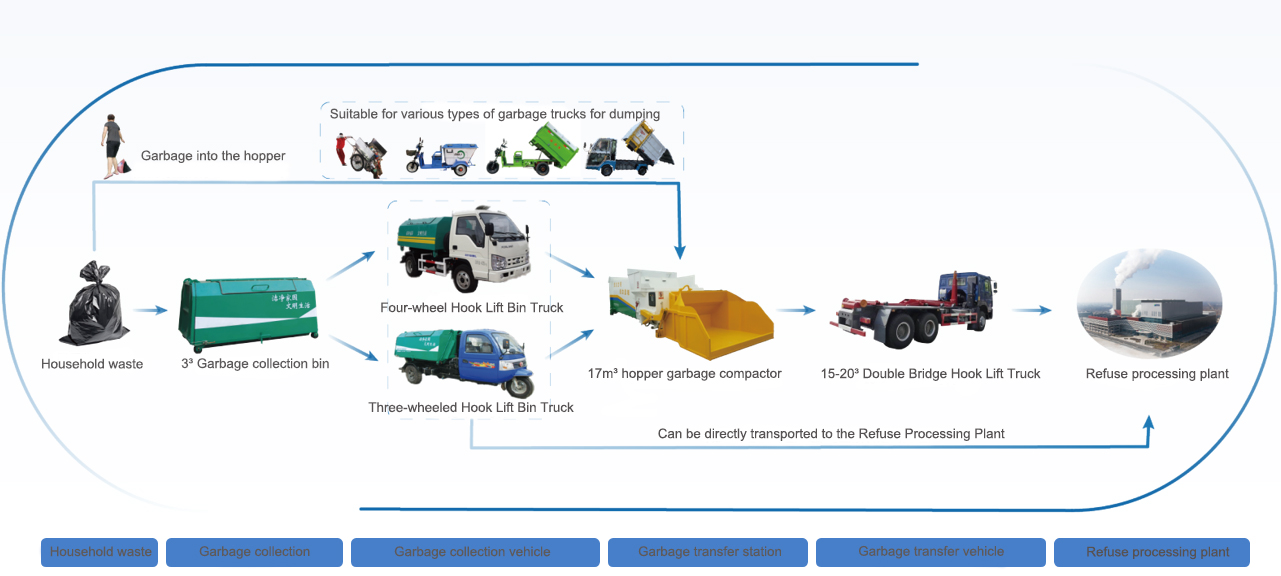
The process begins when residents generate household waste during daily activities.
Waste is deposited into designated community waste storage containers strategically placed throughout residential areas, commercial centers, and public spaces.
Convenient for residents
Improves waste collection efficiency
Reduces littering and illegal dumping
Enhances community cleanliness
Supports standardized waste management practices
In this system, 3m³ waste storage containers are commonly used as front-end waste collection units due to their durability and sufficient storage capacity.
Once waste containers reach their designated capacity, sanitation vehicles collect and transport the waste to a transfer station.
Depending on road conditions and waste generation volumes, different collection vehicles can be deployed.
Suitable for:
Narrow streets
Old residential communities
Rural villages
Urban villages
Areas with limited road access
Excellent maneuverability
Low operating costs
Easy access to confined areas
Fast container replacement
Suitable for:
Residential developments
Industrial parks
Commercial districts
Municipal road networks
Larger carrying capacity
Greater operating range
Improved transportation efficiency
Higher productivity
Hook lift collection vehicles allow rapid loading and unloading of waste containers, significantly reducing collection time and labor costs.
After collection, waste is transported to a Garbage Compactor Station.
The waste transfer station serves as the core component of the entire waste handling system.
Its primary functions include:
Receiving waste from collection vehicles
Compressing municipal solid waste
Increasing waste density
Reducing transportation frequency
Minimizing environmental pollution
Collection vehicles arrive at the transfer station.
Waste is discharged into the hopper.
The hydraulic compaction system begins operation.
Waste is compressed into a sealed container.
The container is prepared for long-distance transportation.
High compaction ratio (up to 3–5 times volume reduction)
Fully enclosed operation
Reduced odor emissions
Lower leachate leakage risk
Improved sanitation conditions
Increased transportation efficiency
By reducing waste volume significantly, municipalities can lower transportation costs and improve operational performance.
Once the compactor container reaches full capacity, it is transported by a heavy-duty hook lift truck.
The hook lift truck is responsible for moving compacted waste from the transfer station to the final treatment facility.
Large payload capacity
Reduced transportation trips
Lower fuel consumption per ton of waste
Faster container exchange
Improved fleet efficiency
This "small vehicle collection + large vehicle transportation" model is widely recognized as one of the most cost-effective waste logistics solutions.
After transportation, the waste arrives at the waste treatment plant for final processing.
Several treatment methods can be adopted depending on local environmental policies and infrastructure.
Waste incineration plants convert municipal waste into electricity while significantly reducing landfill demand.
Benefits include:
Up to 90% waste volume reduction
Renewable energy generation
Reduced land occupation
Lower greenhouse gas emissions
Non-recyclable residues and incineration ash can be safely disposed of through engineered landfill facilities.
Valuable materials such as:
Plastics
Metals
Paper
Glass
Organic waste
can be recovered and processed for reuse, supporting circular economy initiatives.
In regions located close to waste treatment facilities, a direct transportation model may be adopted.
Household Waste → Waste Container → Collection Vehicle → Waste Treatment Plant
Eliminates transfer station construction costs
Simplifies logistics
Suitable for small towns and low-density areas
| Process Stage | Equipment | Function |
|---|---|---|
| Waste Collection | 3m³ Waste Container | Temporary waste storage |
| Front-End Collection | Three-Wheel Hook Lift Vehicle | Collection in narrow areas |
| Front-End Collection | Four-Wheel Hook Lift Vehicle | Collection in urban areas |
| Waste Transfer | 17m³ Hopper Garbage Compactor Station | Waste compaction |
| Long-Distance Transportation | 15–20 Ton Hook Lift Truck | Container transportation |
| Final Disposal | Waste Treatment Plant | Incineration, landfill, recycling |
The combination of hook lift collection vehicles and transfer stations ensures fast and continuous waste handling operations.
Waste compaction reduces volume by up to 80%, significantly lowering transportation frequency and fuel expenses.
Sealed transportation and enclosed compaction systems effectively prevent odor dispersion, litter leakage, and secondary pollution.
The system can be integrated with IoT technologies for:
Container fill-level monitoring
Fleet management
Remote equipment diagnostics
Real-time operational reporting
By combining waste reduction, recycling, and environmentally responsible disposal, municipalities can achieve long-term sustainability goals.
A modern waste collection, transfer, and disposal solution is essential for efficient municipal solid waste management. By integrating waste storage containers, hook lift collection vehicles, garbage compactor stations, heavy-duty transportation trucks, and advanced treatment facilities, cities can create a highly efficient, cost-effective, and environmentally friendly waste management system.
Whether applied in residential communities, industrial parks, commercial centers, or rural regions, this integrated waste handling solution provides a reliable pathway toward cleaner cities and sustainable urban development.


