Views: 6 Author: Site Editor Publish Time: 2026-01-03 Origin: Site


In the context of global environmental governance and the pursuit of sustainable development, the problem of solid waste disposal has become a key concern restricting ecological progress. As a core piece of equipment in the garbage treatment chain, the garbage compactor plays an irreplaceable role in optimizing garbage management, reducing environmental pollution and promoting resource recycling. Its significance and advantages in environmental protection are worthy of in-depth discussion and promotion.

The primary environmental significance of garbage compactors lies in reducing the occupied space of garbage and alleviating the pressure on land resources . In nature, uncompressed garbage has a loose structure, large volume and irregular shape. Whether it is stacked temporarily or transported to landfills, it will occupy a large amount of land. Landfills, as one of the main garbage disposal methods in many regions, are facing the dilemma of "land shortage" due to the continuous growth of garbage output. The garbage compactor uses strong mechanical pressure to compress the garbage, which can reduce its volume by 30% - 70% according to different garbage types. This compression effect can directly extend the service life of landfills, avoid the blind expansion of landfill areas, and protect the limited land resources from being occupied by garbage wantonly. At the same time, reducing the area of temporary garbage stacking points also helps to improve the living environment of urban and rural areas and reduce the impact of garbage stacking on the surrounding ecology.
Secondly, garbage compactors are effective in controlling secondary pollution and protecting the ecological environment. Uncompressed garbage has large gaps, which are easy to store rainwater and breed bacteria, mosquitoes and flies. In the process of stacking and transportation, the percolate produced by garbage will penetrate into the soil, pollute the groundwater, and the odor emitted will pollute the air. In addition, light garbage such as plastic bags and foam is easy to be blown away by the wind, causing "white pollution" and endangering the living space of animals and plants. After compression, the structure of garbage becomes dense, the gaps are greatly reduced, which not only reduces the production of percolate, but also prevents the leakage of harmful substances in the garbage. In the process of transportation, compacted garbage is not easy to scatter, which avoids the secondary pollution of the air and soil along the transportation route. For landfills, compacted garbage can reduce the contact area with air, slow down the speed of garbage degradation and fermentation, and reduce the emission of greenhouse gases such as methane, thus contributing to the goal of carbon emission reduction.
In addition, garbage compactors lay a solid foundation for promoting resource recycling and realizing circular economy. A large number of recyclable resources such as plastic, paper and metal are mixed in domestic garbage and industrial garbage. Uncompressed garbage has complex components and loose structure, which is not conducive to the sorting and recycling of recyclable resources. After compression, the garbage volume is reduced, the components are relatively concentrated, which is convenient for the subsequent sorting work of the garbage treatment plant. At the same time, the compression process can also crush some large pieces of garbage, making it easier to separate recyclable materials from the garbage. This not only improves the efficiency of resource recycling, but also reduces the amount of garbage entering the terminal disposal link, realizing the reduction, harmlessness and resource utilization of garbage treatment, which is in line with the development concept of circular economy.

From the perspective of practical application, garbage compactors also have many advantages that are conducive to environmental protection work. First of all, it improves garbage transportation efficiency and reduces energy consumption and carbon emissions. The reduction of garbage volume means that the number of transportation vehicles required for the same amount of garbage is greatly reduced. Taking urban garbage transportation as an example, if a garbage truck can load three times the amount of garbage after compression, the number of trips can be reduced by two-thirds. This not only saves transportation costs, but also reduces the fuel consumption of vehicles and the emission of exhaust gases such as carbon monoxide and nitrogen oxides, alleviating the pressure of vehicle exhaust on air pollution.
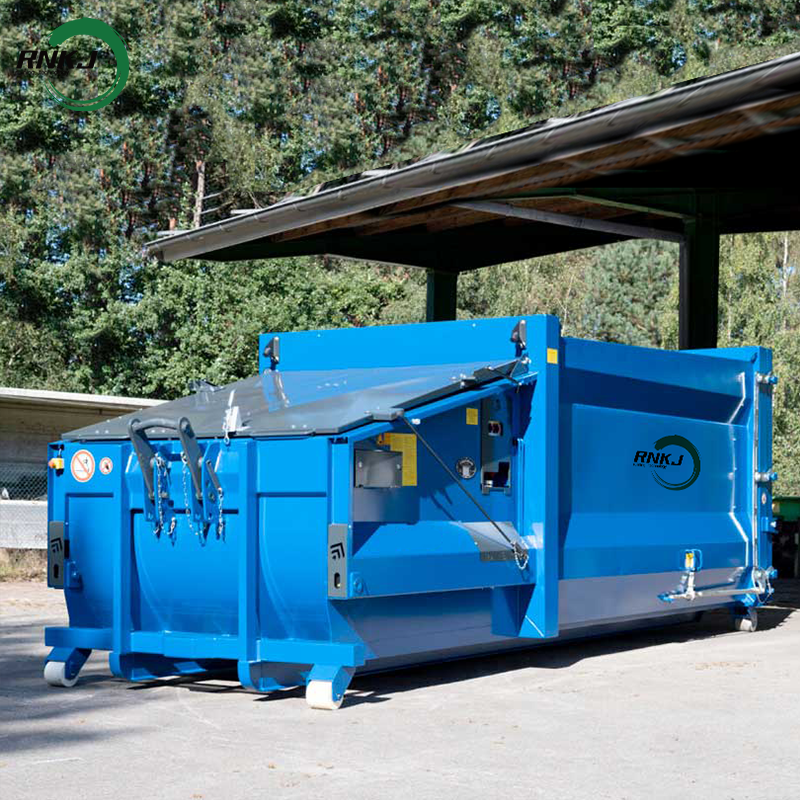
Secondly, garbage compactors have strong adaptability and can be applied to various types of garbage treatment scenarios. Whether it is domestic garbage in cities, kitchen garbage in communities, or industrial solid waste in factories, garbage compactors can play a role through structural adjustment and pressure regulation. For example, closed garbage compactors used in residential areas can effectively solve the problem of garbage overflow and odor diffusion; mobile garbage compactors are suitable for garbage collection in remote areas or construction sites; large-scale fixed garbage compactors are the core equipment of garbage transfer stations. This wide applicability makes it possible to carry out standardized and centralized treatment of garbage in different regions and scenarios.
Finally, the application of garbage compactors is conducive to promoting the standardization of garbage management and improving the level of environmental governance. The traditional garbage disposal method is mostly extensive, with problems such as random stacking and irregular transportation. The use of garbage compactors requires the establishment of a complete garbage collection, transportation and treatment chain, which promotes the transformation of garbage management from extensive to intensive and standardized. At the same time, the popularization of garbage compactors can also enhance the public's awareness of garbage classification and environmental protection, and promote the formation of a good social atmosphere of "environmental protection by everyone".

In conclusion, as a key equipment in the garbage treatment system, the garbage compactor is not only a powerful tool to reduce garbage volume and save land resources, but also an important barrier to control secondary pollution and protect the ecological environment. Its advantages in improving transportation efficiency, promoting resource recycling and adapting to various scenarios make it an indispensable part of modern environmental protection work. With the continuous advancement of environmental governance, the technical level of garbage compactors will be further improved, and its role in building a green, low-carbon and sustainable ecological civilization will be more prominent.