
Views: 0 Author: Site Editor Publish Time: 2025-10-14 Origin: Site


Garbage compressor is an efficient waste management solution designed to reduce waste volume, improve transportation efficiency, and optimize disposal processes. With the rapid growth of urban waste generation, traditional waste collection methods often face challenges such as high transportation costs, limited storage space, and low waste handling efficiency. A garbage compressor solves these problems by using powerful hydraulic compression technology to compact different types of waste into smaller volumes, allowing more waste to be stored and transported efficiently.
Modern garbage compressors are widely used in residential communities, commercial areas, industrial facilities, municipalities, recycling centers, and public waste collection stations. By reducing waste volume and improving collection efficiency, they have become an important part of modern smart waste management systems.
This article will explain the working principle of a garbage compressor, its main components, advantages, applications, and why it is an ideal solution for efficient waste disposal.
A garbage compressor is a mechanical waste compaction machine that uses hydraulic power to compress loose waste materials into dense blocks or compacted volumes. The equipment is mainly designed to reduce the occupied space of household waste, commercial waste, industrial waste, and other solid waste.
Compared with traditional garbage storage containers, a hydraulic garbage compressor can significantly increase waste storage capacity while reducing the frequency of waste collection and transportation.
Depending on the application requirements, garbage compressors can be designed in different types, including:
Different models provide flexible solutions for various waste collection environments.
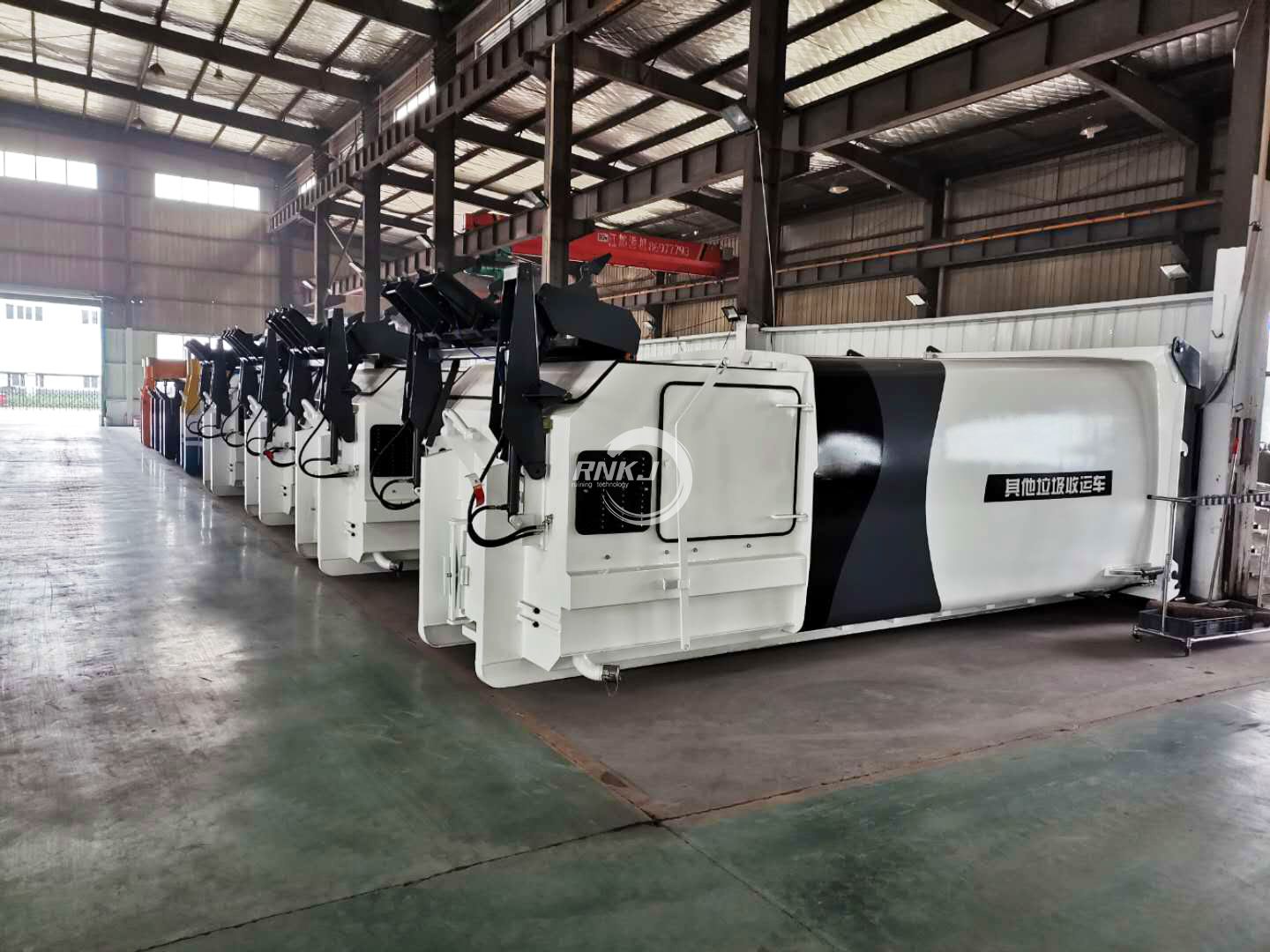
The working principle of a garbage compressor is based on hydraulic pressure technology. The system uses a hydraulic power unit to drive a compression mechanism, which applies strong force to squeeze and compact loose waste materials.
The complete working process mainly includes the following steps:
The first step of the garbage compressor working principle is waste loading.
Waste materials are loaded into the compression chamber, hopper, or garbage storage container depending on the equipment design.
Common waste types include:
Household garbage
Food waste
Commercial waste
Packaging materials
Paper and cardboard
Plastic waste
Industrial waste
For garbage compression stations equipped with garbage bins, operators can directly place 240L, 660L, or 1100L garbage bins into the lifting system. The automatic lifting mechanism can empty the waste into the compression chamber, reducing manual handling.
For hopper-type garbage compressors, waste can be directly dumped into the large feeding hopper through garbage trucks or waste collection vehicles.
The core technology of a garbage compressor is the hydraulic compression system.
After waste enters the compression chamber, the hydraulic power unit activates the hydraulic cylinder. The hydraulic pump converts electrical energy into hydraulic pressure, driving the piston forward.
The hydraulic cylinder pushes the compression plate with strong force, creating high pressure inside the chamber.
The main hydraulic components include:
Hydraulic pump
Hydraulic cylinder
Hydraulic valves
Hydraulic oil tank
Control system
Electric motor
The hydraulic system provides stable and powerful compression performance, allowing the machine to handle large amounts of waste efficiently.
During the compression process, the compression plate moves forward and pushes waste materials together.
The loose waste becomes more compact as air gaps between materials are removed.
The compression process provides several benefits:
Reduces waste volume significantly
Increases storage capacity
Prevents waste overflow
Reduces odor spreading
Improves transportation efficiency
A high-performance garbage compressor can reduce waste volume by a large percentage depending on waste characteristics and compression pressure.
For example, bulky waste such as cardboard boxes and packaging materials can be compressed into much smaller volumes, allowing more waste to be stored in the same container.
After compression, compacted waste remains inside the storage container until collection.
For mobile garbage compression equipment, the container can be transported as a complete unit using a Hook Lift Truck system.
The transportation process is simple:
Garbage compressor becomes full.
Hook Lift Truck connects with the container.
The entire compressed waste container is lifted and transported.
Empty container is returned for continuous operation.
This design eliminates the need to unload waste manually and improves waste collection efficiency.
A modern garbage compressor consists of several key components working together to achieve efficient waste compaction.
The hydraulic system is the power source of the machine. It provides high-pressure force to drive the compression plate.
Advantages:
High compression force
Stable operation
Low maintenance requirements
Long service life
The compression chamber is the area where waste is compacted.
It is usually manufactured from high-strength steel materials to withstand repeated compression pressure and harsh working environments.
The compression plate directly contacts the waste materials.
Its function is to:
Push waste forward
Remove air spaces
Increase waste density
Improve container utilization
The intelligent control system allows operators to easily manage the garbage compressor.
Functions may include:
Automatic compression cycles
Emergency stop
Hydraulic system monitoring
Remote control options
Safety protection
The container stores compressed waste after compaction.
Depending on the project requirements, garbage compressors are available in different capacities, such as:
8 cubic meter garbage compressor
10 cubic meter garbage compressor
12 cubic meter garbage compression station
Customized capacity solutions
| Feature | Garbage Compressor | Traditional Garbage Container |
|---|---|---|
| Waste volume | Highly reduced | Large unused space |
| Storage capacity | Increased | Limited |
| Transportation frequency | Reduced | More frequent |
| Labor requirement | Lower | Higher |
| Hygiene performance | Better | Easily causes overflow |
| Operation efficiency | High | Low |
A garbage compressor provides a more efficient and sustainable solution compared with conventional waste containers.
Our garbage compressor solutions are designed for high-efficiency waste management with reliable hydraulic technology and durable construction.
Key advantages include:
Powerful hydraulic systems provide strong compression force for different types of waste.
Heavy-duty materials ensure reliable operation in outdoor and industrial environments.
Compatible with Hook Lift Truck systems for convenient waste container transportation.
Different capacities and configurations are available according to customer requirements.
Efficient compression reduces transportation frequency and saves long-term waste management costs.
The working principle of a garbage compressor is based on hydraulic compression technology, which uses powerful hydraulic force to squeeze and reduce waste volume. Through the processes of loading, hydraulic compression, waste storage, and transportation, garbage compressors provide an efficient solution for modern waste management.
With advantages such as high compression efficiency, reduced transportation costs, improved hygiene, and intelligent operation, hydraulic garbage compressors are becoming increasingly popular for municipalities, businesses, and industrial applications worldwide.
If you are looking for a reliable garbage compressor manufacturer or customized waste compaction solution, choosing the right compression system can help improve waste handling efficiency and create a cleaner, smarter environment.


