
Views: 0 Author: Site Editor Publish Time: 2026-08-27 Origin: Site


As cities become more densely populated, traditional waste collection methods are facing increasing challenges. Large numbers of exposed garbage bins can occupy valuable public space, affect the appearance of urban areas, and create problems related to odors, overflowing waste, and inefficient collection.
A Smart Underground Waste Classification System provides a modern alternative by combining underground waste storage, source waste separation, automatic sensing, intelligent monitoring, and efficient collection management. Instead of placing multiple conventional garbage bins directly on the ground, the main waste collection equipment is installed underground while users access the designated disposal openings from the surface.
A well-designed Underground Waste Classification System can be customized for residential communities, commercial areas, industrial parks, schools, hotels, public facilities, and municipal sanitation projects. The system can also be configured according to local waste classification regulations, site conditions, waste generation, and collection requirements.
So, what are the key features that make a smart underground waste classification system different from traditional garbage collection equipment?
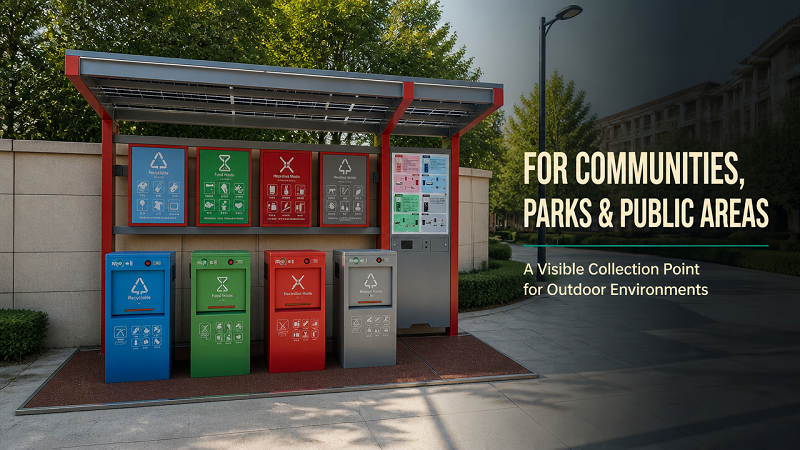
One of the most important characteristics of an Underground Waste Classification System is its underground installation structure.
Traditional garbage bins require a relatively large amount of surface space. When several containers are installed together for different waste categories, the collection area can quickly become crowded.
An underground system moves the primary waste storage area below ground level. Only the necessary disposal interfaces, identification signs, and operating components remain visible at the surface.
This design can provide several advantages:
Better utilization of limited urban space
Cleaner and more organized collection areas
Reduced visual impact of garbage containers
Easier integration with surrounding landscapes
Suitable for areas with high pedestrian traffic
For modern urban development projects, underground waste storage can be particularly valuable where land and surface space are limited.
Waste classification is another core function of a Smart Underground Waste Classification System.
The system can provide separate disposal openings and collection compartments for different types of waste. Depending on local regulations and project requirements, the system can be configured for:
General household waste
Recyclable waste
Food and organic waste
Paper and cardboard
Plastic
Glass
Metal
Other designated waste categories
Clear labels, icons, colors, or customized identification systems can be used to guide users.
Source separation helps prevent different waste streams from being mixed together and can create better conditions for subsequent recycling, transportation, sorting, and treatment.
An Auto-Sensing Underground Waste Classification System can use sensors to improve the convenience and intelligence of waste disposal.
When a user approaches the designated disposal area, the sensor can detect the user's presence and activate the corresponding opening or mechanism according to the system configuration.
Automatic sensing can reduce the need to touch certain components during waste disposal, which is especially useful in residential communities, shopping areas, office districts, and other locations with frequent public use.
The sensing system can also be configured for additional monitoring functions, making the equipment more suitable for smart sanitation applications.
Waste level monitoring is an important feature for improving collection efficiency.
Traditional waste collection often relies on fixed schedules. A garbage truck may visit a collection point according to a predetermined timetable regardless of whether the container is full.
A smart Underground Waste Collection System can incorporate fill-level sensors to monitor the condition of individual containers.
When the waste level reaches a predefined threshold, the system can provide a warning or transmit the information to a management platform, depending on the selected configuration.
This allows sanitation operators to understand:
Which container is approaching full capacity
Which waste category requires collection
When collection may be required
Whether abnormal overflow conditions exist
Which collection points need priority attention
This information can help operators move toward more data-driven waste collection management.
Leakage is an important consideration in underground waste management.
Household garbage, food waste, and organic waste may contain liquids. If liquid waste is not properly controlled, it can create unpleasant odors, contaminate the surrounding area, and increase cleaning and maintenance requirements.
A Leak-Proof Underground Waste Classification System can incorporate structural sealing, liquid collection, drainage protection, and corrosion-resistant components according to the project requirements.
The exact leak-proof configuration can be customized based on:
Waste characteristics
Local rainfall
Underground installation conditions
Expected waste volume
Cleaning requirements
Local environmental standards
This makes leak-proof protection an important feature for projects that prioritize hygiene and environmental protection.
Another benefit of intelligent sensing technology is the possibility of contactless operation.
Instead of manually opening a conventional garbage bin lid, users can dispose of waste through an automatically activated opening.
This can provide a more convenient user experience and reduce direct contact with frequently touched surfaces.
Contactless disposal is particularly useful in:
Residential communities
Shopping malls
Airports
Railway stations
Hotels
Office buildings
Schools
Public parks
The exact operating method can be customized according to the project's functional requirements.
A smart underground waste classification solution can include an electronic control system for managing sensors, operating mechanisms, alarms, and other intelligent functions.
Depending on the configuration, the control system may coordinate:
Automatic opening and closing
Sensor detection
Waste level monitoring
Equipment status
Warning signals
Maintenance information
System operating parameters
For larger municipal projects, intelligent control can help centralize information from multiple waste collection points.
This can make it easier for sanitation managers to monitor equipment and respond to abnormal conditions.
Overflowing garbage is one of the common problems associated with conventional waste collection.
When a garbage container becomes full but collection is delayed, waste may accumulate around the container and negatively affect the surrounding environment.
With waste level monitoring, a Smart Underground Waste Classification System can provide an early warning when the container approaches its preset capacity.
Operators can then arrange collection before the waste reaches an excessive level.
This can help maintain:
Cleaner collection points
Better environmental hygiene
Improved user experience
More efficient collection scheduling
Reduced scattered waste
Overflow prevention is especially important in high-density residential and commercial areas where waste generation can fluctuate significantly.
Urban land is becoming increasingly valuable, particularly in high-density cities.
A conventional waste collection area may require several large containers, access space, and additional protective structures.
By placing the main collection equipment underground, an Underground Waste Classification System can reduce the amount of surface space required for waste storage.
The visible part of the system can be designed to integrate with:
Sidewalks
Residential landscapes
Commercial plazas
Public parks
Building entrances
Streetscape projects
This allows waste collection infrastructure to become less visually dominant.
Different projects generate different amounts and types of waste.
A small residential community may have very different requirements from a large shopping center or industrial park.
Therefore, a professional Underground Waste Classification System should offer flexible capacity and structural configurations.
Customization can include:
Container capacity
Number of waste compartments
Waste classification categories
Underground pit dimensions
Disposal opening size
Sensor configuration
Lifting mechanism
Collection method
Surface panel design
This project-oriented approach helps ensure that the system matches actual waste generation and collection requirements.
Underground waste collection equipment must operate in environments where it may be exposed to moisture, rainwater, temperature changes, soil conditions, and frequent use.
For this reason, structural durability is an important consideration.
Depending on the project, materials and protective treatments can be selected to provide suitable:
Corrosion resistance
Moisture resistance
Structural strength
Weather resistance
Long-term outdoor durability
For projects located in humid or coastal environments, additional corrosion protection can be considered during the design stage.
Although underground waste equipment reduces the visual impact of garbage collection, maintenance remains essential.
The system should be designed with convenient access to key components so that operators can carry out routine inspection, cleaning, and maintenance.
Important maintenance areas may include:
Waste containers
Sensors
Automatic opening mechanisms
Drainage components
Electrical control equipment
Underground structural components
A well-planned maintenance design can help reduce downtime and maintain stable operation over the long term.
A Smart Underground Waste Classification System can become part of a broader smart city sanitation network.
When multiple collection stations are equipped with sensors and monitoring functions, sanitation managers can collect operational information from different locations.
This can support data-driven decisions such as:
Collection route optimization
Waste generation analysis
Container capacity planning
Collection frequency adjustment
Equipment maintenance scheduling
Abnormal condition monitoring
Instead of simply providing a place to throw away garbage, the underground system can become a data-enabled component of modern urban waste management.
The combination of underground storage, waste classification, automatic sensing, and leak-proof protection can help create a cleaner waste collection environment.
Keeping waste storage equipment below ground can reduce direct exposure of garbage to pedestrians and surrounding areas. Classification can reduce unnecessary mixing of waste streams, while leak-proof protection can help control liquid residues.
Together, these functions can contribute to better sanitation conditions in busy urban environments.
The versatility of a Smart Underground Waste Classification System allows it to be used in many different environments.
The system can provide a centralized classified waste collection point for residents while reducing the number of exposed garbage bins.
Shopping centers, office districts, supermarkets, and commercial developments can use underground collection stations to maintain a cleaner appearance.
Different waste categories can be collected separately according to the requirements of factories, offices, workshops, and employee facilities.
Underground waste collection can help keep waste management facilities away from major visitor areas while maintaining the visual quality of the property.
The system can support waste separation education and provide convenient classified disposal for students and staff.
Public parks, transportation hubs, streets, and other municipal areas can benefit from space-saving and intelligent waste collection infrastructure.
The biggest difference is that a traditional garbage bin mainly provides basic waste storage, while a smart underground system combines storage with classification, sensing, monitoring, and intelligent management.
| Feature | Traditional Garbage Bins | Smart Underground Waste Classification System |
|---|---|---|
| Waste storage | Above ground | Mainly underground |
| Waste classification | Separate bins | Integrated classification |
| Automatic sensing | Usually unavailable | Available |
| Waste level monitoring | Mostly manual | Sensor-based option |
| Leak-proof design | Limited | Available |
| Surface space | More occupied | Space-saving |
| Overflow warning | Usually unavailable | Available with sensors |
| Smart management | Limited | Supported |
| Appearance | More visible | More integrated |
| Customization | Limited | Project-based customization |
Before selecting an Underground Waste Classification System, project owners should consider several factors.
Determine the approximate amount of waste generated every day and select suitable container capacity accordingly.
The number of collection compartments should correspond to local waste classification requirements and the actual waste streams generated at the site.
Available underground space, soil conditions, drainage, groundwater, access routes, and construction requirements should be considered before installation.
Not every project requires the same level of intelligence. Depending on the budget and management requirements, the system can include automatic sensing, waste level detection, warning functions, and other monitoring technologies.
The waste removal method should be compatible with the project's sanitation vehicles, lifting equipment, collection schedule, and existing waste management infrastructure.
Rainfall, humidity, temperature, and coastal conditions can influence material selection and waterproofing or corrosion protection requirements.
For modern waste management projects, the objective is no longer simply to store garbage. A complete waste collection solution should also consider environmental hygiene, source classification, space utilization, collection efficiency, user convenience, and long-term management.
A Smart Underground Waste Classification System addresses these requirements by combining multiple functions into one integrated solution.
Its main advantages include:
Underground and space-saving waste storage
Intelligent waste classification
Automatic sensing operation
Optional waste level monitoring
Leak-proof protection
Contactless disposal
Overflow warning
Customizable capacity and configuration
Durable outdoor construction
Improved environmental appearance
Support for smart sanitation management
Flexible application in residential, commercial, municipal, and industrial projects
A Smart Underground Waste Classification System is more than an underground garbage container. It is an integrated waste management solution designed to improve how waste is collected, classified, monitored, and managed.
Key technologies such as automatic sensing, waste level monitoring, leak-proof protection, underground storage, source waste classification, and intelligent control make the system suitable for modern urban environments where cleanliness, efficiency, space utilization, and smart management are important.
For residential communities, commercial developments, industrial parks, schools, hotels, public facilities, and municipal sanitation projects, a customized Underground Waste Classification System can provide a practical way to modernize waste collection while reducing the visual and environmental impact of traditional garbage collection points.
As cities continue to develop smarter and more sustainable waste management infrastructure, underground classified waste collection can play an increasingly important role in creating cleaner, more efficient, and better-organized urban environments.


