
Views: 0 Author: Site Editor Publish Time: 2026-10-09 Origin: Site


Industrial waste management requires more than simply placing a container near a production line or waste collection area. Different facilities generate different types of waste, and each material has its own volume, weight, handling requirements and storage characteristics. Choosing the wrong container can lead to inefficient collection, unnecessary handling, limited site space and difficulties during waste transportation.
An industrial skip bin provides a designated space for collecting and temporarily storing solid waste before it is removed, sorted, recycled or transported for further processing. However, selecting the right industrial skip bin involves several factors, including capacity, material strength, structural design, loading methods and operating conditions.
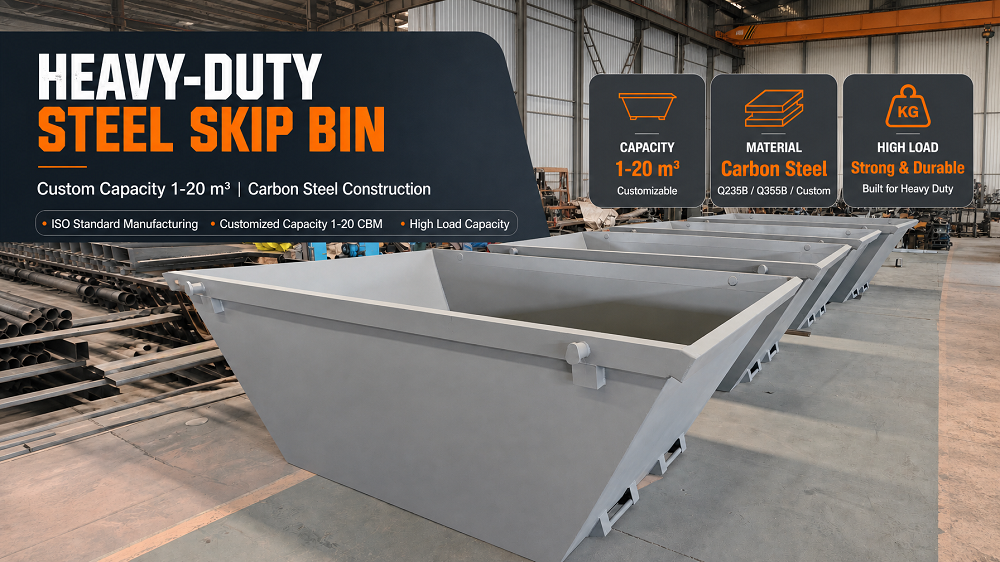
For manufacturers, construction contractors, recycling facilities and commercial operators, a customized industrial skip bin can offer greater flexibility than a standard-size container. Capacities ranging from 1 CBM to 20 CBM, together with material options such as Q235 and Q355 steel, allow the container to be configured for different industrial applications.
So, how do you choose the right skip bin for industrial waste management? This guide explains the main considerations to help you identify a suitable container for your project.
The first step in selecting an industrial skip bin is understanding the characteristics of the waste being collected. The material type affects the required container structure, loading method, internal volume and suitable steel specification.
Different waste streams place different demands on a waste container.
Manufacturing plants may generate metal offcuts, discarded components, machining waste and other production residues. Some metal waste is relatively compact and heavy, meaning that a container can reach its maximum permitted payload before its available volume is fully utilized.
For these applications, buyers should pay particular attention to the bottom plate, side-wall reinforcement, loading conditions and the rated capacity of the handling equipment.
A heavy-duty steel skip bin can be configured for the expected material load, provided that its structural design and operating limits are properly specified.
Construction sites commonly produce broken bricks, timber, concrete fragments, metal pieces and other building materials. These materials can vary considerably in density, shape and size.
An industrial skip bin for construction waste should provide sufficient space for the intended materials while allowing safe loading and removal. Reinforced structural sections may be appropriate for demanding applications, depending on the waste characteristics and loading method.
For dense materials such as concrete, the maximum payload must be considered alongside container volume. A large-capacity bin is not necessarily suitable for every heavy material.
Warehouses, distribution centers and manufacturing facilities may generate cardboard, plastic packaging, wooden pallets and other lightweight waste.
These materials often occupy considerable space relative to their weight. A larger-volume industrial skip bin may therefore be more appropriate than a compact container, particularly when waste is collected over several operating shifts.
The container dimensions should also suit the available collection area without obstructing forklift routes, loading bays or pedestrian access.
Some facilities collect several types of non-hazardous solid waste in the same container. In these cases, the skip bin should be selected according to the combined waste characteristics, expected load and applicable disposal requirements.
Where different materials require separate recycling or disposal processes, dedicated containers may provide better waste segregation and simplify downstream handling.
Selection tip: Define the waste type, approximate density, largest material dimensions and expected quantity before choosing a skip bin. These details provide a more reliable starting point than capacity alone.
Capacity is one of the most important factors when choosing an industrial skip bin. The right size should accommodate the expected waste volume without creating unnecessary demands on floor space, handling equipment or transportation arrangements.
Customized industrial skip bins can be designed with capacities ranging from 1 CBM to 20 CBM, depending on the project requirements.
Smaller containers may be suitable for individual workshops, maintenance areas, compact commercial premises and localized waste collection points.
They are particularly useful when waste is generated in limited quantities or when available installation space is restricted.
Medium-sized containers can support routine waste collection in manufacturing facilities, warehouses, renovation projects and recycling operations.
Their suitability depends on the amount of waste generated per collection cycle and the space available for positioning and handling the container.
Large industrial skip bins may be suitable for centralized collection points, high-volume production facilities and construction projects that generate substantial quantities of waste.
Before selecting a large container, buyers should confirm that the site has sufficient space and that the transportation or lifting equipment can safely handle the loaded bin.
The following table provides general guidance for initial capacity selection.
| Capacity Range | Potential Applications | Main Consideration |
|---|---|---|
| 1–3 CBM | Small workshops and localized collection points | Limited space and smaller waste volumes |
| 4–8 CBM | Warehouses, production areas and routine industrial collection | Balance between volume and collection frequency |
| 9–14 CBM | Larger facilities and selected construction projects | Structural strength and handling compatibility |
| 15–20 CBM | High-volume waste collection and centralized storage | Payload limits, site access and transportation requirements |
These ranges are general examples rather than fixed industry standards. The best capacity depends on the waste material, its density, the expected collection interval and the handling equipment available.
A practical starting point is to estimate the amount of waste generated between collections.
For example, if a facility generates approximately 2 CBM of loose packaging waste per day and empties its container every three days, the estimated accumulation is 6 CBM before allowing for operational variation.
In this situation, a container larger than the estimated accumulation may be worth considering, depending on the actual loading pattern and the available site space.
This calculation should not be used alone for heavy waste. Metal scrap, concrete and other dense materials may reach the permitted payload long before the container reaches its nominal volume.
The material used to manufacture an industrial skip bin directly affects its structural properties, fabrication options and suitability for the intended operating environment.
Carbon steel is widely used for industrial waste containers because it can be fabricated into different shapes and structural configurations. For customized skip bins, common material options include Q235 steel, Q355 steel and other specified grades.
Q235 is a common structural steel option for general-purpose industrial containers. It may be suitable for applications where the selected plate thickness, reinforcement and overall design meet the required operating conditions.
For routine waste collection involving packaging, general industrial waste and other suitable materials, Q235 may provide an appropriate starting point for engineering evaluation.
Q355 is a higher-strength structural steel option that can be considered when the application requires greater material strength.
It may be suitable for selected heavy-duty container designs, but choosing Q355 does not automatically make a skip bin suitable for every heavy load. The complete design, including plate thickness, welds, reinforcement and handling components, must be evaluated together.
Some projects have particular technical requirements relating to material grade, operating environment or expected loading conditions.
In these situations, buyers can provide the relevant specifications or engineering drawings so that the appropriate material can be determined before production.
When comparing carbon steel skip bins, consider the following:
Steel grade and applicable material specifications.
Bottom and side-wall plate thickness.
Reinforcement arrangement and load distribution.
Fabrication quality and weld design.
Surface treatment and corrosion protection.
Intended handling method and maximum permitted payload.
The goal is to select a material and structure that meet the actual application requirements rather than choosing a steel grade based on its name alone.
An industrial skip bin must withstand the loads associated with filling, temporary storage and handling. Its structural requirements depend on the type of waste, container dimensions and the way the bin is moved.
The bottom of the container supports the accumulated waste and may experience concentrated loads when heavy or irregular materials are deposited.
For demanding applications, the base structure and bottom plate should be designed according to the expected loading conditions. Additional reinforcement may be incorporated where the engineering design requires it.
Side walls contain the waste and help maintain the overall shape of the container. Their design should account for the material being loaded and the possibility of localized forces from bulky or unevenly distributed waste.
Reinforced upper edges and side-wall ribs may be incorporated to improve structural stability where appropriate.
Welded connections, lifting points and other handling components are important parts of the overall structure.
If the skip bin will be moved by lifting equipment, its connection points and load paths should be compatible with the intended handling arrangement. The finished container should only be used with suitable equipment and within its specified limits.
A container intended for lightweight cardboard waste may not require the same structural configuration as one used for dense metal scrap.
Customizing the plate thickness and reinforcement according to the actual application can help avoid an unsuitable design. It also allows buyers to consider the relationship between structural requirements, container weight and manufacturing cost.
Before ordering an industrial skip bin, determine how waste will enter the container and how the loaded bin will be removed from the site.
The handling arrangement affects the container dimensions, positioning, structural details and compatibility with existing equipment.
An open-top skip bin allows waste to be loaded from above. This configuration can be useful for facilities where materials are deposited manually or with suitable loading equipment.
The required opening dimensions and surrounding clearance should be considered during site planning.
Some containers can be designed with forklift pockets or other compatible handling features where the application requires them.
The pocket dimensions, spacing and structural reinforcement must be designed for the intended equipment. Buyers should confirm the forklift's rated capacity and operating limits, including the effects of load position and attachment configuration.
Where a skip bin will be lifted by a crane or another lifting system, the handling components must be specifically designed and rated for that arrangement.
Not every industrial skip bin is suitable for every lifting method. The required lifting points, load distribution and operating procedures should be confirmed before use.
For containers that will be transported between facilities or removed by waste collection vehicles, buyers should verify the required dimensions and handling interfaces.
A customized bin should fit the intended collection system without exceeding applicable weight, dimensional or equipment limits.
Important: Do not assume that every skip bin is compatible with hook-lift trucks, forklifts or crane systems. Confirm the required handling configuration with the manufacturer before placing an order.
Even when a container has sufficient capacity, its dimensions may make it unsuitable for the intended site.
Industrial facilities should assess the available area before selecting a skip bin. This includes the footprint of the container, the space required for loading and the clearance needed for collection equipment.
Consider the following questions:
Is there sufficient room to position the container safely?
Can workers or loading equipment access the opening?
Will the bin obstruct vehicle routes, pedestrian walkways or emergency exits?
Is there enough clearance for the intended collection vehicle or lifting equipment?
Can the loaded container be removed without disrupting normal operations?
Customized dimensions are particularly useful when a facility has limited space or specific equipment interfaces.
For example, a long and narrow container may suit one installation area, while a shorter, wider design may be more practical for another. The final dimensions should be evaluated alongside capacity, load distribution and handling requirements.
Industrial skip bins may be used indoors, outdoors or in areas exposed to moisture, dust and changing weather conditions. The surface finish should reflect the actual operating environment.
Carbon steel provides flexibility in manufacturing, but it can corrode when its surface protection is damaged or unsuitable for the environment.
Common surface treatment considerations include:
Surface preparation before painting.
Suitable anti-corrosion primer.
Industrial protective topcoat.
Customized paint color and identification markings.
Inspection and maintenance requirements.
For outdoor applications, the coating system should be selected according to expected exposure and maintenance practices.
Where waste contains corrosive substances or the container will operate in an aggressive environment, the material and protective finish should be evaluated carefully. Standard painted carbon steel should not be assumed to be suitable for every chemical or hazardous waste stream.
Routine inspection can help identify damaged paint, exposed steel and other signs of deterioration. Timely maintenance helps preserve the container's condition during its intended service life.
A standard skip bin may be sufficient for straightforward applications. However, projects with specific dimensions, loading arrangements or material requirements may benefit from a customized industrial skip bin.
A customized capacity industrial skip bin can be specified according to the operational requirements of the facility.
Capacity can be selected from 1 CBM to 20 CBM, with dimensions adjusted to suit the required volume and available site space.
Buyers can specify Q235, Q355 or another agreed steel grade according to the engineering requirements of the application.
The bottom plate, side walls and other structural sections can be specified according to the expected loading conditions and selected material.
The bottom frame, side-wall ribs and upper edges can be configured according to the container design and intended use.
Industrial painting, corrosion protection and identification colors can be selected according to project requirements.
Depending on the design, buyers may request features such as lids, rear doors, drainage arrangements, forklift pockets or compatible lifting components. These features should be confirmed before production because they can affect the structure and handling method.
Not every customization option is necessary for every project. The most suitable configuration is the one that meets the required function without adding unnecessary complexity.
Choosing the right skip bin also involves evaluating the manufacturer. Product specifications alone do not fully explain how a container will perform under actual operating conditions.
Before placing an order, buyers should clarify the manufacturer's production capabilities and confirm how the agreed specifications will be implemented.
A reliable purchasing process should establish the required capacity, dimensions, material grade, plate thickness, structural configuration and surface treatment before manufacturing begins.
Where drawings are available, the buyer and manufacturer should confirm the relevant dimensions and handling interfaces.
The fabrication process affects the finished container's dimensional accuracy and structural integrity. Buyers can ask about fabrication procedures, welding inspection and the quality checks applicable to their order.
The specified steel grade should match the agreed material documentation and purchasing requirements. Where necessary, buyers can clarify material identification and documentation before production.
The finished skip bin should be checked against the confirmed specifications. Relevant checks may include dimensions, weld appearance, structural details, coating condition and the configuration of handling components.
For projects requiring unusual dimensions or special handling arrangements, a manufacturer with relevant custom fabrication capabilities may help translate the operating requirements into a suitable container design.
Providing clear application details at the quotation stage can make the specification and manufacturing process more straightforward.
Several common mistakes can lead to poor container selection or operational difficulties.
Choosing capacity based only on volume. Heavy materials may reach the payload limit before the container is full. Both volume and weight must be considered.
Ignoring the handling method. A container that cannot interface with the site's existing equipment may create additional handling requirements or require redesign.
Selecting steel without considering the application. Material grade, plate thickness and reinforcement should be evaluated together.
Overlooking installation space. The container must fit the available area while allowing safe loading and removal.
Assuming every waste type is suitable. Hazardous, corrosive, liquid or otherwise restricted materials may require specialized containment and handling arrangements.
Adding unnecessary accessories. Additional features should serve a defined operational purpose and be compatible with the intended handling system.
Failing to confirm specifications before production. Clear agreement on dimensions, materials, load requirements and surface treatment helps reduce misunderstandings during manufacturing.
Avoiding these issues can make the purchasing process more efficient and improve the suitability of the finished container.
For facilities with specific waste collection requirements, a customized industrial skip bin offers flexibility in capacity, dimensions and construction.
A container with a capacity ranging from 1 CBM to 20 CBM can be configured for different waste volumes and installation conditions. Carbon steel construction, with Q235, Q355 or other specified material options, allows the design to be matched to the required application.
Customization can also cover plate thickness, reinforcement, surface treatment and handling arrangements. This helps buyers define a container around their waste type, available space and collection workflow.
Rather than selecting a bin based on volume alone, businesses can evaluate the complete configuration, including material properties, structural design and compatibility with existing equipment.
For industrial facilities, construction projects and recycling operations, this approach supports a more informed purchasing decision and helps ensure that the selected container is appropriate for its intended use.
Choosing the right skip bin for industrial waste management requires a clear understanding of waste characteristics, required capacity, material specifications, structural strength, handling methods and installation conditions.
Start by identifying the type and quantity of waste, then select a suitable capacity and evaluate the steel grade, plate thickness and reinforcement. Confirm that the container is compatible with the site's handling equipment and that its surface treatment matches the operating environment.
For projects with specific requirements, a Customized Capacity Industrial Skip Bin offers the flexibility to select a capacity from 1 CBM to 20 CBM, choose Q235, Q355 or customized steel specifications, and define the dimensions and structural configuration according to the application.
By confirming these factors before ordering, buyers can select an industrial skip bin that fits their waste collection process, site conditions and operational requirements.


