
English
Views: 0 Author: Site Editor Publish Time: 2026-05-25 Origin: Site


Facilities generating massive amounts of dry waste face serious operational hurdles every single day. Distribution centers, manufacturing plants, and large retail stores often struggle against runaway hauling costs. Open dumpsters overflow quickly. This creates severe facility congestion and noticeable safety hazards for your workforce. To solve this, you need heavy-duty engineering.
We introduce the split-system unit as a standard solution for continuous, high-volume material streams. Industry experts often refer to it as a stationary unit paired alongside a detachable receiver. It tackles massive trash piles effortlessly. This setup separates the crushing mechanism from the storage container, offering unique logistical advantages.
This article provides facility managers and procurement teams a clear, evidence-based evaluation framework. You will discover how a split system matches your capacity needs and spatial constraints. We will also explore the financial benefits, covering hauling reductions and labor efficiency. Ultimately, you will learn if this robust equipment fits your exact operational requirements.
Unmatched Capacity: Split compactors are specifically designed for continuous, large-scale dry waste, commonly achieving up to an 80% reduction in volume.
Operational Separation: Unlike self-contained units, the mechanical ram stays permanently bolted to your facility, while only the massive receiver box (often 30–40+ cubic yards) is hauled away.
TCO Optimization: The primary ROI is realized by reducing hauling frequency by 50% to 75%, which concurrently reduces heavy-truck pavement damage and operational bottlenecks.
Site Prerequisites: Deployment requires rigorous site preparation, including specialized concrete foundations, 3-phase power access, and precise turning radius clearances for roll-off trucks.
Before upgrading your facility infrastructure, you must understand how equipment architecture dictates operational success. A standard trash compactor comes in several forms, but industrial environments rely heavily on split-system designs.
You might wonder what makes a system "split." A commercial split trash compactor consists of two completely separate components. The first part is the stationary compactor. This houses the powerful motor and mechanical ram. Installers bolt it permanently to a reinforced concrete pad. The second part is a detachable roll-off container. When the container fills up, a truck driver detaches it, hauls it away, and leaves the motor behind. This differs drastically from self-contained units where the entire machine travels to the landfill.
Not every machine handles every type of garbage. Split systems are engineered strictly for dry bulk waste. They dominate in environments producing endless streams of cardboard, rigid plastics, wooden pallets, and manufacturing scrap. They excel at crushing bulky, dry items into dense blocks. However, you must never use a split system for wet or highly perishable garbage. Grocery stores and restaurants generate liquid-heavy waste. If you place wet materials in a split system, liquids will inevitably leak from the junction point between the ram and the container. Wet environments strictly require sealed, self-contained units.
One major operational advantage over self-contained models involves fluid safety. Because the mechanical head stays on-site constantly, hauling drivers never interact with the hydraulic systems. They simply unlatch the container box. If you use a self-contained unit, drivers must detach and reattach high-pressure hydraulic hoses during every pickup. Industry data shows a high frequency of drivers forgetting to disconnect these hoses before driving off. This oversight causes catastrophic hydraulic oil spills. Split systems virtually eliminate this costly environmental risk.
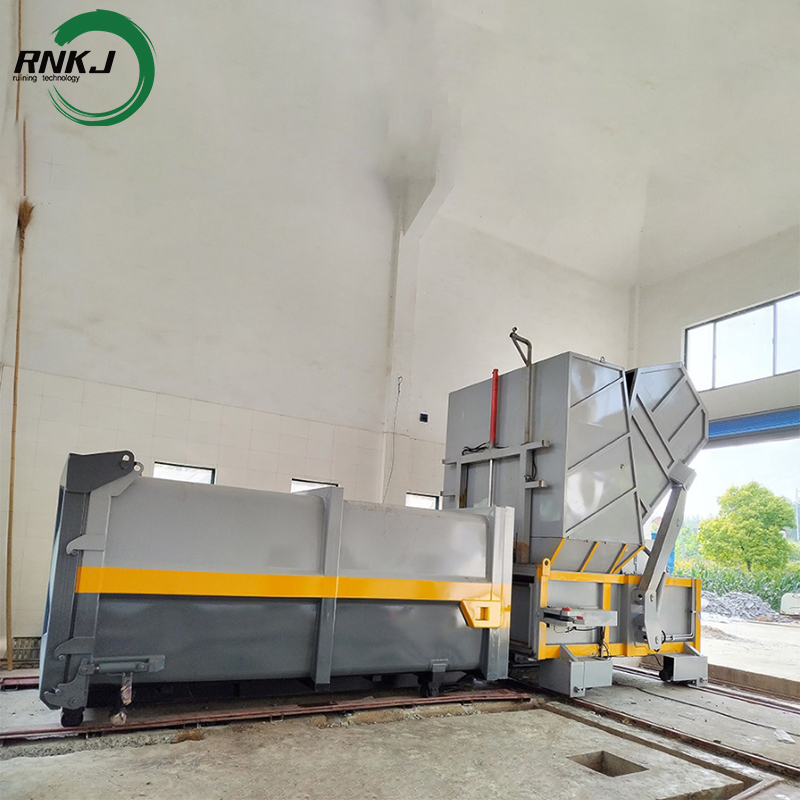
High-volume manufacturing plants cannot afford operational bottlenecks. Trash piles interrupt forklift lanes and delay shipping schedules. You must evaluate if a new machine can handle your peak production hours.
A true large volume compactor manages extreme capacity through sheer mechanical force and massive container pairing. While standard self-contained models max out around 15 to 35 cubic yards, split systems routinely utilize 30 to 40-plus cubic yard receivers. The stationary motor packs a larger hydraulic cylinder. It delivers superior pressure to crush rigid materials faster. This massive capacity ensures your facility can endure multi-shift production runs without prematurely filling the bin.
Volume reduction directly drives cost savings. Realistic compaction ratios typically range from 4:1 to 5:1. This means the machine compresses five cubic yards of loose cardboard into one single cubic yard of space. Consequently, facilities reduce their overall waste footprint by up to 80%. However, material memory impacts this ratio. Corrugated cardboard compresses easily and stays flat. Rigid plastics or thick wooden crates resist compression. They often spring back slightly after the ram retracts. Your exact compaction ratio will depend entirely on your specific material mix.
Because the motor assembly never leaves your property, you unlock a major logistical benefit. You can integrate continuous feed systems directly into your architecture. Facilities commonly build wall chutes, attach long conveyor belts, or design custom forklift loading hoppers above the machine. Your assembly line workers never have to stop. They simply dump scrap onto a belt. The system handles the rest. During a pickup, workers can still stage trash near the stationary chute while waiting for the empty container to return.
Heavy machinery requires a significant upfront investment. Procurement teams need concrete data to justify this capital expenditure. You must look past the sticker price and evaluate long-term financial impacts.
The fastest way to realize financial returns is by drastically cutting hauling trips. Open-top dumpsters fill up mostly with air. If your distribution center currently requires four or five open-top container pulls every week, a split system changes the math entirely. By applying a 4:1 compaction ratio, you can reduce those five weekly pulls down to a single pickup. Every canceled trip eliminates per-haul fees, fuel surcharges, and municipal environmental levies. Over a single fiscal year, these savings multiply rapidly.
Facility managers often overlook one massive financial benefit. Waste collection trucks are exceptionally heavy. When they maneuver around your loading docks five times a week, they destroy your asphalt. Reducing heavy truck traffic by 75% significantly extends the lifespan of your concrete and asphalt loading zones. Delaying a major parking lot resurfacing project by five years can save tens of thousands of dollars. This hidden benefit heavily tips the scale in favor of high-capacity equipment.
Manually handling trash wastes expensive labor hours. Consider the daily routine of a warehouse worker. Without automated compaction, workers must break down hundreds of cardboard boxes by hand. Then, they must walk those flat boxes out to a distant outdoor dumpster. They repeat this trip multiple times a day. By installing a centralized, continuous-feed split system, workers just toss fully assembled boxes into a chute. You recover hundreds of lost labor hours every month. You can reallocate those hours to actual revenue-generating tasks.
| Cost Category | Traditional Open Dumpsters | Commercial Split System | Financial Impact |
|---|---|---|---|
| Hauling Frequency | 4-5 times per week | 1 time per week | Up to 80% reduction in hauling fees |
| Labor Time | High (manual box breakdown) | Low (automated chute feed) | Saves hours of manual labor daily |
| Pavement Wear | Severe (frequent heavy trucks) | Minimal (rare truck visits) | Delays costly asphalt repaving |
| Space Utilization | Poor (multiple bins needed) | Excellent (high density packing) | Frees up valuable dock space |
You cannot simply drop a massive piece of industrial equipment onto an empty parking space. Deployment requires rigorous site preparation. Failing to prepare the installation zone leads to structural damage and operational delays.
First, you must map out exact physical dimensions. A standard industrial unit demands a significant footprint. Expect to allocate a space approximately 3 to 5 meters wide and 7 to 14 meters long. This accounts for the stationary motor, the massive receiver box, and the loading zone. Vertical clearance is equally critical. When the roll-off truck arrives, it uses an angled rail system to pull the container up onto its bed. Therefore, you need a minimum of 7 to 8 meters of overhead vertical clearance. You must check for low-hanging branches, building overhangs, and security cameras.
Never deploy heavy compaction equipment on standard asphalt. Asphalt is too soft. It shifts under immense weight and seasonal temperature changes. The machine generates thousands of pounds of continuous hydraulic pressure. It also bears the massive dead weight of compressed materials. You must pour a reinforced concrete pad. Engineers typically mandate a 3,000 PSI minimum concrete strength. Without this reinforced pad, the heavy steel rollers will sink into the ground. This sinking causes structural cracking and prevents the container from aligning properly with the stationary ram.
Proper utility access often causes unexpected delays. These machines require robust industrial power. You will need a dedicated 3-phase electrical connection routed securely to the installation pad. If your loading dock lacks 3-phase power nearby, trenching and wiring costs will escalate quickly. Furthermore, you must evaluate the truck approach path. Drivers need a massive turning radius to back a 40-foot container perfectly into the guide rails. Failing to map out truck maneuverability is a common and costly implementation failure.
Measure Footprint: Verify 3-5m width and 7-14m length.
Check Vertical Clearance: Ensure 7-8m of overhead space free from wires.
Pour Foundation: Install a steel-reinforced 3,000 PSI concrete pad.
Route Utilities: Secure a dedicated 3-phase electrical connection.
Simulate Truck Access: Confirm adequate turning radius for heavy haulers.
Choosing the right equipment partner matters just as much as choosing the right machine. A top-tier split waste compression station manufacturer provides ongoing support, safety compliance, and custom engineering. Do not treat this as a simple commodity purchase.
An authoritative manufacturer shouldn't just sell you an off-the-shelf steel box. Every facility layout presents unique challenges. Your partner must engineer custom hoppers that fit your specific workflow. For example, they might design a dock-level loading platform so workers can dump carts safely. Alternatively, they might build security chutes directly through your warehouse walls. This allows workers to dispose of trash without ever stepping outside into severe weather. Custom fabrication ensures the machine adapts to your process, rather than forcing your process to adapt to the machine.
Heavy hydraulic equipment poses severe risks if operated improperly. Your chosen partner must deliver non-negotiable safety compliance. Look for OSHA-compliant interlocked access doors. These doors automatically shut down the motor if a worker opens them during a cycle. Emergency stop systems must be highly visible and instantly responsive. Furthermore, demand modern automation. Modern systems utilize IoT monitoring. These smart sensors track hydraulic pressure to calculate exact fill levels. They send automated email alerts to your hauling company before the bin overflows, preventing messy overloading scenarios.
Industrial compactors endure immense structural stress every single day. Steel welds fatigue over time. Hydraulic fluids degrade. You must evaluate potential partners based on their post-sale support. Examine their local technician network. If a machine breaks down on a busy Friday afternoon, how fast will a technician arrive? Review their preventative maintenance schedules. Regular inspections and hydraulic fluid replacements are vital. Finally, scrutinize the steel-weld durability guarantees. A robust SLA ensures your equipment runs smoothly for decades without unexpected catastrophic failures.
Implementing a heavy-duty compaction system transforms chaotic waste streams into highly organized, predictable workflows. For distribution centers, manufacturing plants, and sprawling retail environments, relying on basic open dumpsters is financially irresponsible. A commercial split system provides massive capacity, structural longevity, and critical logistical separation.
Here are your crucial next steps:
Conduct a Waste Audit: Monitor your exact daily tonnage and peak generation times over a 2 to 4 week period.
Evaluate Space: Measure your loading docks against the strict 3,000 PSI concrete and spatial clearance requirements.
Engage a Specialist: Contact a custom manufacturer to design a hopper system that fits your specific worker workflows.
By executing these steps, facility decision-makers can take control of their logistics, drastically reduce heavy truck traffic, and build a cleaner, safer working environment.
A: A high-quality industrial unit typically lasts between 10 and 20 years. Reaching this lifespan requires rigorous preventative maintenance. You must schedule regular hydraulic fluid replacements, inspect steel welds, and keep the guide rails free of debris. Outdoor environments may require extra rust prevention care.
A: No. Split systems are designed strictly for dry waste like cardboard and plastics. Because the container detaches from the stationary ram, the junction point is not liquid-tight. High liquid volumes will leak out during operation and transportation. Wet waste always requires a sealed, self-contained unit.
A: It depends entirely on your recycling goals. A baler is better if you sort pure cardboard or plastic to sell as commodities to recyclers. A compactor is better for mixed dry waste destined for the landfill or a centralized material recovery facility. It focuses purely on saving space.


